

Pinocchio’s origins are much darker than you might expect. Carlo Collodi’s tale isn’t just about a wooden puppet wishing to be a real boy; it’s a grim reflection of 19th-century Italy. The story critiques societal hypocrisy and depicts the consequences of disobedience, with Pinocchio facing violence and exploitation. His journey emphasizes the harsh realities of childhood and the importance of moral growth. Discover how these themes shaped the beloved character you know today.
The Dark Origins of Pinocchio: A Tale of Consequences

While many know Pinocchio as a whimsical tale of a wooden puppet who dreams of becoming a real boy, the original story reveals a much darker narrative steeped in the harsh realities of post-unification Italy.
Carlo Collodi’s *The Adventures of Pinocchio* serves as a cautionary tale, highlighting the dangers of ignorance and laziness. You’ll find Pinocchio impulsive and disobedient, even committing violent acts like murdering the Talking Cricket.
His journey is fraught with severe consequences, and characters like the Fox and the Cat exploit his weaknesses.
Geppetto, representing the struggles of the Italian working poor, sacrifices everything for Pinocchio amidst a world filled with exploitation.
Collodi’s poignant social commentary starkly contrasts with Disney’s sanitized adaptation, revealing the complexities of historical context and ideology that shape the narrative.
Who Was Carlo Collodi? The Man Behind the Puppet?
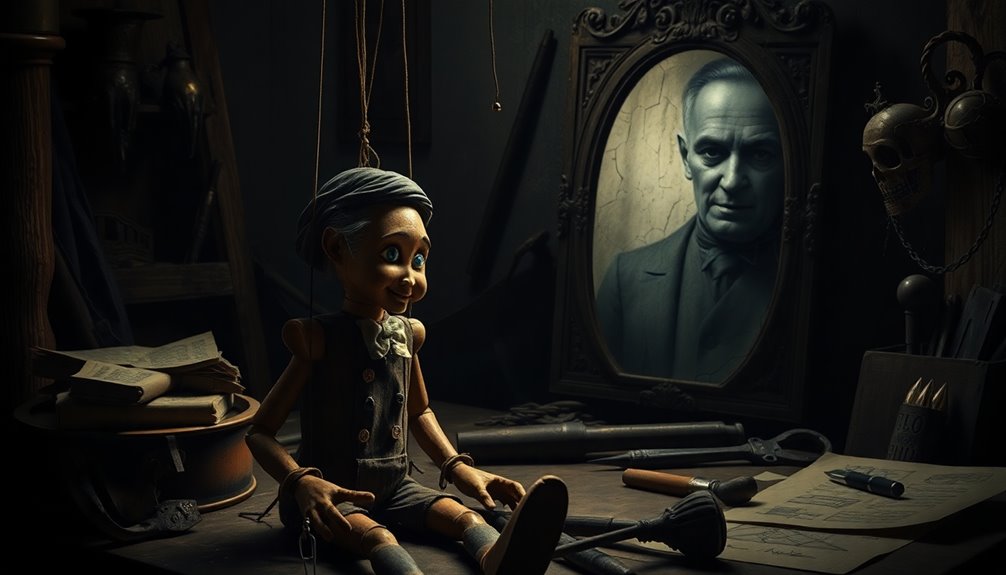
Carlo Collodi, the man behind the iconic puppet, wasn’t just a storyteller; he was a keen observer of society. Born Carlo Lorenzini in 1826, he shaped children’s literature with a sharp political edge. His masterpiece, *The Adventures of Pinocchio*, was more than a puppet show; it was a reflection of his times.
- Advocated for Italian national unification and educational reform
- Critiqued bureaucracy and societal hypocrisy in post-unification Italy
- Portrayed Pinocchio as a symbol of impulsive, disobedient youth
- Highlighted themes of education, discipline, and moral growth
Collodi’s legacy contrasts sharply with Disney’s sanitized adaptation, preserving the depth of social criticism that defined his original narrative. His work resonates with systemic oppression and the struggles for identity and agency that echo through literature across generations.
The Original Tone: Pinocchio’s Troubling Adventures

In Collodi’s *The Adventures of Pinocchio*, you see a puppet who struggles with impulsiveness and selfishness, often facing harsh consequences for his disobedience. The violence throughout the story serves as a critique of society, exposing the dangers children faced in 19th-century Italy. As you explore Pinocchio’s journey, you’ll uncover the darker themes that shape his character and the world around him. This struggle reflects the broader narrative of collective action against oppression, resonating with the resilience seen in historical resistance movements.
Pinocchio’s Impulsive Nature
Though Pinocchio’s adventures are often whimsical, his impulsive nature drives him into a series of troubling situations that reveal deeper societal issues. You’ll find that his reckless choices lead to dire consequences, reflecting the harsh realities of 19th-century Italy.
- He runs away from home, seeking freedom but finding danger instead.
- His impulsive actions, like the murder of the Talking Cricket, highlight his violent tendencies.
- Engaging with morally corrupt characters, like the Fox and the Cat, only deepens his troubles.
- Collodi emphasizes that ignorance and laziness are his greatest flaws, underscoring the importance of education and discipline.
Through these adventures, you see a critique of societal issues, showcasing the vulnerability of the uneducated working class.
Harsh Consequences of Disobedience
As Pinocchio navigates his chaotic world, his disobedience leads to severe repercussions that starkly illustrate the dangers of ignoring moral guidance.
Unlike the Disney version, where lessons are light-hearted, Collodi’s tale shows darker consequences. You witness Pinocchio impulsively murder Jiminy Cricket, setting a grim tone for his journey.
His reckless choices plunge him into life-threatening situations, like being hanged by the Fox and the Cat, emphasizing the brutal realities of 19th-century Italy. These characters exploit his weaknesses, reinforcing that ignorance and laziness invite dire outcomes.
Ultimately, Pinocchio’s harrowing adventures serve as a cautionary tale, highlighting the importance of discipline and the harsh repercussions of straying from moral paths.
Societal Critique Through Violence
While Pinocchio’s adventures may seem whimsical, they serve as a disturbing reflection of societal issues through vivid violence. The narrative exposes you to moral ambiguity, challenging your perception of childhood innocence and societal values.
Consider the following elements:
- Pinocchio’s impulsive actions lead to the murder of the Talking Cricket, showcasing harsh realities.
- Severe physical abuse and near-death experiences mirror the struggles of poor, uneducated children.
- Characters like the Fox and the Cat exploit Pinocchio’s naivety, critiquing those who prey on the vulnerable.
- Geppetto embodies the sacrifices of the working poor, revealing the moral dilemmas faced by parents in a harsh society.
These violent episodes are more than mere entertainment; they impart essential lessons about discipline and the consequences of disobedience.
Violence and Death: Collodi’s Harsh Realities
In Collodi’s *The Adventures of Pinocchio*, disobedience brings brutal consequences that reflect harsh realities. You witness Pinocchio facing extreme punishments, from physical abuse to terrifying near-death experiences. This dark portrayal starkly contrasts with the lighter themes often seen in modern adaptations, making you reconsider the lessons embedded in the tale. The narrative highlights the dehumanizing effects of racism that can exist in various societal contexts, emphasizing the importance of understanding the underlying messages in classic literature.
Consequences of Disobedience
- Pinocchio’s initial violence results in the murder of the Talking Cricket, showcasing the severity of his disobedience.
- His ignorance and laziness repeatedly land him in perilous situations.
- Encounters with characters like the Fox and the Cat highlight betrayal and exploitation.
- The narrative reflects the brutal struggles of 19th-century Italy, emphasizing the need for discipline and education.
These disobedience consequences serve as cautionary tales, urging you to reflect on the importance of making wise choices.
Harsh Punishments Faced
Pinocchio’s journey is marked by harsh punishments that starkly reflect the brutal realities of 19th-century Italy. His impulsive actions lead to extreme consequences, like being hanged for his misdeeds. This punishment symbolism reveals the childhood fears ingrained in his experiences.
When he kills the Talking Cricket, the violent act results in near-death and brutal treatment from adults, showcasing the dangers children faced. Collodi’s narrative emphasizes death and mutilation, presenting perilous situations that highlight life’s fragility.
Each grim encounter serves as a cautionary tale, teaching moral lessons about the importance of education and discipline. By ignoring guidance, Pinocchio risks severe repercussions, reminding readers that disobedience can lead to terrifying outcomes.
Social Commentary: Reflecting 19th-Century Italian Society
- The impulsiveness and disobedience of youth, mirroring adult anxieties.
- The exploitation of the vulnerable by figures like the Fox and the Cat.
- Geppetto’s sacrifices, illustrating the burdens of parenthood in poverty.
- The emphasis on education and hard work as antidotes to ignorance and laziness.
- These themes reveal a society grappling with economic hardship and the need for moral education amid social injustices, similar to how systemic injustices affect marginalized communities in literature.
The Flaws of Ignorance and Laziness in Pinocchio’s Journey
In Pinocchio’s journey, you see how ignorance and laziness lead to dire consequences. His impulsive choices often land him in dangerous situations, exposing the risks of being easily swayed by bad influences. As you follow his story, it becomes clear that the path to growth demands awareness and hard work. This theme resonates with the historical context of systemic discrimination faced by marginalized communities, illustrating how ignorance can perpetuate injustice.
Consequences of Ignorance
While steering through his adventures, ignorance and laziness emerge as Pinocchio’s most significant flaws, driving him toward impulsive choices with severe consequences. His naivety leads him down treacherous paths, as he fails to grasp the moral implications of his actions.
Consider the lessons learned from his journey:
- Ignorance’s impact fuels manipulation by characters like the Fox and the Cat.
- Disobedience results in physical and emotional turmoil.
- A lack of education perpetuates cycles of hardship.
- Geppetto’s sacrifices highlight the need for responsibility.
These experiences serve as a cautionary tale, reminding you that ignorance can lead to dire moral consequences, ultimately shaping Pinocchio’s fate in ways he never anticipated.
Dangers of Laziness
Laziness, much like ignorance, serves as a dangerous trap in Pinocchio’s journey, leading him into a cycle of missed opportunities and regret. His refusal to embrace education and responsibility sets the stage for grave laziness consequences.
By running away impulsively, he invites exploitation from cunning characters like the Fox and the Cat, who manipulate his naivety. Each encounter highlights the significance of hard work in his character development, showcasing how neglecting discipline can result in physical harm and emotional turmoil.
Collodi emphasizes that without the virtues of education and moral integrity, life’s challenges become insurmountable. Ultimately, Pinocchio’s tale warns us that laziness not only stalls growth but also invites danger, urging readers to value diligence and learning.
Geppetto: A Symbol of the Struggling Working Class
Geppetto stands as a poignant symbol of the struggling working class in 19th-century Italy, illustrating the relentless hardships faced by those trapped in economic despair. His character embodies the resilience and dedication of parents who sacrifice for their children, even amid poverty.
- Geppetto’s creation of Pinocchio reflects his longing for companionship.
- His life is marked by mechanical routines, highlighting the constraints of the working poor.
- The sacrifices he makes underscore the weight of parental responsibilities.
- Collodi critiques societal expectations through Geppetto’s relationship with Pinocchio.
In this way, Geppetto serves as a reminder of the challenges faced by those laboring under economic strain, revealing the heart and struggle of the working class. Moreover, his character resonates with themes of isolation within society, reflecting the emotional turmoil experienced by individuals grappling with societal pressures.
Redemption in Collodi’s Tale: Hard Lessons Learned
As Pinocchio navigates the treacherous landscape of his world, his impulsiveness and disobedience lead him into harrowing situations that starkly reflect the harsh realities faced by children in 19th-century Italy.
Each encounter teaches him painful lessons about the importance of hard work and education, highlighting his initial ignorance. Through these trials, you witness his redemption arc unfold; every setback pushes him toward moral growth.
Geppetto’s unwavering parental sacrifice serves as a beacon of love and resilience, reminding you of the struggles faced by working families.
Ultimately, Pinocchio transforms from a selfish puppet to a caring boy, proving that true redemption comes through suffering and accepting responsibility. His journey reveals that honesty and integrity are invaluable virtues. This transformation mirrors the struggles of immigrant families in their quest for a better life, emphasizing the universal themes of resilience and hope.
The Language of Collodi: A Blend of Prose and Vernacular
Collodi’s narrative artistry shines through in *The Adventures of Pinocchio*, where he masterfully blends formal prose with the vibrant vernacular of 19th-century Italy. This linguistic diversity captures the speech and attitudes of various social classes, enriching the story’s depth.
Key elements include:
- Social Satire: Collodi’s sharp critiques reveal the absurdities of societal norms and bureaucracy.
- Character Authenticity: Dialects and regional expressions make characters relatable, emphasizing their struggles.
- Humor and Irony: Dialogue often highlights the ridiculousness of Pinocchio’s adventures, teaching moral lessons.
- Social Commentary: The narrative addresses pressing issues like poverty and education, reflecting the working class’s realities.
Through this blend, Collodi not only entertains but also provokes thought about social disparities, much like the themes of systemic racism found in *A Lesson Before Dying*.
Disney’s Adaptation: Softening the Dark Themes
The film omits disturbing elements like the hanging scene and violent actions, opting instead for a lighthearted narrative. Jiminy Cricket shifts from a victim to a beloved moral guide, offering wisdom and comic relief. This transformation mirrors intricate plot elements found in classic mystery novels, where character development plays a crucial role in storytelling.
Key Differences Between Collodi’s and Disney’s Versions
While both adaptations center on the wooden puppet’s journey to becoming a real boy, their portrayal of character and consequence diverges sharply.
- Collodi’s Pinocchio is impulsive, selfish, and even murders the Talking Cricket.
- In the original tale, he faces severe repercussions, including physical abuse and near-death experiences.
- Disney sanitizes these moments, omitting dark elements like the hanging scene and Pinocchio’s corpse.
- Jiminy Cricket, a victim in Collodi’s story, becomes a beloved moral guide in Disney’s version.
These differences highlight Collodi’s intentions to critique society and its harsh realities, while Disney’s impact leans toward whimsical adventure.
Collodi critiques societal harshness, while Disney crafts a whimsical adventure, transforming Pinocchio’s journey.
As a result, Pinocchio’s transformation reflects a more sanitized journey in Disney’s adaptation.
The Legacy of Pinocchio: From Dark Tale to Cultural Icon
The transformation of Pinocchio from a cautionary tale steeped in darkness to a beloved cultural icon illustrates the power of storytelling to adapt and resonate across generations.
Originally, Carlo Collodi’s work reflected societal anxieties of post-unification Italy, focusing on violence and moral education.
Disney’s adaptation shifted this narrative evolution, turning Pinocchio into a naive and cheerful character, softening the story’s darker elements.
This character reinterpretation helped shift the tale from a warning about disobedience to a cherished children’s story.
Iconic songs like “When You Wish Upon a Star” further solidified Pinocchio’s legacy in popular culture.
The stark differences between the two versions highlight how cultural transformation can reshape narratives to align with contemporary values and audience expectations.
Conclusion
In the end, you can’t help but marvel at how Collodi’s grim tale morphed into Disney’s whimsical classic. What started as a cautionary yarn about consequences and the harsh realities of life transformed into a sugary adventure filled with talking animals and happy endings. As Pinocchio’s legacy endures, you realize it’s more than just a puppet’s journey; it’s a wild ride through the dark corners of society, where morality and mischief tango in a dazzling dance of fate.