
James Cameron’s “Titanic” transformed filmmaking by merging historical authenticity with a engrossing love story, creating a cultural phenomenon. You’ll appreciate the groundbreaking special effects and innovative techniques used to simulate the ship’s sinking. By balancing emotional depth with accurate detail, the film engaged audiences like never before. Its immense success shifted industry standards, emphasizing the need for rich narratives and high production values. You might discover even more about its lasting impact and lessons for future filmmakers.
The Visionary Behind Titanic: James Cameron’s Creative Genius
James Cameron’s creative genius revolutionized filmmaking with “Titanic,” merging historical detail with a poignant love story that resonates deeply. His vision transformed the film into a cultural phenomenon, capturing the hearts of audiences worldwide.
By investing significant time in research, you see how he guaranteed every detail—from the ship’s decor to the characters’ backstories—reflected the reality of the Titanic’s ill-fated voyage.
Cameron’s meticulous research ensured every detail, from decor to character backstories, mirrored the Titanic’s tragic reality.
Cameron’s groundbreaking special effects, like life-size ship replicas, set new standards for realism and influenced countless future productions.
The film’s intricate narrative structure intertwines multiple plotlines while maintaining emotional tension, showcasing his expertise in storytelling.
This commitment to innovation and character-driven narratives not only made “Titanic” unforgettable but also redefined disaster and romance in cinema. Additionally, the film’s intricate plot has drawn comparisons to timeless masterpieces in literature, emphasizing the importance of storytelling in both film and novels.
Historical Accuracy vs. Narrative: Striking the Right Balance
While crafting an engaging story, filmmakers often grapple with the challenge of maintaining historical accuracy. James Cameron’s “Titanic” masterfully strikes this balance, intertwining real events with a poignant narrative.
His meticulous attention to detail—like props stamped with the White Star Line emblem and accurate ship mechanics—enhances authenticity without sacrificing emotional depth. By focusing on characters like Jack and Rose, you connect with the tragedy on a personal level, making history more relatable.
Cameron’s commitment to material culture enriches storytelling, providing insights into the era’s social dynamics. This film set a new standard, showing that audiences can engage deeply with history through well-crafted narratives that respect factual integrity, thereby influencing future filmmaking practices. Moreover, the exploration of the psychological toll of war in narratives like Faulks’ “Birdsong” illustrates how emotional depth can enhance a historical narrative.
How Titanic Redefined Special Effects in Cinema
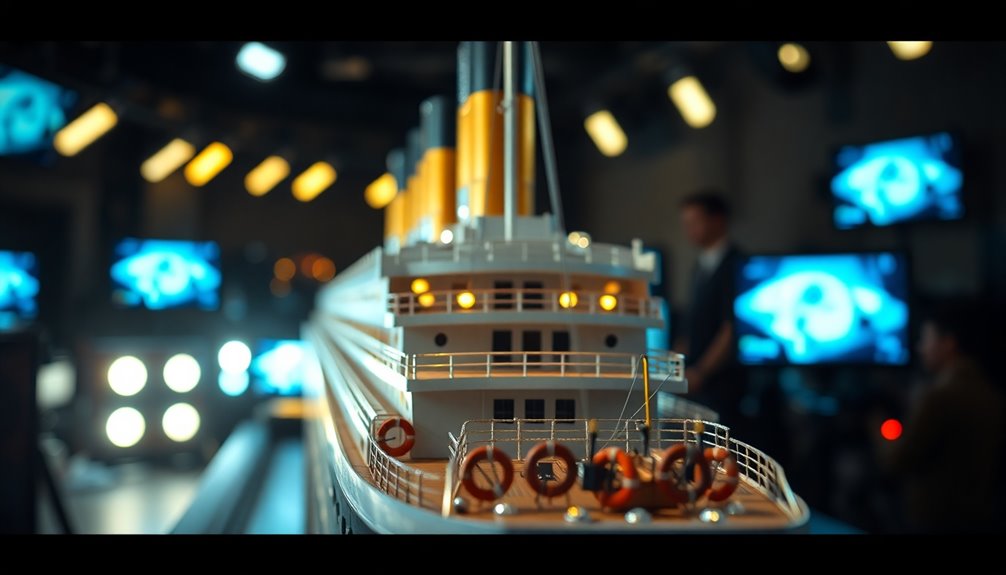
When you think about how “Titanic” redefined special effects in cinema, it’s hard to overlook the film’s revolutionary techniques that brought an unprecedented level of realism to the screen.
James Cameron expertly blended life-size sections of the ship with hydraulic rigs to simulate its tilt, creating a gripping visual experience. The use of miniatures and practical effects allowed for dynamic scenes of the sinking that were groundbreaking at the time.
James Cameron’s masterful combination of life-size ship sections and hydraulic rigs created a stunningly realistic portrayal of Titanic’s tragic sinking.
With thousands of gallons of water machines, Cameron captured the chaos of that tragic night. This innovative integration of advanced CGI and practical effects not only set new standards but also influenced future filmmakers. Ultimately, “Titanic” broke box office records and won 11 Oscars, solidifying its legacy in visual storytelling. Additionally, the film’s use of practical effects established a benchmark for authenticity that many modern filmmakers strive to achieve.
The Emotional Core: Crafting Relatable Characters
In *Titanic*, the love story between Jack and Rose isn’t just a plot point; it’s a mirror reflecting your own emotional struggles.
Their realistic arcs and relatable experiences make you feel deeply connected to their journey, highlighting how love and loss shape us all. This emotional core not only resonates with viewers but also sets a new standard for character-driven storytelling in film. The narrative illustrates that grief is a complex tapestry woven with love, enhancing the depth of their relationship.
Relatable Love Stories
Crafting relatable love stories lies at the heart of Titanic’s emotional impact, drawing viewers into the intimate world of Jack and Rose. Their romance embodies themes of passion, sacrifice, and the fleeting nature of life, allowing you to see reflections of your own emotions.
James Cameron masterfully weaves their relationship through shared experiences and personal struggles, making it easy for you to connect with their journey. The backdrop of disaster amplifies the stakes, heightening your empathy for their profound connection.
Simple yet powerful dialogues enhance the emotional core of their love story, making it universally accessible. The tears and joy you experience underscore the effectiveness of relatable character development, engaging your feelings throughout the film.
Realistic Emotional Struggles
While traversing the tumultuous waters of love and tragedy, Jack and Rose’s emotional struggles resonate deeply with viewers. James Cameron crafted relatable characters, portrayed brilliantly by Leonardo DiCaprio and Kate Winslet, who face universal themes of love and loss.
Their journey allows you to reflect on your own experiences, fostering empathy and understanding.
- The film evokes a spectrum of emotions, from joy to heartbreak.
- Jack and Rose’s story anchors the narrative amidst historical chaos.
- It highlights the fragility of life and relationships.
- Viewers connect through the raw emotions depicted.
- The depth of character development sets a new standard for emotional authenticity in storytelling.
These elements guarantee their struggles remain timeless and impactful.
Impactful Character Arcs
Jack and Rose’s character arcs in “Titanic” resonate powerfully, drawing you into their emotional journeys of love and sacrifice. Their impactful character arcs illustrate how love transforms Jack from a carefree artist into a selfless hero, while Rose’s evolution from societal constraints to personal freedom empowers you to reflect on your own struggles.
The film masterfully intertwines individual experiences with a historical disaster, fostering a deep connection that allows you to empathize with their challenges. This emotional authenticity, highlighted by relatable desires and vulnerabilities, sets a new standard for character development in cinema.
“Titanic” shows that prioritizing depth in storytelling not only enhances emotional impact but also influences future films to create more relatable, memorable characters.
The Unique Filming Techniques That Brought Titanic to Life
James Cameron revolutionized filmmaking with “Titanic” by employing unique techniques that brought the iconic ship to life. He combined practical effects with groundbreaking technology, making you feel the tension and drama of the sinking.
- Massive life-size replicas of the Titanic captured the ship’s grandeur.
- Hydraulic rigs tilted the ship nearly 90 degrees for realism.
- Thousands of gallons of water blasted through machines to simulate chaos.
- Set design paid meticulous attention to detail in sections of the ship, reflecting the historical period.
- Miniature models and Dutch angle camera techniques amplified the disaster’s illusion.
These innovative methods not only enhanced the film’s authenticity but also set new standards in cinematic storytelling, influencing filmmakers for years to come. Additionally, the film’s emphasis on themes of community resonates with audiences, much like the interconnected narratives found in literary works such as those by Joanne Harris.
Budget Battles: Navigating Financial Challenges During Production
Maneuvering the financial turbulence during the production of *Titanic* was no small feat. The initial budget of $109 million quickly escalated to $130 million due to hidden costs and production delays. Paramount’s investment was capped at $65 million, heightening the budget battles between the studios, especially as tensions with Fox grew. Accusations of deception flew, and legal threats loomed as production costs surged. Weekly cost reports highlighted the strain, with issues like set construction delays and cast illnesses exacerbating the situation. After five days of intense negotiations, an agreement was finally reached, underscoring the project’s significant financial stakes. Despite early skepticism, *Titanic* ultimately grossed over $2.19 billion, reshaping industry standards for large-scale films. This financial saga echoes the complexities of navigating historical contexts that shaped other major productions, like *Gone With the Wind*.
Behind-the-Scenes Drama: Conflicts and Resolutions
As you explore the making of *Titanic*, you’ll uncover a whirlwind of conflicts and resolutions that shaped its production.
Tensions rose over budget struggles and clashes between director James Cameron and producers, leading to pivotal last-minute creative decisions.
These behind-the-scenes dramas not only tested the team’s resolve but also ultimately contributed to the film’s iconic status, echoing the need for emotional balance in high-pressure environments.
Production Budget Struggles
While the ambitious vision for “Titanic” captivated audiences, it also sparked intense behind-the-scenes drama over its production budget. The initial budget of $109 million swelled to $130 million, leading to serious tensions.
- Paramount’s Sherry Lansing negotiated a 50-50 budget split with Fox.
- Extensive production needs and hidden costs escalated expenses.
- Accusations of deception emerged, raising potential legal actions.
- New financial terms capped Paramount’s investment at $65 million.
Despite budget struggles, the film grossed over $2.19 billion worldwide.
These conflicts underscored the high stakes involved in filmmaking, ultimately reshaping industry standards for box office success and financial management in major productions. The lessons learned from “Titanic” continue to influence filmmakers today.
Director-Producer Tensions
The budget struggles of “Titanic” set the stage for intense director-producer tensions that defined its production. James Cameron faced significant conflicts with producers over escalating budget concerns and the film’s ambitious scope.
As costs soared, accusations of deception emerged, prompting Paramount’s Jonathan Dolgen to threaten legal action against Fox. Amid these challenges, Sherry Lansing, Paramount’s chairman, remained a strong supporter, screening early cuts that lifted crew morale.
However, artistic tensions also surfaced regarding the theme song “My Heart Will Go On,” which Cameron defended against Lansing’s concerns.
Ultimately, the resolution of these conflicts not only bolstered the film’s success but also set new standards for production budgets and emotional storytelling in cinema.
Last-Minute Creative Decisions
Creative decisions made in the final stages of “Titanic” often sparked intense debates among the cast and crew, revealing the pressures of high-stakes filmmaking.
The creative tensions reached a peak when James Cameron defended the inclusion of “My Heart Will Go On,” countering Sherry Lansing’s concerns about its commercial viability. This clash highlighted the struggle between artistic vision and industry expectations.
Other challenges included:
- Escalating tensions with crew members, leading to confrontations.
- Positive feedback from Lansing that boosted morale.
- Production delays due to extended ship set building and illness.
- Unique practical effects that redefined cinematic storytelling.
- Creative problem-solving that resulted in groundbreaking visual sequences.
These last-minute decisions ultimately shaped the film’s legacy, forever altering the landscape of filmmaking.
The Role of Music: How “My Heart Will Go On” Became Iconic
When you think of “Titanic,” it’s hard not to recall “My Heart Will Go On,” the film’s unforgettable theme song. Composed by James Horner and performed by Celine Dion, it perfectly captures the emotional depth of Jack and Rose’s love story, portrayed by Leonardo DiCaprio and Kate Winslet.
Released alongside the film in 1997, the song became a cultural phenomenon, topping charts in over 25 countries and selling 18 million copies worldwide. Its haunting melody and poignant lyrics resonated deeply, enhancing the film’s most emotional moments. The song’s impact mirrors how Fifty Shades of Grey reshaped contemporary romance and explored deep emotional themes through its characters.
Winning an Academy Award for Best Original Song, “My Heart Will Go On” solidified its place in pop culture as a timeless anthem of love and loss, forever linked to the cinematic masterpiece.
Audience Reception: From Skepticism to Adoration
When “Titanic” hit theaters, many doubted it could succeed due to its hefty budget and production hurdles. However, audiences quickly proved them wrong, as they connected deeply with Jack and Rose’s love story. This emotional resonance transformed skepticism into adoration, setting a new standard for epic romance films. The film’s success echoed the themes of courage found in stories like *The Help*, illustrating how powerful narratives can inspire social change.
Initial Doubts
Despite initial skepticism surrounding its colossal budget and production hurdles, “Titanic” quickly transformed audience perception. Many questioned its viability, but early screenings shifted views considerably. As the release of “Titanic” approached, excitement replaced doubt, and the film made a remarkable impact.
- Early executive reactions boosted morale.
- Opening weekend grossed $28.6 million, exceeding expectations.
- It became the highest-grossing film, earning $2.19 billion worldwide.
- Received 14 Oscar nominations and won 11, showcasing its critical acclaim.
- Audiences embraced its emotional depth and storytelling.
Those initial doubts faded as viewers flocked to theaters, marking the first time a film of such ambition captured hearts globally. “Titanic” not only succeeded but redefined expectations for blockbuster filmmaking.
Emotional Resonance
Emotional resonance often defines a film’s lasting impact, and “Titanic” is a prime example of this phenomenon. Initially met with skepticism, it quickly transformed audience perceptions with its emotional depth.
Early screenings revealed a love story that connected with viewers of all ages, making it one of the most beloved movies ever. Jack and Rose’s journey became an emotional outlet for many, sparking intense reactions in theaters.
The film’s staggering $28.6 million opening weekend and eventual $2.19 billion global total underscored its cultural significance. With 14 Oscar nominations and 11 wins, “Titanic” demonstrated that its exploration of love and loss resonated deeply.
It’s no wonder that the song “My Heart Will Go On” became an anthem, echoing the film’s profound impact.
Awards and Recognition: Changing Industry Standards
As “Titanic” swept through the awards circuit, it not only captured 14 Academy Award nominations but also redefined what success meant in Hollywood. Its impressive haul of 11 Oscars, including Best Picture and Best Director, marked a turning point in Oscar influence and industry evolution.
- Established new benchmarks for box office earnings
- Elevated the importance of quality storytelling
- Encouraged high-budget, emotionally-driven narratives
- Changed marketing strategies to focus on audience connection
- Set trends for future award-winning films
“Titanic” didn’t just celebrate artistic achievement; it transformed industry standards, prompting studios to invest in richer narratives and higher production values, ultimately reshaping award trends for years to come. Its impact was reminiscent of the enduring rivalry seen in epic tales like “Kane and Abel,” highlighting how competition can drive innovation and excellence in storytelling.
Titanic’s Lasting Impact on Future Filmmaking
While many films have left their mark on the industry, “Titanic” stands out for its profound and lasting impact on future filmmaking. Its staggering budget of $200 million set a new financial benchmark, pushing studios to invest in ambitious projects.
The film’s cinematic innovations, like realistic sinking scenes, reshaped visual storytelling and encouraged filmmakers to prioritize quality effects. With a box office of $2.19 billion, it showcased the commercial viability of emotional narratives, prompting studios to explore similar themes.
“Titanic” also popularized using historical events as backdrops, driving narrative evolution in historical dramas. By winning 11 Oscars, it raised the artistic bar, inspiring filmmakers to blend critical acclaim with commercial success, forever changing audience engagement in cinema.
Revisiting Titanic: What Do We Still Learn Today?
Revisiting “Titanic” reveals timeless lessons that still resonate in today’s filmmaking landscape. You can glean valuable insights from its approach to emotional storytelling techniques and historical context exploration.
- Prioritize emotional engagement through relatable characters.
- Emphasize historical accuracy to enhance viewer immersion.
- Utilize a tight narrative structure for impactful storytelling.
- Experiment with innovative filmmaking techniques for visual storytelling.
- Explore universal themes of love and loss for cultural resonance.
Through cinematic legacy analysis, “Titanic” showcases how personal narratives can elevate stories, making them unforgettable.
Conclusion
In the end, you can’t deny Titanic’s monumental impact. It transformed special effects, it deepened emotional storytelling, and it set new standards for filmmaking. As you revisit its legacy, consider how it shaped your expectations for cinema today. You might find that its lessons on creativity, authenticity, and passion resonate just as powerfully now. Whether you’re a filmmaker or a fan, Titanic invites you to dream bigger, push boundaries, and tell stories that truly matter.