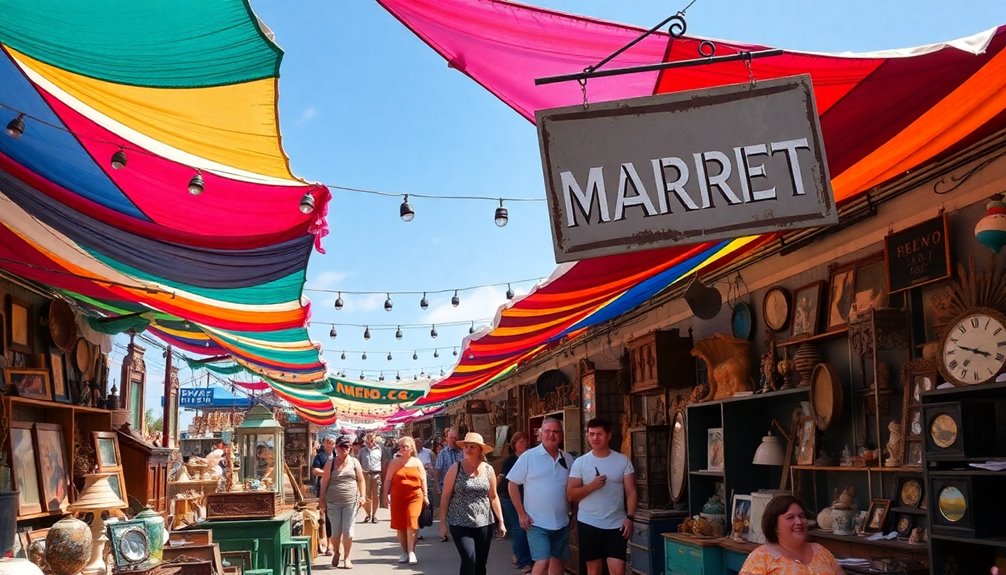
You’ve probably wondered why it’s called a flea market. The name comes from the French term “marché aux puces,” which hints at the idea that second-hand goods might come with pests. Some say it also relates to vendors fleeing during renovations in 19th-century Paris. Today, those negative connotations have faded, and flea markets are celebrated for unique finds and community vibes. Curious about other odd word origins? There’s plenty more to uncover!
The Curious Origins of “Flea Market

The term “flea market” has a fascinating backstory that reveals much about its origins. Likely derived from the French “marché aux puces,” meaning “market of fleas,” the name reflects the notion that second-hand goods could come with pests.
The first recorded use of “flea market” in English dates back to 1922, marking its entry into popular culture. Curiously, this terminology may connect to mid-19th century street renovations in Paris, where vendors had to “flee” to outdoor stalls.
Historically, flea markets trace their roots to ancient trading practices, serving as vibrant hubs for exchanging goods and social interaction. By the late 19th century, their popularity surged in the U.S., showcasing the timeless appeal of second-hand shopping. This evolution mirrors how marginalized individuals’ contributions have historically shaped various economic landscapes.
Theories Behind the Name: Fleas or Fleeing Vendors?

Two intriguing theories exist regarding the name “flea market,” each offering a unique lens on its origins. One suggests it comes from the French “marché aux puces,” meaning “market of fleas,” implying that second-hand goods might carry pests. This association, however, has faded as you browse modern flea markets, focusing instead on unique finds.
The other theory points to mid-19th century Paris, where displaced vendors had to “flee” to outdoor stalls during street renovations. This likely led to the term “flee market,” which eventually morphed into “flea market.”
Both theories illustrate how language evolves, reflecting cultural attitudes towards secondhand goods—from negative connotations to a celebration of the eclectic and unexpected treasures you can discover today. Interestingly, this evolution parallels the intricate plots found in classic mystery novels, which often reveal deeper meanings and hidden layers as the story unfolds.
Historical Context: Flea Markets Through the Ages
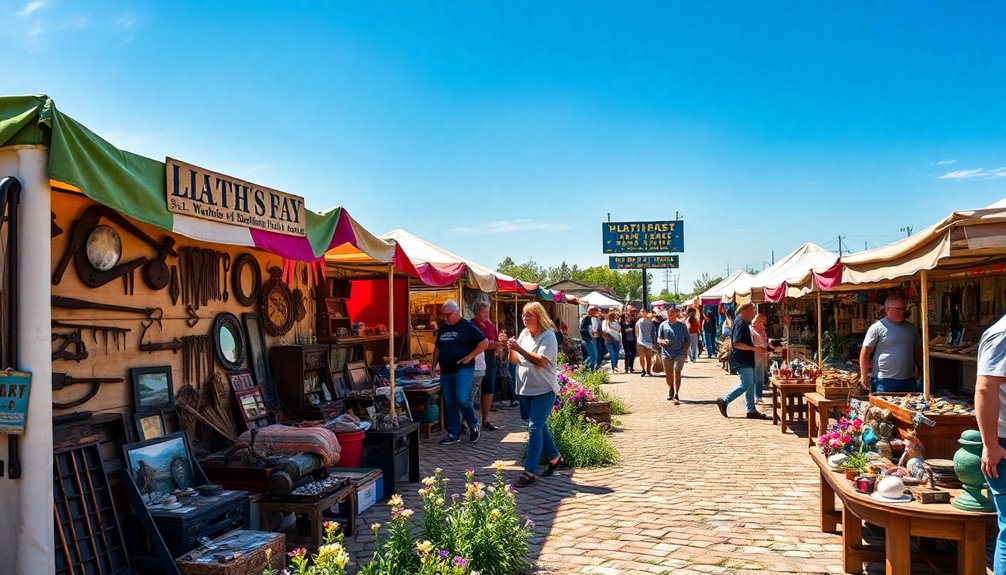
While many might think of flea markets as a modern phenomenon, their roots stretch back to medieval Europe, where such markets thrived as vibrant centers for trade and social interaction.
By the 19th century, Parisian markets like Saint-Ouen popularized the term “marché aux puces,” highlighting perceptions that second-hand goods might harbor fleas. The first American flea market likely opened around 1873, marking the start of a considerable cultural and economic tradition in the U.S. This evolution mirrors the systemic oppression faced by marginalized communities, who often utilized flea markets as spaces for economic survival and cultural expression.
Modern Perceptions: Are Flea Markets Still Flea-Infested?
Are flea markets still seen as flea-infested havens, or have perceptions changed?
Modern perceptions of flea markets have shifted considerably. Shoppers today often overlook the historical association with pests, focusing instead on the unique finds and collectibles available.
Studies show that cleanliness and safety of second-hand goods have improved, easing concerns about infestations. In fact, more than 100 million shoppers visit flea markets in the U.S. annually, proving their popularity has outgrown any negative connotations. The eclectic atmosphere, combined with a growing emphasis on sustainability and recycling, paints a positive picture that contrasts sharply with their original name. Additionally, the rise of mindful practices in consumer behavior encourages shoppers to make conscious decisions about their purchases and support local vendors.
Cultural Significance: More Than Just a Marketplace
Flea markets have evolved far beyond their original associations with pests, serving as vibrant cultural hubs that foster community connections.
Today, flea markets have become essential spaces where social interactions and exchanges flourish. They provide a platform for local artisans and small business owners, encouraging creativity and entrepreneurship.
With over 5,000 markets across the U.S., they notably boost local economies, generating tens of billions in sales annually. You’ll find diverse crowds drawn to unique finds that reflect local culture and history, preserving cultural artifacts and traditions.
Plus, flea markets promote sustainability through the recycling and reusing of goods, making them not just a marketplace, but a crucial part of community identity and connection.
Other Quirky Etymologies: Words With Unexpected Roots
Words often carry stories that surprise us, revealing unexpected origins that challenge our assumptions.
Take a look at these quirky etymologies that might make you rethink what you know:
- Quarantine: From the Italian “quaranta giorni,” meaning “forty days,” referring to ships isolated during the plague.
- Ketchup: Originally “kê-tsiap,” a Hokkien Chinese fish sauce before becoming the tomato-based condiment we love.
- Whiskey: Derived from Gaelic “uisce beatha,” meaning “water of life,” reflecting its cultural importance.
- Nightmare: Combines “mare,” a mythological creature that tormented sleepers, with “night.”
- Panic: Traces back to the Greek god Pan, whose sudden appearances frightened travelers.
Interestingly, etymologies can serve as hidden contributions that reveal the cultural and historical significance behind everyday terms.
Next time you visit a flea market, think about the rich history behind the words we use every day!
Conclusion
So, next time you stroll through a flea market, remember it’s not just about the eclectic finds; it’s a journey through history and culture. You might stumble upon a vintage lamp that once lit a famous artist’s studio or a rare vinyl record that tells a story of its own. These markets are treasure troves of the past, reminding us that even the quirkiest words can hold deep significance. Embrace the adventure and immerse yourself in the unexpected!