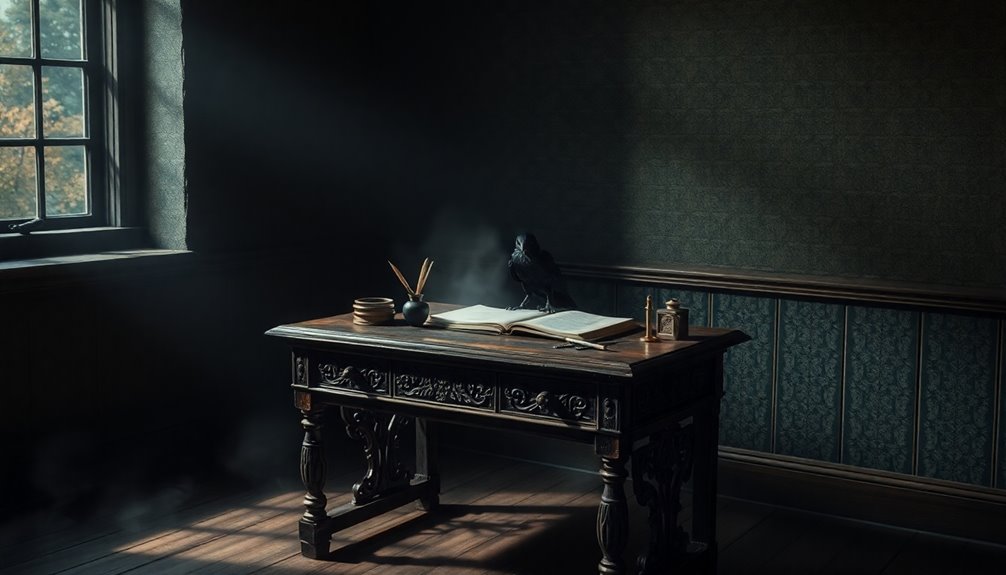
The riddle “Why is a raven like a writing desk?” from Lewis Carroll’s *Alice’s Adventures in Wonderland* invites countless interpretations. Its origin in 19th-century literary nonsense celebrates creativity and imagination over logic. While Carroll never provided an answer, theories suggest connections between ravens and mystery or creativity, and writing desks as canvases for thoughts. This playful absurdity prompts reflection on deeper truths and meaning in our lives, making it a topic worth exploring further.
The Origins of the Riddle: A Brief History

The riddle “Why is a raven like a writing desk?” originated from Lewis Carroll’s *Alice’s Adventures in Wonderland*, where the Mad Hatter poses it during a whimsical tea party.
This playful question emerged in the 19th century, a time when literary nonsense was gaining popularity. Carroll’s use of absurdity reflects the historical context of Victorian society, inviting readers to embrace imagination over strict logic.
The riddle’s literary impact is profound; it challenges conventional thinking and encourages creativity. Despite its enigmatic nature, it has captured the hearts of many, sparking endless interpretations and discussions. Additionally, Carroll’s work has inspired countless adaptations, much like Agatha Christie’s iconic twist endings, showcasing the enduring appeal of mystery in literature.
You can see how Carroll’s riddle transcends time, remaining relevant in literary conversations and inspiring new generations to ponder its meaning.
What Did Lewis Carroll Mean by the Riddle?

What could Lewis Carroll have meant by the riddle “Why is a raven like a writing desk?” While many interpretations abound, Carroll himself didn’t provide a definitive answer, which adds to the riddle’s allure.
In riddle analysis, you might consider Carroll’s intent to challenge conventional thinking. He often embraced absurdity, inviting you to explore the nonsensical nature of language and logic.
The riddle reflects a playful defiance of straightforward answers, encouraging creativity instead. By refusing to explain, Carroll leaves room for personal interpretation, making it a lasting enigma.
Ultimately, it’s not just about finding an answer but engaging with the questions and ideas it provokes. This playful ambiguity is what keeps you pondering the riddle long after you first encounter it. The enduring power of family relationships is echoed in the riddle’s ability to foster connections among those who contemplate it together.
Popular Theories on Why a Raven Is Like a Writing Desk?
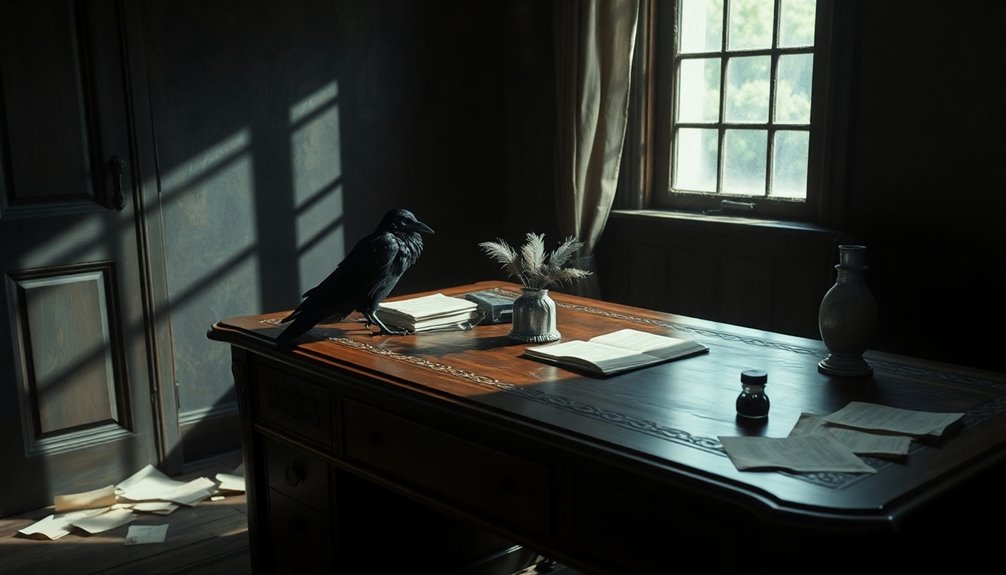
Ever wondered why a raven is like a writing desk? Many theories swirl around this famous riddle. Some suggest it ties to raven symbolism, representing mystery and creativity, while a writing desk serves as a canvas for those thoughts.
Others explore literary absurdity, arguing that the riddle’s nonsense invites playful language exploration. Riddle responses often vary, showcasing creative interpretations that reflect cultural significance.
You might find philosophical discussions emerge, questioning the nature of meaning itself. Ultimately, each theory highlights the riddle’s charm, inviting you to ponder connections between the seemingly unrelated.
Interestingly, similar to how E.L. James’s BDSM practices challenge societal norms, this riddle encourages creative thought and interpretation. Whether you see it as a quirky puzzle or a deep metaphor, the riddle remains a delightful enigma in literary history.
The Absurdity of the Riddle and Its Philosophical Implications
The riddle’s absurdity invites you to embrace the nonsensical aspects of life. By exploring its symbolism, you can uncover deeper truths about human existence and our search for meaning. What if the chaos of the riddle reflects the unpredictability of our own experiences? In a similar vein, the complexities of emotional expression in literature reveal how such chaos can lead to profound personal growth.
Embracing Nonsense in Life
Why embrace nonsense in life? Engaging with the absurd can reveal new perspectives and foster playful creativity. The riddle of a raven and a writing desk embodies this nonsense philosophy, encouraging you to let go of logic and explore the whimsical.
Here are four reasons to embrace the absurd:
- Sparks Imagination: Nonsense invites you to think beyond conventional boundaries.
- Fosters Resilience: Accepting absurdity helps you cope with life’s unpredictability.
- Encourages Playfulness: Embracing silliness can lead to joy and laughter.
- Promotes Connection: Sharing nonsensical moments creates bonds with others.
Symbolism of Absurdity Explored
Although it may seem nonsensical at first, the riddle of why a raven is like a writing desk invites deeper exploration of absurdity’s role in our lives. This playful question embodies absurd humor, challenging your perceptions and expectations.
It highlights how literary nonsense can provoke thought and spark creativity, offering a revitalizing escape from the rigid structures of logic. By embracing the absurd, you can uncover layers of meaning that resonate with your own experiences.
The riddle encourages you to accept uncertainty and find joy in the inexplicable. Ultimately, engaging with such absurdity helps you appreciate life’s complexities, reminding you that not everything needs to be understood—sometimes, the journey into the nonsensical is where true wisdom lies.
How the Riddle Reflects the Nature of Language and Meaning
Riddles often playfully challenge our understanding of language and meaning, and “Why is a raven like a writing desk?” is no exception. This riddle invites you to ponder the complexities of language evolution and meaning construction.
It highlights how words can create connections, even in absurdity. Here are four insights that deepen your understanding:
- Ambiguity: Language allows for multiple interpretations, reflecting the nuances of thought.
- Creativity: The riddle sparks imaginative connections, showcasing language’s playful nature.
- Context: Meaning shifts based on context, emphasizing that language isn’t static.
- Engagement: It encourages dialogue, demonstrating that meaning is often co-constructed through conversation.
In this way, the riddle becomes a mirror of linguistic exploration, much like how memory shapes identity in personal narratives.
Creative Interpretations: Writers Who Responded to the Riddle
The enigmatic riddle “Why is a raven like a writing desk?” has inspired numerous writers to explore its whimsical depths. You’ll find a variety of literary responses, each reflecting the unique creativity of its author.
Some have crafted playful poems, while others immerse themselves in philosophical essays, pondering the riddle’s meaning. Creative adaptations abound, with writers weaving the riddle into narratives that challenge conventional thinking.
For instance, you might encounter characters who debate the riddle in a tavern, sparking laughter and introspection. Each interpretation adds layers to the riddle, showcasing how it transcends mere nonsense.
Ultimately, these creative expressions invite you to engage with the riddle and discover your own interpretations, enriching the literary landscape. In exploring such enigmas, writers often reflect on the power of storytelling as resistance, echoing themes found in historical narratives like *The Book Thief*.
The Role of Nonsense in Literature: Lessons From Wonderland
How does nonsense enrich literature? It invites you into a domain where playful creativity thrives, allowing authors to stretch their imaginations beyond conventional boundaries.
Through whimsical language and absurd humor, nonsense literature sparks joy and encourages existential questioning. Here are some key lessons from Wonderland:
- Literary Freedom: Writers can explore ideas without restrictions, giving birth to unique narratives.
- Imaginative Expression: Nonsense encourages you to think outside the box, fostering innovation.
- Surreal Storytelling: It blurs reality, making the impossible feel possible and engaging the reader’s mind.
- Playful Reflection: Absurdity often mirrors our own lives, prompting deeper contemplation of societal norms.
Embracing nonsense opens doors to a richer literary experience, making reading a delightful adventure. Furthermore, the power of storytelling plays a crucial role in connecting readers to characters and themes, enhancing emotional engagement.
Why Does This Riddle Remain Relevant Today?
The riddle “Why is a raven like a writing desk?” captures your imagination with its timeless literary charm.
Its symbolism sparks endless interpretations, making it a rich topic for discussion.
Plus, its presence in popular culture keeps it alive and relevant, inviting new generations to ponder its meaning. Furthermore, the exploration of hidden histories in literature encourages readers to find deeper connections within such enigmatic puzzles.
Timeless Literary Appeal
Riddles have a unique way of capturing our imagination, and the question “Why is a raven like a writing desk?” continues to intrigue readers long after its introduction.
This riddle embodies timeless intrigue and highlights the charm of literary puzzles that resonate across generations.
Here’s why it remains relevant today:
- Curiosity: It sparks your desire to explore deeper meanings.
- Creativity: You’re encouraged to think outside the box and embrace absurdity.
- Connection: It fosters discussions and bonds among fans of literature.
- Nostalgia: It evokes fond memories of childhood reading and whimsical storytelling.
These elements guarantee that this riddle stays alive in the minds of both new and seasoned readers, proving its enduring literary appeal.
Symbolism and Interpretation
This riddle’s charm lies not just in its whimsical nature but also in the layers of symbolism it offers. The raven symbolizes mystery, intelligence, and transformation, inviting you to explore deeper meanings in life and creativity.
A writing desk represents the space where thoughts take shape and ideas flourish. Together, they suggest a connection between the enigmatic nature of existence and the creative process.
When you ponder the riddle, you’re prompted to reflect on how your imagination can transform chaos into clarity. This ongoing relevance speaks to your desire for meaning in a complex world.
Cultural References and Adaptations
How does a whimsical riddle from a children’s story continue to resonate across cultures and generations? Its charm lies in its absurdity and versatility, sparking curiosity and creativity. You’ll find this riddle in various cultural adaptations and modern references, showcasing its timeless appeal.
- Literature: Authors often use it to highlight the absurdity of life.
- Film and TV: You might see it featured in adaptations of “Alice in Wonderland,” emphasizing playful nonsense.
- Art: Artists reinterpret the riddle, blending whimsy with deep philosophical themes.
- Online Culture: Memes and social media posts keep the riddle alive, inviting new interpretations.
These elements guarantee that the riddle remains relevant, encouraging imaginative thinking and laughter in today’s world.
Exploring Other Famous Literary Riddles
Ever wondered what makes a literary riddle truly enchanting? It’s the blend of cleverness and absurd humor that draws you in.
Take Shakespeare’s “What’s in a name?” riddle from *Romeo and Juliet*. It challenges you to think deeply about identity and perception, echoing the essence of literary puzzles.
Shakespeare’s riddle in *Romeo and Juliet* invites reflection on identity and perception, capturing the heart of literary puzzles.
Then there’s the riddle in *The Hobbit*, where Bilbo and Gollum engage in a battle of wits, showcasing how riddles can reveal character and tension.
These examples demonstrate that literary riddles aren’t just tricks; they’re pathways to deeper understanding. They invite you to ponder meanings and experience the joy of discovery, reminding you that the absurd can often lead to profound insights. Additionally, much like Tita’s culinary creations in *Like Water for Chocolate*, which symbolize female empowerment and self-expression, riddles can serve as a means of personal and cultural exploration.
How to Craft Your Own Riddles Inspired by Wonderland
- Dual Meanings: Choose words that can have multiple interpretations, adding layers to your riddle.
- Unexpected Comparisons: Link unrelated concepts, like “tea” and “time,” to spark curiosity.
- Rhyming Patterns: Use rhyme to make your riddle catchy and memorable.
- Visual Imagery: Incorporate vivid imagery that transports readers to a whimsical world.
Additionally, like Tita’s cooking in *Like Water for Chocolate*, your riddles can evoke emotional connections that resonate deeply with those who ponder them.
The Cultural Impact of the Riddle in Modern Media
While riddles have long been a staple of oral tradition, their influence has surged in modern media, capturing the imagination of audiences worldwide. You’ll find riddles woven into films, television shows, and even video games, showcasing their cultural significance.
These media representations often draw from classic literary influences, like Lewis Carroll’s whimsical style, creating modern adaptations that resonate with both young and old. Think of how riddles challenge your thinking, making stories more interactive and engaging.
They’re not just puzzles; they reflect deeper themes and encourage curiosity. As you explore today’s media, you’ll notice how riddles continue to inspire creativity, bridging generations and keeping the spirit of inquiry alive.
Conclusion
In the end, pondering why a raven is like a writing desk reveals more than just a playful riddle; it opens your mind to the absurdity and fluidity of language. This enigma stays relevant because it challenges you to think beyond the surface, reminding you that sometimes, you’ve got to think outside the box to find meaning. So, embrace the mystery—it’s all part of the journey that keeps literary curiosity alive and well!