
In “Murder on the Orient Express,” you join detective Hercule Poirot aboard a luxurious train where a notorious criminal, Samuel Ratchett, is found dead in his locked compartment. With twelve stab wounds and an elaborate web of suspects, each passenger’s motive links back to the tragic Armstrong family case. As Poirot uncovers clues, tangled loyalties and a quest for justice unfold. Keep following along, and you’ll unravel the twists that make this classic whodunit unforgettable.
Plot Overview and Structure
In “Murder on the Orient Express,” you follow Detective Hercule Poirot as he boards the luxurious train, only to become entangled in a chilling murder mystery.
The plot centers around the murder of Samuel Ratchett, a notorious criminal known as John Cassetti, who’s found dead with twelve stab wounds in a locked compartment.
This locked room mystery pulls you into an intricate investigation, revealing that the passengers harbor connections to the Armstrong family, all tied to the tragic kidnapping and murder of Daisy Armstrong.
As Poirot interviews each passenger, you uncover their motives and relationships, leading to a complex conspiracy.
Agatha Christie masterfully crafts a tale where justice ultimately takes a unique turn, challenging your perceptions of morality and guilt. This classic mystery is set aboard the luxurious Orient Express train, emphasizing the tension and isolation experienced by the characters.
Investigation Process and Clues
Detective Poirot launches his investigation by meticulously examining the locked compartment where Samuel Ratchett was murdered.
He investigates a murder with keen insight, uncovering clues that suggest a staged escape and multiple assailants.
Interviewing the passengers, he notes their contradictory testimonies and potential motives, each revealing connections to the Armstrong family.
Among the critical evidence, Poirot discovers a burnt note, a handkerchief with the initial “H,” and a stopped watch.
The presence of a woman in a red kimono and a mysterious stranger in a Wagon Lit jacket adds to the intrigue.
As the investigation unfolds, a conspiracy theory emerges, challenging traditional notions of justice and suggesting a coordinated effort in Ratchett’s demise. Poirot’s interviews reveal a shared desire for justice through crime, complicating the moral landscape of the case.
Character Profiles and Relationships
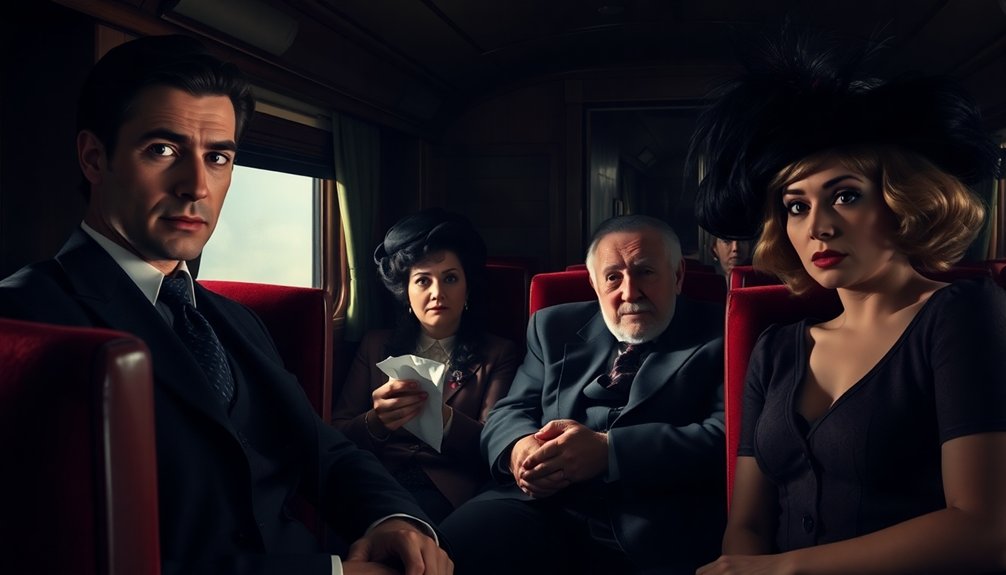
As the investigation unfolds, the characters on the train come into sharper focus, each with their own motives and connections to the Armstrong family.
- Hercule Poirot: The meticulous detective driving the investigation.
- Samuel Ratchett: The infamous John Cassetti, linked to Daisy Armstrong’s murder.
- Countess Andrenyi: Helena Goldenberg, Daisy’s aunt, deeply embroiled in the conspiracy.
- Linda Arden: Mrs. Hubbard, orchestrating revenge for her family’s suffering.
Colonel Arbuthnot, a loyal friend of the Armstrongs, seeks retribution for Ratchett’s past crimes.
Each character’s relationship to Daisy Armstrong and the shared quest for justice complicates the narrative, creating a web of conspiracy that Poirot must untangle to solve the murder on the Orient Express. This intricate web of motives and relationships echoes the themes of obsession and jealousy found in classic Gothic literature, like Du Maurier’s “Rebecca.”
Themes and Analysis
Justice and revenge intertwine in “Murder on the Orient Express,” creating a complex tapestry of moral dilemmas that challenges both characters and readers alike.
As you explore the narrative, you uncover psychological motivations that reveal deep emotional connections among the passengers, all linked to the Armstrong case. Their loyalty to the victims contrasts sharply with the betrayal of justice, prompting them to enact vigilante justice against Ratchett/Cassetti.
Throughout the plot, red herrings mislead you, enhancing the mystery while challenging your perception of truth.
Ultimately, the story raises ethical questions about morality and the nature of true justice, compelling you to reflect on the characters’ choices in a world rife with ambiguity and moral conflict. The psychological tension serves as a driving narrative force, further immersing readers in this intricate tale.
Writing Style and Techniques
While steering through the intricate mystery of “Murder on the Orient Express,” you’ll notice Agatha Christie’s distinctive writing style and techniques play an essential role in shaping the narrative.
- Employs a third-person perspective, focusing on Poirot’s deductions
- Uses a dialogue-driven narrative for rich character development
- Incorporates foreshadowing that enhances suspense
- Masterfully weaves in red herrings and misdirection
Christie’s writing style emphasizes analytical thinking, showcasing Poirot’s reliance on logical deduction rather than physical evidence.
Agatha Christie’s narrative highlights Poirot’s brilliant analytical skills, prioritizing deduction over mere physical evidence.
The dialogue-driven narrative not only fosters character development but also reveals hidden connections among passengers.
With clever foreshadowing and strategic misdirection, Christie keeps you guessing, making the resolution all the more satisfying.
This intricate web of techniques guarantees an engaging reading experience. Additionally, the influence of Christie’s work can be seen in modern mystery novels like the Millennium series, showcasing how her storytelling continues to inspire new generations of authors.
Conclusion
In “Murder on the Orient Express,” Agatha Christie masterfully weaves a tale of mystery and intrigue that keeps you guessing until the very end. Did you know that this iconic novel has sold over 100 million copies worldwide, making it one of the best-selling books of all time? As you unravel the clues alongside Poirot, you can’t help but appreciate how timeless this classic whodunit remains, enchanting readers with its intricate plot and unforgettable characters.