
In *Charlie and the Chocolate Factory*, you meet Charlie Bucket, a boy from a poor family who discovers a golden ticket that grants him access to Willy Wonka’s magical factory. As he tours this whimsical wonderland filled with chocolate rivers and fantastical treats, Charlie witnesses the misbehavior of other children and learns valuable lessons about humility and respect. His journey culminates in a heartwarming climax, revealing the true treasures of family and values. Discover what awaits in Wonka’s enchanting world!
Charlie Bucket’s Life and Family Struggles
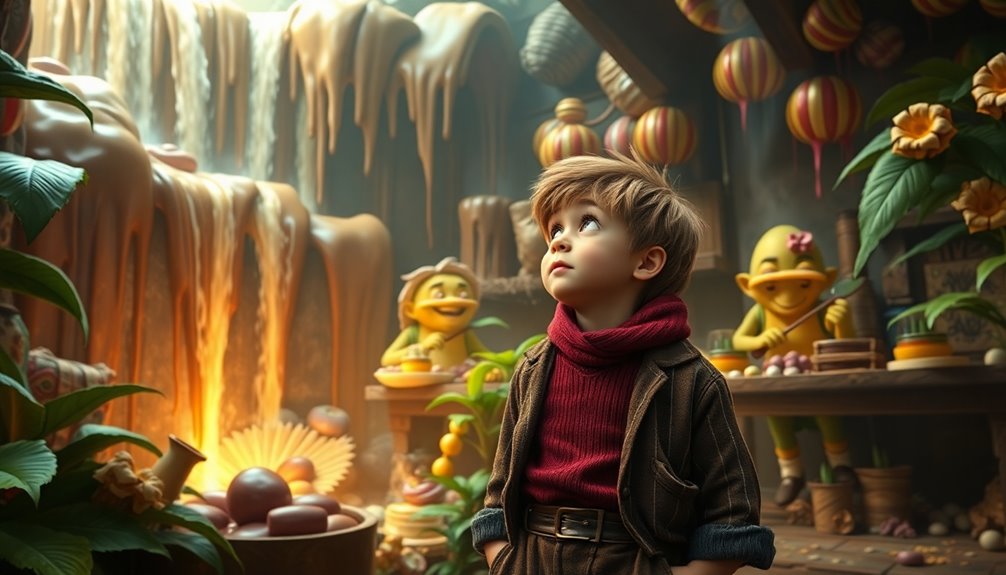
In the heart of a rundown neighborhood, Charlie Bucket’s life is a daily struggle against poverty. He lives in a tiny, dilapidated house with his parents and four bedridden grandparents.
Every day, they face the harsh reality of hunger, relying on Charlie’s father, Mr. Bucket, who barely makes enough at the toothpaste factory to keep them afloat.
In a world shadowed by hunger, Charlie’s family clings to hope through his father’s meager earnings.
Yet, despite their dire situation, Charlie remains optimistic. He dreams of chocolate and often saves whatever little money he can to buy a Wonka bar, hoping for that elusive golden ticket.
Together, Charlie and his family share stories about the wonders of Willy Wonka’s chocolate factory, which fuels their dreams and offers a glimmer of hope amidst their challenges. This longing for sweetness and delight parallels the complexity of love that intertwines with societal obligations and dreams, reflecting how food can embody emotions and aspirations.
The Mysterious Willy Wonka and His Factory
Though many wonder about the enigma that’s Willy Wonka and his extraordinary factory, few truly understand the genius behind his creations. The chocolate factory stands as the biggest and best in the world, filled with fantastical elements that ignite the imagination.
- A flowing chocolate river
- Edible landscapes
- Innovative candy-making wonders
- The whimsical Oompa Loompas
- A shrouded history of secrets
Willy Wonka, the eccentric owner and master candy maker, keeps the factory’s operations hidden, heightening intrigue. The enchanting world within the factory mirrors the magical realms found in epic fantasy adventures, capturing the hearts of those who dare to dream.
After years of closure, rumors swirl about his mysterious factory, especially with the upcoming golden ticket contest. His tumultuous past and strained relationship with his father drive his quest to find a worthy heir to his sugary empire.
The Golden Ticket Contest Announcement
Willy Wonka’s announcement of the golden ticket contest sparked excitement across the globe, as five special tickets hidden under Wonka Bar wrappers promised a magical factory tour and a lifetime supply of chocolate.
Children and parents alike rushed to find a ticket, fueling a frenzy for Wonka Bars. As the days went by, Augustus Gloop, Veruca Salt, Violet Beauregarde, and Mike Teavee each found a golden ticket, leaving only one for the remaining hopefuls.
Charlie Bucket, a boy living in poverty, desperately searched for his chance. With luck on his side, he discovered a dollar bill, allowing him to buy a Wonka Bar.
This small purchase would change everything, as it set the stage for a life-altering adventure with Grandpa Joe. The story captures the essence of intricate plot development that keeps readers engaged until the very end.
Charlie’s Joyful Discovery of the Last Ticket
Charlie’s heart raced as he unwrapped the Wonka Bar, hope coursing through him like a river of chocolate. Living in poverty, this dollar bill felt like a treasure. As he peeled back the wrapper, he couldn’t believe his eyes—the fifth golden ticket!
- Joy spilled over as he shared the discovery with Grandpa Joe.
- They jumped and danced, celebrating the moment of pure happiness.
- Offers of money came pouring in, but Charlie knew the ticket’s true value.
- He cherished the experience over financial gain.
- This marked a turning point, leading him to the highly anticipated factory tour.
In that instant, Charlie’s dreams soared, and a world of wonder opened before him. The journey would soon reveal the consequences of misbehavior faced by the other ticket holders.
The Excitement of the Factory Tour
As you step inside Willy Wonka’s factory, you’re immediately captivated by the dazzling sights, like the flowing chocolate river and the edible garden.
You can’t help but notice how each child’s reaction highlights their flaws, from Augustus Gloop’s reckless indulgence to Veruca Salt’s spoiled behavior.
With the Oompa-Loompas singing about their missteps, the excitement of the tour becomes a mix of wonder and caution. This journey through the factory echoes themes of oppressive structures that dictate behavior, much like societal expectations in traditional narratives.
Unforgettable Factory Features
Step into the enchanting world of Willy Wonka’s factory, where imagination and wonder collide at every turn.
You’ll encounter unforgettable factory features that leave a lasting impression on your mind.
- A mesmerizing Chocolate River, where Augustus Gloop’s gluttony leads to his downfall.
- An area with trained squirrels that judge nuts, discarding Veruca Salt as a “bad nut.”
- An experimental gum room, showcasing Violet Beauregarde’s disastrous transformation into a blueberry.
- The television room, where Mike Teavee shrinks after jumping in front of the camera.
- Oompa-Loompas singing moralizing songs, reminding everyone of the consequences of bad behavior.
Every feature serves as a lesson wrapped in delicious magic, making the tour an unforgettable experience!
Children’s Reactions and Misbehaviors
While exploring Willy Wonka’s magical factory, you can’t help but notice how the other children’s reactions and misbehaviors create both excitement and chaos.
Augustus Gloop’s insatiable gluttony leads him to plunge into the chocolate river, only to be sucked up a pipe, illustrating the consequences of greed.
Veruca Salt’s spoiled attitude results in her being labeled a “bad nut” by the squirrels, emphasizing her entitlement’s repercussions.
Violet Beauregarde’s obsession with winning causes her to steal experimental gum, swelling her into a blueberry and highlighting the risks of competitiveness.
Meanwhile, Mike Teavee’s fixation on television drives him to leap in front of a camera, shrinking him and reminding everyone, including Charlie, that misbehavior often leads to dire consequences in this whimsical world.
Meet the Other Contest Winners
As you meet the other contest winners, you’ll quickly notice their negative traits glaringly contrast with Charlie’s goodness. Augustus Gloop’s insatiable appetite leads him to fall into a chocolate river, while Veruca Salt’s spoiled attitude gets her into trouble with the squirrels. Then there’s Violet Beauregarde, whose competitive gum-chewing antics result in her turning into a blueberry—each child’s flaw paving the way for their downfall. This serves as a cautionary tale about the consequences of greed, emphasizing how their vices ultimately lead to their undoing.
Augustus Gloop’s Gluttonous Behavior
Augustus Gloop indulges his insatiable appetite, showcasing his gluttonous nature right from the start of the factory tour. His obsession with chocolate leads him to consume vast amounts without a second thought.
Here’s what you need to know about Augustus:
- Known for his excessive eating habits
- Falls into Willy Wonka’s chocolate river
- Represents the consequences of poor self-control
- Gets sucked up a pipe for his greed
- The Oompa Loompas highlight his fate with a cautionary song
Augustus serves as a stark contrast to Charlie’s virtuous nature.
His journey illustrates how unchecked gluttony and a lack of self-control can lead to dire consequences, ensuring that his experience in the factory is more than just a sweet adventure.
Veruca Salt’s Spoiled Attitude
Entitlement often leads to disastrous consequences, and Veruca Salt embodies this notion perfectly. This spoiled child, showered with indulgences from her wealthy father, throws tantrums to get whatever she wants.
During the factory tour, her selfish demands push her to insist on acquiring a trained squirrel, despite Willy Wonka’s warnings. This behavior earns her the label of a “bad nut” from the squirrels, leading to her unexpected downfall down a garbage chute.
Veruca’s fate serves as a stark reminder of the consequences of entitlement and poor behavior. The Oompa-Loompas sing a cautionary tune, contrasting her actions with Charlie Bucket’s humility, reinforcing the importance of character over selfish desires in Wonka’s world.
Violet Beauregarde’s Competitive Nature
While Veruca Salt’s entitlement led to her downfall, Violet Beauregarde’s competitive nature showcases a different flaw. Her aggressive ambition drives her to win at all costs, often disregarding others.
During the factory tour, she impulsively steals and chews an experimental gum, ignoring Willy Wonka’s strict warnings.
- Violet’s obsession with winning
- Reckless disregard for rules
- Consequences of her impulsive behavior
- The shocking blueberry transformation
- The lesson on accountability
As a result of her actions, she swells up into a blueberry, illustrating the steep consequences of prioritizing ambition over respect for rules.
Violet’s fate serves as a cautionary tale about the dangers of unchecked competitiveness and the importance of accountability in her journey.
The Enchanting Features of the Chocolate Factory
As you step into Willy Wonka’s chocolate factory, you’re instantly captivated by its enchanting features, each more whimsical than the last.
The magical chocolate river flows gracefully, its rich aroma enticing you, even as Augustus Gloop’s gluttony leads him to a sticky fate.
The enchanting chocolate river flows, its irresistible aroma beckoning, while gluttony leads some to unexpected fates.
Around you, Oompa Loompas sing catchy tunes, their melodies echoing Wonka’s innovative candy-making.
You marvel at the chocolate jungle, where edible plants invite you to indulge.
In a special room, experimental gum showcases the factory’s creativity, but you remember Violet Beauregarde’s unfortunate transformation into a blueberry when she can’t resist stealing a piece.
And then there are the nut-judging squirrels, expertly trained to dismiss Veruca Salt, reminding you that not everyone can savor Wonka’s delights.
Additionally, the factory embodies the interconnection of food and emotion, illustrating how culinary creations can evoke powerful feelings.
Consequences of Misbehavior: The Fates of the Other Children
The enchanting features of Willy Wonka’s chocolate factory reveal not just wonder, but also the consequences of misbehavior among the children who enter.
Each fate serves as a moral lesson sung by the Oompa-Loompas, reminding you of the dangers of poor choices:
- Augustus Gloop’s gluttony leads him to fall into a chocolate river, sucked up a pipe.
- Veruca Salt, spoiled and entitled, is discarded by squirrels as a “bad nut.”
- Violet Beauregarde’s competitive greed turns her into a blueberry after stealing gum.
- Mike Teavee’s obsession with TV shrinks him when he jumps in front of a camera.
These consequences illustrate that misbehavior can lead to unexpected and often humorous outcomes, much like Tita’s emotional journey in “Like Water for Chocolate,” where personal choices lead to significant transformations.
Charlie’s Respectful Attitude Towards Mr. Wonka
Charlie’s respectful attitude towards Mr. Wonka truly sets him apart during the factory tour.
While the other children display entitlement and disobedience, you see Charlie’s good character shine through. He listens attentively, follows instructions, and shows genuine admiration for Wonka’s incredible creations. Instead of treating the factory like a playground, he appreciates its magic and artistry.
When the other kids face consequences for their bad behavior, Charlie’s integrity and humility become even more evident. This respectful demeanor not only wins Mr. Wonka’s favor but also solidifies a special bond between them. Ultimately, it’s Charlie’s commendable attitude that leads to his success in the contest, showcasing how respect can pave the way for great rewards. Additionally, Charlie’s behavior mirrors the themes of female empowerment found in *Like Water for Chocolate*, emphasizing the importance of individual character in overcoming challenges.
The Heartwarming Climax: Charlie Inherits the Factory
With respect and admiration earned through his behavior, Charlie Bucket finds himself standing alone as the last child in Willy Wonka’s factory.
Mr. Wonka reveals that the golden ticket contest aimed to find a worthy heir, and he recognizes Charlie’s integrity. In a pivotal moment, he offers Charlie the entire factory, changing his life forever.
Yet, Charlie faces a moral dilemma; he must consider leaving his family behind. Ultimately, with Grandpa Joe by his side, he prioritizes their happiness.
- Charlie’s kindness shines through.
- Wonka’s true intentions unfold.
- A life-changing decision looms.
- Family bonds take precedence.
- A magical future awaits.
Charlie inherits the factory, inviting his family to join him in their chocolate-filled dreams. This moment symbolizes the transformative power of connection and love, reminiscent of the healing journeys found in classic tales like The Secret Garden.
The Importance of Family and Values in Charlie’s Journey
In a world where adversity often threatens to tear families apart, the strength of love and unity shines brightly in Charlie Bucket’s life. Living in poverty, Charlie and his family rely on one another for emotional support, demonstrating the power of family bonds.
His values of kindness and selflessness become evident when he chooses to keep the Golden Ticket instead of selling it for profit. Grandpa Joe’s unwavering support fuels Charlie’s excitement for the factory visit, highlighting the importance of encouragement.
Throughout the tour, Charlie respects Mr. Wonka and follows the rules, contrasting sharply with the other children’s greed. Ultimately, Charlie’s choice to prioritize family over wealth underscores that love and family are far more valuable than any material success.
Legacy of “Charlie and the Chocolate Factory” in Pop Culture
“Charlie and the Chocolate Factory” has left a lasting mark on pop culture through its memorable film adaptations and enchanting theme park attractions.
You can see how the 1971 classic and Tim Burton’s 2005 version brought the story to life, capturing audiences of all ages.
Plus, with rides inspired by the factory, fans get to experience the magic firsthand, showing just how much this tale continues to resonate.
Film Adaptations Impact
- Gene Wilder’s portrayal of Willy Wonka became iconic in the 1971 film, despite Roald Dahl’s disapproval.
- Tim Burton’s 2005 adaptation, featuring Johnny Depp, closely followed Dahl’s story, introducing darker themes.
- The 2005 film grossed over $475 million, introducing a new generation to the tale.
- Musical adaptations, like the 2013 West End production, emphasize themes of family and morality through song.
- The upcoming Wonka film, starring Timothée Chalamet, explores Wonka’s origins, continuing to shape the character’s legacy.
These adaptations guarantee that *Charlie and the Chocolate Factory* remains relevant and beloved across generations.
Theme Park Attractions
Theme park attractions inspired by “Charlie and the Chocolate Factory” bring the whimsical world of Roald Dahl’s creation to life, allowing fans to experience the magic firsthand.
Amusement parks like Alton Towers in the UK showcase immersive experiences, featuring rides that highlight the factory’s enchanting elements. The 1971 film adaptation spurred various themed attractions, including a chocolate river ride and interactive experiences that recreate key scenes from the story.
Though an unlicensed attraction briefly operated in the US, it closed due to legal issues. The franchise’s popularity continues to thrive, influencing pop culture and inspiring themed events worldwide.
As of 2023, discussions about new attractions incorporating the factory’s themes are still underway, showcasing its lasting impact.
Conclusion
In the end, you realize that Charlie’s journey isn’t just about chocolate; it’s a sweet reminder of the importance of family and values. As you imagine the colorful world of Wonka, you can’t help but think how Charlie, just like any kid today, chased his dreams with hope and kindness. By inheriting the factory, he shows that true wealth lies in love and family, proving that even in a world of candy, heart matters most.