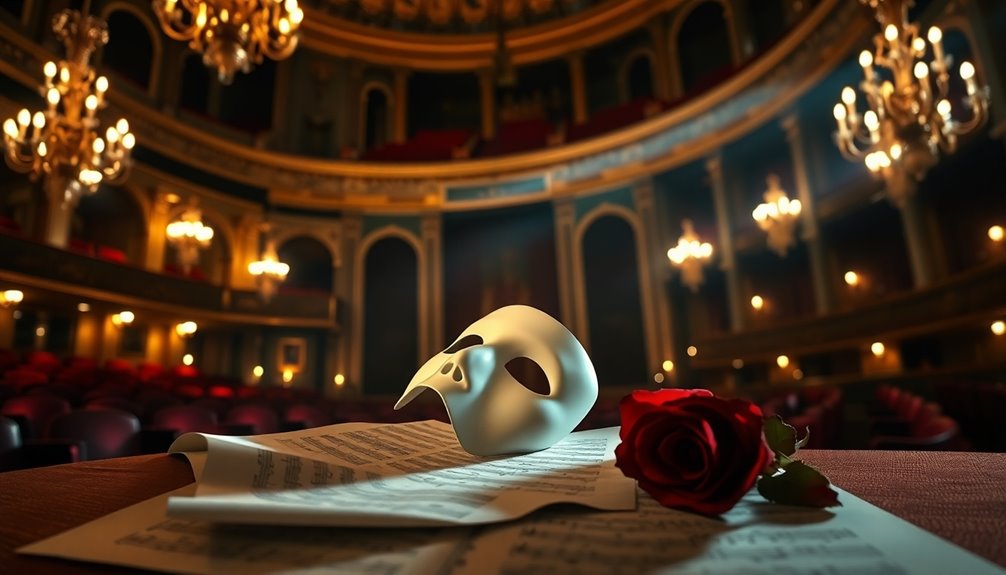
In “The Phantom of the Opera,” you meet Christine, a talented singer caught between the haunting Phantom’s obsession and the loving support of Raoul. As a mysterious figure, the Phantom lures Christine into his world, revealing his darker side. Through her journey, she grapples with her identity, love, and the fear of control. Set in the majestic Paris Opéra House, the story intertwines themes of loneliness and belonging. Discover how these dynamics unfold and shape the characters’ fate.
The Origins of The Phantom of the Opera: A Literary Masterpiece
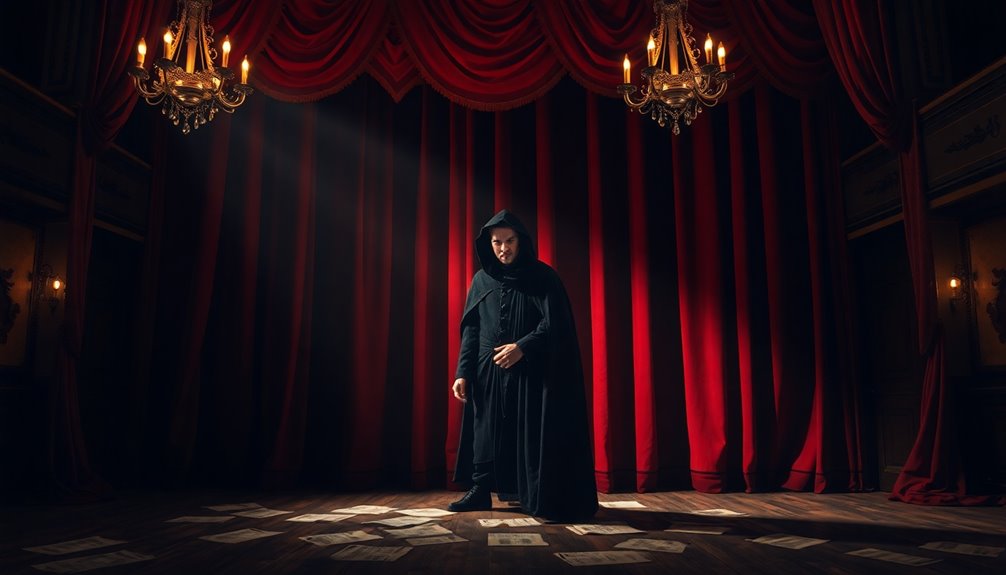
The origins of “The Phantom of the Opera” reveal an enthralling blend of inspiration and creativity.
This iconic novel by French author Gaston Leroux was first published as a serial from September 1909 to January 1910, later appearing in book form in March 1910.
Leroux drew from fascinating rumors of a ghost haunting the Palais Garnier, the Paris Opera House, which serves as the tale’s haunting backdrop.
His experience as a reporter and courtroom critic allowed him to weave elements of mystery, romance, and horror into a compelling gothic narrative.
Initially met with mixed reviews, the novel gained acclaim over time, influencing countless adaptations, including the famed musical that captivated audiences in 1986.
The story’s lasting influence on popular culture is evident through its contributions to the horror genre and anti-hero narratives.
Key Characters: Exploring Christine, Raoul, and the Phantom
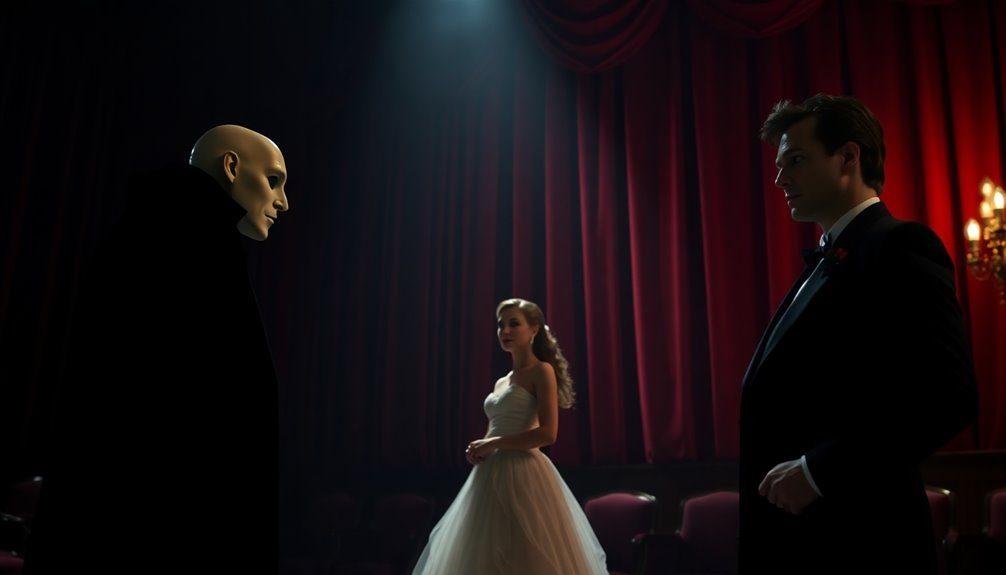
In “The Phantom of the Opera,” Christine’s struggle between her attraction to the Phantom’s genius and her fear of his control creates a compelling duality of desire.
Meanwhile, Raoul steps in as her protector, embodying a love that’s healthy and supportive.
Together, their relationships highlight the tension between true love and obsession, shaping the emotional core of the story. This dynamic echoes the themes of obsession and jealousy found throughout Gothic literature, adding depth to their interactions.
Christine’s Duality of Desire
Torn between two compelling forces, Christine Daaé navigates her feelings for Raoul and the Phantom, each embodying different aspects of her desires. Raoul represents safety and familiarity, offering a love grounded in mutual respect.
In contrast, the Phantom embodies a darker allure, blending obsession with romance, which fascinates and terrifies Christine. This internal conflict manifests within the opera house, the psychological battleground where her emotions clash.
As Christine grapples with her attraction to both men, she reflects the tension between societal expectations and her own deepest longings. Ultimately, her journey reveals the complexities of desire, illustrating how love can be both nurturing and destructive, leaving her to confront what she truly wants amidst the chaos of her heart.
Raoul’s Role as Protector
Raoul de Chagny steps into the role of protector with unwavering determination, ready to shield Christine from the Phantom’s menacing grip.
As her childhood friend, he embodies a healthy love that starkly contrasts with the Phantom’s obsessive tendencies. Throughout the story, you see Raoul actively working to rescue Christine from the Phantom’s manipulative hold, risking his life for her safety and freedom.
His loyalty shines as he tirelessly pursues her, emphasizing the importance of mutual respect in relationships. The tension between Raoul and the Phantom highlights love’s duality, showcasing Raoul as a stabilizing force in Christine’s tumultuous emotional journey.
In this battle against obsession, Raoul’s commitment to Christine proves essential for her ultimate liberation.
Setting the Scene: The Opulent Paris Opéra House

As you step into the Paris Opéra House, the architectural grandeur instantly captivates you with its Beaux-Arts design. Every corner reveals lavish details, from the grand staircase to the stunning chandelier, symbolizing the height of artistic expression. This opulent setting not only serves as a backdrop for the drama but also embodies the essence of the opera itself. The Gothic architecture of Palais Garnier enhances the Phantom’s tale, enveloping the story in a mysterious ambiance that resonates with the characters’ emotions.
Architectural Grandeur and Design
The Paris Opéra House stands as a magnificent tribute to architectural grandeur and design, enchanting visitors with its Beaux-Arts style that embodies the opulence of the Second Empire period.
Designed by architect Charles Garnier, this stunning opera house, completed in 1875, showcases intricate sculptures and lavish interiors that transport you to a world of elegance.
You can’t help but be awed by the vast auditorium, accommodating around 1,900 spectators, and the breathtaking ceiling painted by Marc Chagall.
The grand chandelier, weighing over 8 tons and suspended 24 meters above, adds a dramatic flair, famously linked to “The Phantom of the Opera.”
Every detail of the Paris Opera House invites you to explore its rich history and artistic beauty.
Symbolism of The Opera
Beauty and darkness intertwine within the opulent Paris Opéra House, setting the stage for the haunting tale of “The Phantom of the Opera.”
This grand venue isn’t just a backdrop; it embodies the duality of the story, reflecting the Phantom’s tragic obsession and Christine’s aspirations as a performer.
The lavish opera stage showcases talent and dreams, while the mysterious figure of the Phantom lurks in the shadows, symbolizing the darker aspects of love and madness.
The hidden catacombs beneath the opera house echo his secretive existence, representing the depths of his emotions.
Meanwhile, the empty box five stands as a poignant reminder of his yearning for acknowledgment, contrasting sharply with his isolation and loneliness, enhancing the opera’s rich symbolism.
The Phantom’s Obsession: a Deep Dive Into Unrequited Love
While many see the Phantom as a tragic figure, his obsession with Christine Daaé reveals a darker side of unrequited love. His traumatic past and insecurities lead him to idealize Christine as his sole source of affection, driving him to extreme measures.
You’ll notice how he manipulates and intimidates her, using threats against those she loves, especially Raoul. This possessiveness isolates Christine, as he believes only by controlling her can he win her loyalty.
His psychological profile mirrors that of obsessive love, where passion morphs into a dangerous fixation. The Phantom’s actions serve as a cautionary tale about the perils of idealizing one-sided relationships, highlighting the emotional turmoil that can arise from such destructive attachment. This narrative echoes the theme of shame in love, illustrating the complexities of desire and societal expectations that complicate relationships.
Christine’s Journey: From Innocence to Self-Discovery
As Christine Daaé navigates her tumultuous emotions, she transforms from a naïve girl into a woman who fiercely understands her own identity.
Initially captivated by the Phantom’s obsession, she grapples with conflicting feelings for him and her childhood love, Raoul. Her abduction forces her to confront her desires, propelling her towards self-discovery.
Each encounter with the Phantom reveals the darker side of love, and her compassion for him signifies her growth. As Christine learns to navigate her emotions, she ultimately embraces her autonomy, recognizing the complexity of her relationships. This journey of self-discovery mirrors the evolution from submission to empowerment found in Laura Esquivel’s *Like Water for Chocolate*.
The Role of Music: How Melodies Shape the Narrative
In *The Phantom of the Opera*, music isn’t just an accompaniment; it drives the story forward.
You’ll notice how melodic foreshadowing hints at future events, while the emotional resonance of the lyrics deepens your connection to the characters.
Each composition reveals themes that enhance the narrative, making the music an essential part of the storytelling experience. Furthermore, the acts of resistance showcased in the opera parallel the historical courage and defiance seen during WWII, emphasizing the power of unity and resilience in the face of adversity.
Melodic Foreshadowing Techniques
Music’s power in storytelling lies in its ability to foreshadow events and emotions, shaping the narrative in profound ways.
In *The Phantom of the Opera*, melodic themes play an essential role in guiding you through the characters’ emotional journeys. For instance, the haunting “Music of the Night” not only showcases the Phantom’s seductive nature but also hints at his darker intentions toward Christine.
The intertwining melodies in “The Point of No Return” build tension, signifying a pivotal choice for Christine and revealing her internal struggle.
Additionally, recurring musical motifs throughout the score unify the narrative, evoking specific emotions and enhancing your experience as the drama unfolds.
This clever use of music enriches the storytelling, making every note significant.
Emotional Resonance Through Lyrics
Emotional resonance thrives in the poignant lyrics of *The Phantom of the Opera*, revealing the depths of the characters’ souls.
Andrew Lloyd Webber’s haunting melodies, paired with Charles Hart’s insightful lyrics, capture the characters’ emotions with remarkable clarity. In songs like “The Music of the Night” and “The Point of No Return,” you feel the Phantom’s obsession and Christine’s struggle for autonomy.
The recurring “Angel of Music” motif emphasizes her journey from innocence to self-discovery. As you listen, the contrasting musical styles heighten emotional impact—romantic duets between Christine and Raoul stand in stark contrast to the Phantom’s darker themes.
This interplay of lyrics and music deepens your understanding of the characters’ inner conflicts, enriching the narrative experience.
Themes Conveyed Via Composition
Melody serves as a powerful vehicle for storytelling in *The Phantom of the Opera*, shaping the narrative and enhancing the emotional landscape. The music, composed by Andrew Lloyd Webber, underscores the characters’ emotional depth, with haunting melodies like “The Music of the Night” reflecting obsession and longing.
You’ll notice how melodic motifs articulate the complex bond between the Phantom and Christine, contrasting his darker themes with her innocence. The orchestration intensifies dramatic moments, like the chandelier crash, accentuating chaos.
Shifts between major and minor keys reveal the duality of love and obsession, while crescendos and diminuendos mirror rising tensions. Through these musical themes, the score effectively encapsulates the gothic atmosphere and emotional journeys of the characters.
Themes of Loneliness and Belonging: The Human Experience
Loneliness permeates the lives of characters in “The Phantom of the Opera,” driving their actions and desires. The Phantom embodies a profound isolation shaped by societal rejection, yearning for love and connection with Christine.
In her journey, you witness Christine’s struggle for belonging as she navigates the conflicting affections of the Phantom and Raoul, highlighting the complexity of human relationships.
The opera house acts as a metaphor for the collective unconscious, revealing both the sanctuary of artistic expression and the hidden fears of its inhabitants.
Christine’s internal conflict between her attraction to the Phantom and her longing for Raoul underscores the bittersweet nature of belonging, illustrating how love can heal yet cause destruction in the domain of loneliness and connection. This theme resonates with Bigger Thomas’s experiences in “Native Son,” where systemic oppression further complicates his quest for identity and belonging.
The Chandelier Crash: Symbolism and Its Impact on the Story
Amid the tangled emotions of longing and connection, the chandelier crash serves as a pivotal moment in “The Phantom of the Opera.”
Occurring during the climax of Act I, this dramatic event highlights the precarious balance between beauty and chaos within the opera house. The Phantom orchestrates this catastrophe to assert control and demonstrate his power, revealing the chaos lurking beneath the glamorous surface.
The crash results in the tragic death of an audience member, heightening the tension surrounding the Phantom’s obsession with Christine. This moment marks his shift from an ominous presence to a tangible threat, intensifying the conflict with Christine and Raoul.
Ultimately, the chandelier crash foreshadows the destructive consequences of the Phantom’s obsessive love. This incident parallels the broader themes of obsession and duality present throughout the novel, showcasing how the Phantom’s inner turmoil leads to catastrophic outcomes.
Adaptations Over Time: From Novel to Stage to Film
Since its publication in 1910, Gaston Leroux’s “The Phantom of the Opera” has captivated audiences, inspiring a wide array of adaptations in both theater and film.
Particularly, Andrew Lloyd Webber’s stage musical, premiering in 1986, transformed the story into a theatrical masterpiece.
Here’s a glimpse of its evolution:
- The 2004 film adaptation retained many musical numbers but featured a different cast than the stage version.
- The original musical garnered seven Tony Awards, including Best Musical, showcasing its popularity.
- A sequel, “Love Never Dies,” premiered in 2010, though it received mixed reviews.
- The show closed in 2023 after 35 years, cementing its place in Broadway history.
These adaptations highlight the timeless appeal of the Phantom of the Opera and its enduring legacy, resonating with themes of female empowerment and identity that are explored in various forms of storytelling.
The Enduring Legacy: Why The Phantom of the Opera Captivates Audiences
The Phantom of the Opera captivates audiences because it explores universal themes that resonate deeply with the human experience.
Andrew Lloyd Webber’s stage musical brilliantly captures the essence of obsessive love, weaving a tale of passion, isolation, and the quest for acceptance. Since its 1986 debut, it has become a cultural phenomenon, holding the title of the longest-running Broadway musical.
The Phantom, a complex and tragic figure, symbolizes the darker facets of love and belonging, drawing you into his world.
With over 35 years of performances and a successful film adaptation in 2004, the story continues to captivate new generations, proving its timeless relevance and emotional depth.
Moreover, the themes of psychological horror explored in the narrative resonate with modern audiences, adding layers to the emotional experience.
You can’t help but be moved by its haunting beauty.
Conclusion
In the end, “The Phantom of the Opera” continues to resonate because it dives deep into the complexities of love, identity, and longing. Just like a modern-day artist pouring their soul into a song, you can feel the Phantom’s pain and passion. Consider a young musician, inspired by the Phantom, who uses their struggles to create a haunting melody. This connection shows how timeless stories can shape our lives and inspire our own journeys of self-discovery.