

Rohinton Mistry’s “A Fine Balance” immerses you in the lives of four characters whose journeys reveal profound sorrow and resilience amid India’s oppressive Emergency period. You’ll witness their heart-wrenching struggles against systemic injustice, caste discrimination, and personal loss. Yet, in the depths of despair, moments of hope and friendship shine through, illustrating the enduring human spirit. By exploring these themes, you’ll uncover why this poignant narrative lingers long after you’ve turned the last page.
The Heart of “A Fine Balance”: An Overview

At its core, “A Fine Balance” immerses you in the lives of four diverse characters maneuvering the upheaval of India’s Emergency period.
You witness Dina Dalal, a widow seeking independence, endeavoring to carve out a life in a society that continuously pushes against her.
You also meet Ishvar and Omprakash, two tailors fleeing the horrors of caste violence, whose resilience embodies hope amid despair.
Maneck, a college student, grapples with his identity, reflecting the struggles of youth in turbulent times.
Mistry’s narrative artfully intertwines their stories, revealing that joy can coexist with adversity.
The backdrop of the Emergency under Prime Minister Indira Gandhi adds a layer of urgency to their struggles, emphasizing the societal constraints they face.
As you navigate their intertwined lives, you’ll find that even in the harshest realities, the spark of hope persists, making it a profound exploration of human resilience.
Meet the Characters: A Diverse Tapestry of Lives

In “A Fine Balance,” the lives of Dina, Ishvar, Omprakash, and Maneck intertwine, creating a rich tapestry that reflects the complexities of human experience during a tumultuous era.
Each character in this novel grapples with their own struggles, embodying both hope and despair. Dina, a fiercely independent widow, battles grief while yearning for autonomy and financial stability.
Ishvar and his nephew Omprakash face the harsh realities of caste discrimination, yet their resilience shines as they pursue a better life through tailoring.
Maneck, the idealistic college student, wrestles with his identity amid societal pressures.
Together, these characters reveal the depth of human connection, highlighting the fragility and strength found in their shared pursuit of dignity. Their experiences echo the themes of systemic oppression that resonate throughout literature, illustrating the ongoing fight for justice and equality.
The Setting: 1970s India Under Emergency Rule
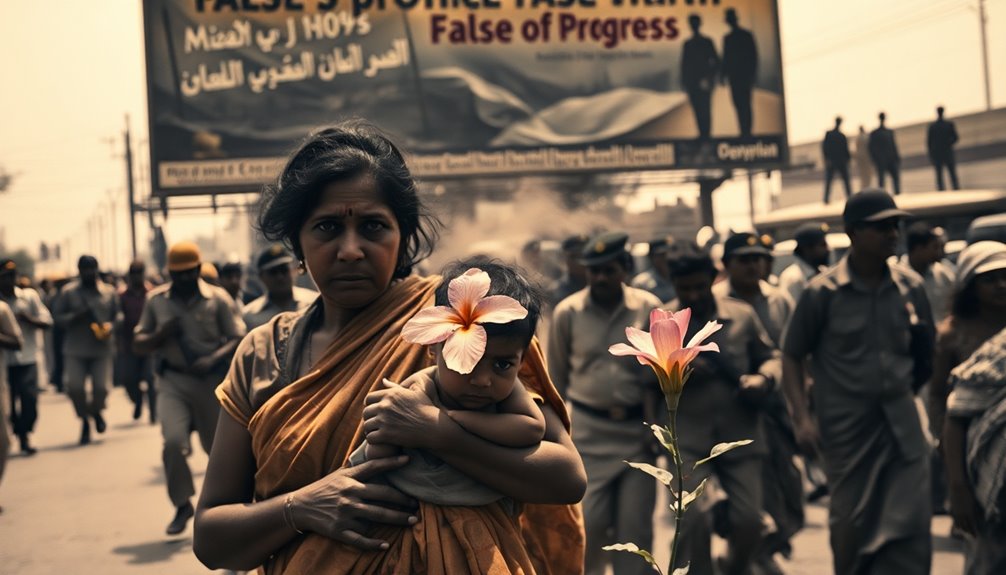
In “A Fine Balance,” you’re transported to 1970s India, a time when political turmoil grips the nation under Emergency Rule.
This oppressive atmosphere not only affects the lives of ordinary citizens but also exacerbates the deep-rooted caste system, pushing many to the brink.
As the characters navigate this harsh reality, you witness how their struggles intertwine with the socio-political landscape, highlighting the impact of systemic oppression. The resilience of individuals in the face of collective action and unity serves as a poignant reminder of the strength found in solidarity against adversity.
Political Turmoil’s Impact
While traversing the complex landscape of 1970s India, you can’t ignore the profound impact of the Emergency on the lives of ordinary citizens. This period, marked by political turmoil, saw Prime Minister Indira Gandhi’s government curtailing human rights, leading to widespread suffering.
Forced sterilizations and the suppression of civil liberties created an atmosphere of fear and despair, shattering the lives of many. Mistry captures these injustices in A Fine Balance, showcasing characters who endure not just systemic oppression, but also a society that turns a blind eye to their struggles.
The backdrop of the Emergency amplifies their resilience, revealing how the fight for dignity persists even amid the harshest conditions, reminding us of the human spirit’s capacity for endurance.
Caste System Oppression
Amid the chaos of the 1970s, the caste system in India remained a relentless force of oppression, particularly for lower castes like the chamars.
You witness the characters Ishvar and Om, who flee their village to escape caste violence, only to face systemic discrimination in urban areas.
The Emergency declared by Indira Gandhi exacerbates their plight, as human rights violations become rampant. Access to jobs, dignity, and basic human rights slips further from their grasp.
Mistry’s narrative starkly illustrates how deeply ingrained this oppressive system is, impacting not just individual lives but also relationships.
As you journey through their struggles, you can’t help but feel the weight of injustice that lingers, making their resilience all the more poignant.
Exploring Themes of Despair and Resilience
Despair and resilience intertwine throughout Rohinton Mistry’s *A Fine Balance*, creating a poignant exploration of the human condition. You witness characters like Dina Dalal and the Darji tailors grappling with systemic oppression and personal losses, yet they manage to find fleeting moments of hope.
Mistry emphasizes that joy can coexist with suffering, revealing the complexities of life. As they face everyday injustices in 1970s India, the pervasive nature of despair looms large. However, their determination to survive showcases resilience.
The bonds they forge and the support they offer each other illustrate the enduring human spirit. Ultimately, the novel leaves you with a profound understanding that while despair is universal, resilience serves as a powerful response to life’s challenges. This mirrors the themes of systemic racism found in Richard Wright’s *Native Son*, highlighting the shared struggles against oppression across cultures and time.
The Role of Caste in Shaping Characters’ Fates
In “A Fine Balance,” the caste system profoundly influences the lives of characters like Ishvar and Omprakash. You see how their lower-caste status traps them in a cycle of discrimination and violence, shaping their identities and aspirations. This systemic oppression not only affects their personal journeys but also complicates their interactions with others, like Dina, who navigates her own middle-class privileges. The characters’ experiences illustrate the enduring impact of the caste system on social mobility and opportunities in India.
Caste System’s Enduring Impact
The caste system‘s pervasive influence shapes the destinies of characters in A Fine Balance, crafting a narrative that reveals the harsh realities of social stratification in India.
Ishvar and Om, as Dalits, constantly confront systemic discrimination and violence, illustrating how their aspirations are stifled by societal prejudice. You see Ishvar’s dreams of a better life through tailoring crushed under the weight of oppression.
The stark divides between communities highlight the daily injustices characters like Dina and Maneck face, complicating their interactions. Mistry critiques these entrenched hierarchies, emphasizing how the caste system dictates access to dignity and freedom.
Yet, through their struggles, the characters embody resilience, endeavoring to maintain their humanity in a dehumanizing society.
Identity and Social Stigma
Although characters in A Fine Balance endeavor to carve out their identities, their lives are often overshadowed by the stigma associated with their caste.
Ishvar and Omprakash Darji, as lower-caste tailors, face systemic oppression that shapes their fates and limits their dignity. The novel starkly illustrates the discrimination faced by chamars, revealing how social stigma hinders their social mobility.
Dina Dalal’s quest for independence is further complicated by the expectations tied to her caste and gender, while Maneck Kohlah, despite his higher caste, battles feelings of worthlessness in a divided society.
Ultimately, Mistry emphasizes that caste identity isn’t just a personal struggle; it’s a societal construct that perpetuates inequality and influences every character’s relationships and life choices.
Dina Dalal: The Independent Widow Navigating Life’s Challenges
While traversing the complexities of a patriarchal society, Dina Dalal stands out as a fiercely independent widow determined to carve her own path. She manages her sewing business in a cramped apartment, resisting her brother’s attempts at financial control.
Dina’s determination to live on her own terms showcases her resilience amid societal pressures. By opening her home to tailors Ishvar and Om, along with paying guest Maneck, she creates a makeshift family that supports her through grief and adversity.
As she grapples with her husband’s death and confronts gender oppression, you see her strength in maneuvering life’s challenges. Dina embodies the struggle for autonomy, proving that independence can flourish even in the face of overwhelming obstacles. Her journey resonates with themes of immigrant resilience, reflecting the universal pursuit of a better life despite systemic challenges.
Ishvar and Om: Tailors Battling Caste Discrimination
Fleeing their village to escape caste violence, Ishvar and Om arrive in the city filled with hope for a better life.
As Dalit tailors, Ishvar Darji and Omprakash Darji carry not just their craft but a legacy of resilience despite systemic oppression.
However, their dreams soon confront harsh realities, as they face daily discrimination in the workplace and unjust treatment from landlords.
Ishvar’s determination to rise above their circumstances clashes with Om’s vulnerability, revealing the emotional toll of their struggles within a rigid caste hierarchy.
Yet, their bond evolves from uncle and nephew to deep friendship, showcasing their unwavering solidarity and resilience against adversity.
Together, they navigate a world that constantly seeks to marginalize them, reflecting the profound impact of systemic racism on marginalized communities.
Maneck Kohlah: the Student Struggling With Identity and Purpose
As Ishvar and Om navigate the harsh realities of city life, their struggles resonate with another character’s experience—Maneck Kohlah.
A college student majoring in Refrigeration, you see Maneck grappling with an identity crisis as he feels both privileged and alienated in the bustling city. Caught between traditional expectations and modern aspirations, he embodies the struggles of educated youth in 1970s India.
His relationships with the apartment’s residents reveal the complexities of class and social status, deepening his sense of disconnect. Maneck’s internal conflict highlights the search for purpose amidst despair, capturing that delicate balance between hope and hopelessness. This mirrors Gifty’s journey in navigating cultural identity as she seeks to understand her place in a society marked by systemic challenges.
Through his journey, you witness the profound impact of a rapidly changing society on one individual’s quest for meaning.
The Impact of Government Policies on Everyday Lives
In “A Fine Balance,” you see how government policies intrude on personal lives, shaping daily experiences in profound ways.
The coercive measures during India’s Emergency, especially the Family Planning Program, expose the harsh realities faced by marginalized communities, including the lower-caste tailors Ishvar and Om.
As you navigate their struggles, it becomes clear how systemic oppression and bureaucratic indifference can dismantle dignity and livelihood. The experiences of Ishvar and Om parallel the struggles depicted in *Native Son*, where systemic racism also plays a critical role in shaping the lives of marginalized individuals.
Government Control Over Lives
Government control can seep into every aspect of life, often leaving individuals feeling powerless against the weight of oppressive policies.
During India’s Emergency, you witness how government control over lives manifests through harsh restrictions and human rights violations. The Family Planning Program, incentivizing sterilization with cash rewards, illustrates the intrusive nature of policies aimed at population control.
You see families torn apart and the marginalized displaced as beautification initiatives demolish slums, exacerbating homelessness. Everyday experiences, from unreliable public transport to police bribery, reveal an oppressive atmosphere fueled by government inefficiency and corruption.
This relentless force impacts characters’ struggles for dignity and survival, showing that the state’s disregard for individual lives is a constant threat to their well-being.
Caste Discrimination and Policies
Caste discrimination pervades everyday life, shaping experiences in ways that government policies often exacerbate. In *A Fine Balance*, you witness the harsh realities faced by marginalized communities, especially during India’s Emergency.
Forced sterilization programs target lower castes, highlighting how government policies can deepen systemic oppression. Characters struggle with discrimination in housing, employment, and social interactions, revealing biases that are often ingrained in society.
The landlord’s preference for tenants based on skin tone illustrates this pervasive issue. Mistry’s portrayal of bureaucratic indifference shows how government-sanctioned actions, like bulldozing homes, lead to displacement and entrench the cycles of poverty and caste discrimination.
This stark reality underscores the urgent need for change and greater awareness of the impact of these policies on everyday lives.
The Power of Friendship Amidst Adversity
Friendship serves as a powerful lifeline for Dina, Ishvar, Om, and Maneck as they navigate the tumultuous landscape of life during India’s Emergency.
The bond they form amidst adversity highlights how friendship can provide emotional support and a sense of family. Despite their differing backgrounds, they create a makeshift family, reminding you of the importance of connection in overcoming hardship.
Friendship emerges as a vital source of emotional support, forging a makeshift family that transcends backgrounds and unites in overcoming hardship.
Their shared experiences in the cramped apartment foster camaraderie, allowing them to face despair together.
Mistry’s portrayal emphasizes resilience, as joy and laughter emerge even in dire situations. This powerful depiction mirrors the themes of generational trauma and resilience found in Alice Walker’s *The Third Life of Grange Copeland*, showcasing how characters can confront their painful histories.
Ultimately, the power of friendship in A Fine Balance showcases the human spirit’s ability to seek solace and strength in community, proving that together, they can endure even the most oppressive circumstances.
Humor as a Coping Mechanism in Harsh Realities
As the characters in A Fine Balance grapple with the harsh realities of life during India’s Emergency, humor emerges as an essential coping mechanism that lightens their burdens.
You see, their witty exchanges and comical moments reveal their resilience, showcasing how they find joy even in dire situations.
Mistry skillfully incorporates dark humor, highlighting the absurdity of bureaucratic failures, which deepens your understanding of their struggles and the human spirit’s endurance.
By juxtaposing humor with heavy themes like caste discrimination and political oppression, Mistry allows you to engage with their pain while also recognizing their humanity.
Ultimately, this use of humor underscores the message that even amid systemic injustice, individuals can forge connections and maintain hope, enriching their survival narrative.
The Unresolved Ending: What It Says About Life
While the ending of A Fine Balance leaves readers with an unsettling sense of ambiguity, it powerfully mirrors the unpredictable nature of life itself. You’re confronted with the harsh realities faced by the characters, who navigate their sorrow without any neat resolutions.
The ambiguous ending of A Fine Balance reflects life’s unpredictability, revealing the harsh realities and unresolved sorrows of its characters.
Here’s what this unresolved ending reveals about life:
- Complexity: Life rarely offers clear answers or resolutions.
- Endurance: Resilience emerges as a form of resistance against systemic oppression, highlighting the strength found in survival.
- Duality: Hope and despair coexist, reminding you to maintain balance amid adversities.
Through poignant imagery, such as the blind man selling monkeys, Mistry emphasizes that sometimes, merely enduring is an affirmation of one’s spirit, reflecting the intricate dance between suffering and resilience.
Why Does “A Fine Balance” Resonate With Readers Today?
Resonance often stems from shared experiences, and “A Fine Balance” taps deeply into universal themes that linger in today’s society.
You’ll find its exploration of sorrow and resilience particularly poignant as it investigates the struggle for dignity amidst systemic oppression. The backdrop of India’s Emergency reminds you of the fragility of human rights, echoing contemporary social justice issues.
Mistry’s masterful prose fosters an emotional connection, prompting you to reflect on your own encounters with adversity. The characters’ everyday struggles highlight the injustices faced by marginalized communities, nurturing empathy and awareness.
Conclusion
In “A Fine Balance,” Rohinton Mistry masterfully intertwines sorrow and resilience, leaving you with a bittersweet taste. You might think that hope would triumph in the end, but instead, you’re left with an unresolved conclusion that mirrors life itself. Ironically, just when you expect a neat resolution, you’re reminded that sometimes, the struggle is the point. The heartache lingers, yet it’s this very discomfort that resonates, echoing the complexities of existence you can’t easily shake off.