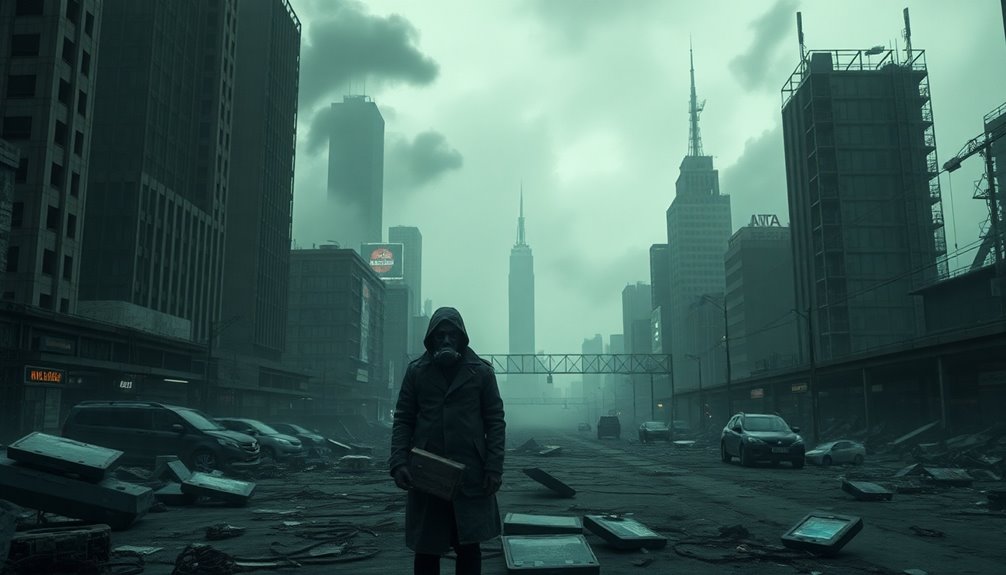
Dystopian fiction often mirrors our reality, warning us about potential futures. Predictions like Orwell’s surveillance state in *1984* and Atwood’s cautionary tale on women’s rights in *The Handmaid’s Tale* resonate today. Censorship seen in *Fahrenheit 451* highlights risks of conformity, while Huxley critiques consumerism in *Brave New World*. Environmental concerns in *The Drowned World* starkly echo current issues. These themes shape our discussions and reflect society’s trajectory, revealing chilling parallels you might find intriguing.
Dystopian Novels That Foreshadowed Our Reality
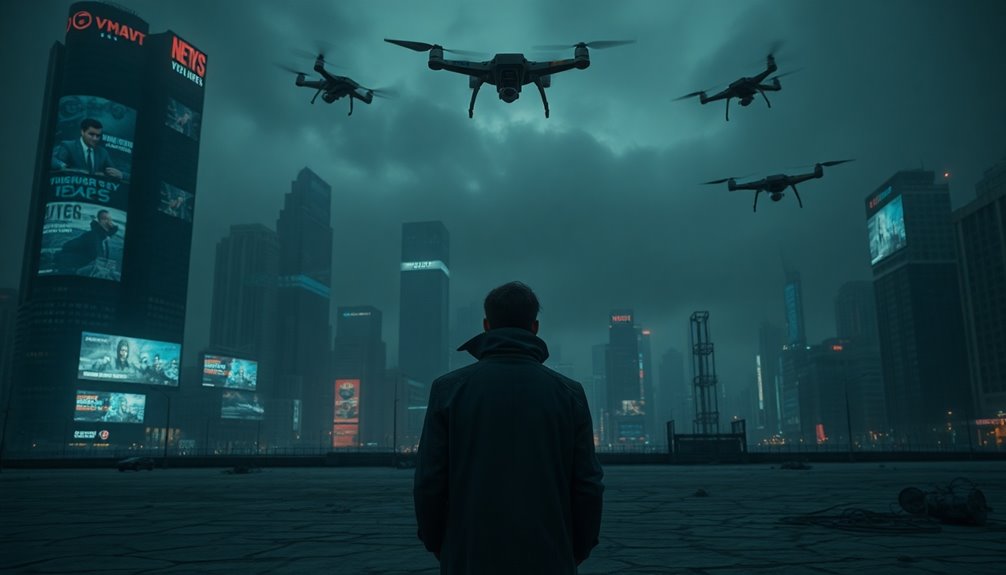
As you explore the world of dystopian literature, you’ll find that many iconic novels have eerily predicted aspects of our current reality.
George Orwell’s *1984* highlights mass government surveillance, a concept that resonates today, especially after Edward Snowden’s revelations about the NSA.
Similarly, Margaret Atwood’s *The Handmaid’s Tale* foresees a theocratic society stripping women of their reproductive rights, a discussion still relevant in today’s world.
Ray Bradbury’s *Fahrenheit 451* showcases a society obsessed with entertainment, mirroring our modern fixation on reality shows.
H.G. Wells’ *The World Set Free* anticipated nuclear technology, influencing the Manhattan Project.
Finally, William Gibson’s *Neuromancer* introduced cyberspace, predicting the internet’s rise and its vulnerabilities.
These works of dystopian fiction truly predict the future, reflecting our ongoing struggles. Additionally, Richard Wright’s *Native Son* illustrates the systemic racism that continues to affect marginalized communities, echoing themes found in dystopian narratives.
The Rise of Surveillance: Lessons From *1984
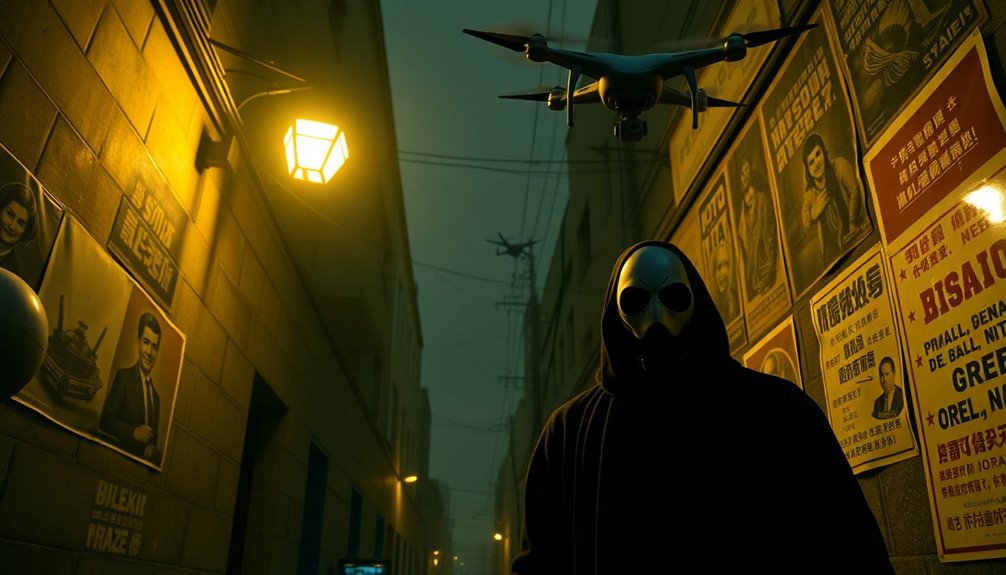
In a world where privacy seems increasingly elusive, the lessons from George Orwell’s *1984* resonate more than ever. The novel’s depiction of relentless surveillance, embodied by the phrase “Big Brother is watching you,” mirrors today’s reality, where CCTV cameras are ubiquitous.
With over 245 million in use globally, our daily lives are under constant watch. Edward Snowden’s 2013 revelations about the NSA’s extensive monitoring of calls and emails remind us of Orwell’s warning against government overreach.
As citizens, we often accept privacy invasions for the sake of security, creating an atmosphere of fear and compliance. Orwell’s concept of “thought crime” underscores the dangers of not just monitoring actions, but also controlling thoughts in our increasingly monitored world. This reflection on systemic oppression highlights how marginalized individuals are often subjected to heightened scrutiny and surveillance, echoing the experiences of Bigger Thomas in Richard Wright’s *Native Son*.
Censorship and Conformity in *Fahrenheit 451
Censorship and conformity permeate Ray Bradbury’s *Fahrenheit 451*, where the suppression of dissenting ideas leads to a desensitized society.
You witness protagonist Guy Montag grappling with his conscience as he questions a world that prioritizes entertainment over critical thought.
The novel starkly illustrates how media manipulation can render individuals passive consumers, much like Mildred Montag, who’s entranced by shallow television programming.
This addiction to mindless entertainment echoes today’s reality TV culture, where intellectual engagement is discouraged.
Bradbury’s cautionary tale warns against the dangers of state-controlled information, urging you to reflect on the erosion of individual thought.
Bradbury’s narrative serves as a stark reminder of the perils of censorship, compelling you to consider the decline of personal critical thinking.
As censorship and conformity continue to plague our world, *Fahrenheit 451* remains alarmingly relevant. Moreover, the themes of systemic oppression in dystopian fiction resonate with contemporary societal issues, prompting a critical examination of our current realities.
Gender and Autonomy: Reflections From *The Handmaid’s Tale
In *The Handmaid’s Tale*, you see how the struggle for bodily autonomy plays out in a chilling totalitarian regime. The story highlights the mechanisms of patriarchal control that strip women of their rights, making it alarmingly relevant today. As global protest movements rise, it’s clear that Atwood’s vision serves as a powerful reminder of the ongoing fight for gender equality and autonomy. This struggle for autonomy is reminiscent of the systemic racism faced by individuals like Bigger Thomas in *Native Son*, where societal structures dehumanize and limit personal freedom.
Bodily Autonomy Struggles
As you explore the world of *The Handmaid’s Tale*, you’ll quickly recognize how bodily autonomy struggles resonate deeply in today’s society.
Atwood’s depiction of a totalitarian regime highlights the ongoing battle for women’s rights and reproductive freedoms.
- The character Offred illustrates the loss of agency that many women face.
- The novel serves as a cautionary tale about the potential regression of women’s rights.
- Global protests inspired by The Handmaid’s Tale advocate for bodily autonomy.
- The narrative underscores the need for vigilance in protecting individual rights.
These themes remind us that the fight for bodily autonomy isn’t just fiction; it’s a pressing reality that demands our attention and action.
Patriarchal Control Mechanisms
While *The Handmaid’s Tale* presents a chilling vision of a society governed by patriarchal control mechanisms, it also serves as a stark reminder of the real-world implications of gender oppression.
In this dystopian narrative, women lose their bodily autonomy, reduced to mere vessels for childbirth as “handmaids.” You see through Offred’s eyes the struggle for identity and the suffocating grip of a patriarchal society.
Atwood’s portrayal of enforced pregnancy ignites important discussions about reproductive rights, highlighting threats women face today. As various countries grapple with legislative challenges, the themes in *The Handmaid’s Tale* resonate strongly, inspiring movements that advocate for gender equality and the protection of women’s rights.
The novel remains a powerful symbol of resistance against oppression.
Global Protest Movements
How do global protest movements reflect the warnings of *The Handmaid’s Tale*? Atwood’s dystopian novel serves as a chilling reminder of the ongoing struggles for women’s rights and reproductive rights. The alarming rise of restrictive legislation has sparked widespread protests, echoing the themes of resistance portrayed in her work.
- The 2017 Women’s March showcased activists donning red cloaks and white bonnets.
- Protests highlight the urgency of protecting bodily autonomy.
- Feminist movements are resurging in response to patriarchal control.
- Global awareness around reproductive rights continues to grow.
These movements symbolize the fight against oppression and reinforce Atwood’s message: vigilance is essential to safeguard gender autonomy and prevent dystopian realities from materializing.
Consumerism and Pleasure in *Brave New World
In *Brave New World*, you see how the relentless pursuit of pleasure can overshadow true happiness and individuality.
Huxley paints a picture of a society consumed by consumerism, where instant gratification through technology and substances like soma becomes the norm.
This critique resonates today, as we navigate our own landscape of escapism and superficial connections. The themes of politics and society in sci-fi, such as those explored in *The Expanse Series*, highlight similar issues in our current world.
The Pursuit of Pleasure
What happens when a society prioritizes pleasure above all else? In *Brave New World*, Aldous Huxley explores this by showcasing a world where consumerism reigns supreme. Individuals are conditioned to seek instant gratification, sacrificing their individuality for a life filled with superficial pleasure.
The drug soma numbs any negative emotions, leading to a lack of critical thought and authentic experiences.
- Pleasure becomes the ultimate goal, overshadowing personal connections.
- Consumerism drives identity, reducing people to mere products.
- The quest for happiness leads to emptiness and disconnection.
- Huxley warns of a reality where genuine emotions are traded for convenience.
His critique serves as a stark reminder of the potential pitfalls of a pleasure-driven society.
Consumerism and Happiness
While you might think that consumerism leads to happiness, *Brave New World* reveals a stark contrast.
In Huxley’s dystopia, individuals are conditioned to equate pleasure with material possessions, leaving them trapped in a cycle of consumption. Genetic engineering creates a caste system, where your worth is tied to your ability to consume and conform.
The society encourages constant buying, offering a false sense of fulfillment that ultimately feels empty. Instead of true happiness, people rely on “soma,” a drug that suppresses dissatisfaction and maintains societal harmony.
Huxley’s critique of consumer culture serves as a cautionary tale, warning you that the pursuit of pleasure through consumerism can lead to a hollow existence devoid of genuine joy.
Escapism Through Technology
Escapism through technology plays an essential role in Huxley’s *Brave New World*, where citizens seek refuge from reality in a world designed to cater to their every desire.
The society thrives on consumerism, using technological advancements to suppress individualism and promote conformity. You can see how:
- Soma provides an escape from discomfort and critical thought.
- Entertainment distracts citizens from meaningful engagement.
- Mass production of genetically engineered humans reinforces a lack of identity.
- Instant gratification mirrors our current reliance on digital devices.
Huxley’s vision warns against sacrificing individuality for superficial pleasures, reflecting ongoing concerns about how consumer culture impacts society.
As you navigate today’s tech-driven world, consider whether you’re truly finding fulfillment or simply seeking escape.
Environmental Warnings From *The Drowned World
As climate change increasingly dominates global conversations, J.G. Ballard’s *The Drowned World* eerily anticipates the consequences of our current environmental concerns.
The novel presents a future where industrial pollution has resulted in a submerged city, reflecting the urgent reality of rising sea levels and extreme weather. You see parallels in today’s world, where ecosystems are altered, and communities face climate-related disasters.
Ballard’s narrative emphasizes survival and adaptation amid drastic changes, mirroring the challenges many face now. His cautionary tale serves as a stark reminder of our impact on the environment and the critical need for proactive measures to combat climate change. This resonates with the theme of resilience and hope, highlighting the importance of collective action in addressing global crises.
The relevance of *The Drowned World* resonates deeply as we navigate our uncertain future.
The Impact of Technology in *Neuromancer* and *Feed
*Neuromancer* introduced the concept of hackers traversing complex networks, foreshadowing today’s cybercrime landscape.
*Feed* illustrates our reliance on constant connectivity and instant information access.
Both novels critique the overwhelming presence of advertising and data-driven marketing.
They highlight growing concerns around surveillance and personal data exploitation.
These dystopian narratives remind us to critically evaluate our relationship with technology and its implications for our autonomy and privacy. Additionally, they encourage reflection on the ethical dilemmas of living under constant scrutiny and the balance between security and individual freedoms.
How Do Dystopian Themes Shape Our Future Conversations?
While dystopian themes often paint grim futures, they serve as essential catalysts for conversation about our present and future. You can see this in how narratives about surveillance and control, like Orwell’s “1984,” spark debates on privacy and government oversight.
Similarly, explorations of environmental degradation in “The Handmaid’s Tale” push you to reflect on climate change’s real-world impact. The rise of AI-driven technologies, reminiscent of Philip K. Dick’s work, invites discussions on ethics in human-robot relationships.
Additionally, critiques of consumerism in Huxley’s “Brave New World” help you contemplate modern marketing and societal values. By challenging complacency, these dystopian themes urge you to engage more deeply in shaping a fairer future and to recognize your role in civic responsibility. Notably, the intricate plots and themes found in Agatha Christie’s works highlight how fiction can mirror societal issues, prompting further reflection on our reality.
Conclusion
As you navigate your daily life, consider this: just like the characters in dystopian novels, we’re all players in a story unfolding before us. When you scroll through social media or hear about new surveillance laws, remember that these aren’t just plot twists—they’re reflections of our reality. By recognizing these parallels, you can become an active participant in shaping a future where fiction doesn’t dictate our fate. The pen, after all, is still mightier than the sword.