
Oscar Wilde wrote *The Picture of Dorian Gray*, a novel that first appeared in 1890. It tells the story of a young man named Dorian Gray, who wishes for eternal youth. His desire leads to moral decay, challenging the complexities of beauty and ethics. The book faced censorship initially but was expanded in 1891. You’ll find intriguing themes and influences throughout, and exploring the novel further reveals its fascinating legacy.
Origins of The Picture of Dorian Gray
Although Oscar Wilde’s *The Picture of Dorian Gray* is now celebrated as a classic, its origins reveal an intriguing blend of inspiration and controversy.
The novel first appeared in 1890 in Lippincott’s Monthly Magazine, born from Wilde’s playful remark during a portrait sitting with Frances Richards in 1887. He jokingly suggested that the portrait would age while he remained youthful.
However, the initial publication faced censorship, with about 500 words cut by publisher J. M. Stoddart due to concerns over indecency.
In April 1891, Wilde released an expanded version that included additional chapters and a preface, providing deeper character development.
The manuscript itself is a treasure, showcasing Wilde’s creative process and the evolution of Dorian Gray’s compelling narrative. This narrative complexity parallels the intertwined fates of characters driven by ambition and rivalry in other literary works, such as those seen in *Kane and Abel*.
Publication History and Versions
The publication history of *The Picture of Dorian Gray* reveals a tumultuous journey marked by censorship and evolving societal attitudes.
The publication history of *The Picture of Dorian Gray* highlights Oscar Wilde’s battle against censorship and societal norms.
First published as a novella in July 1890 in Lippincott’s Monthly Magazine, Oscar Wilde faced immediate backlash, with around 500 words cut due to concerns over indecency. Critics labeled Dorian Gray as “unclean” and “poisonous,” prompting its withdrawal from major retailers like WHSmith.
In April 1891, an expanded version emerged, adding six chapters and a preface that deepened character development and narrative depth, though it still retained some earlier edits.
The manuscript history at the Morgan Library highlights Wilde’s extensive revisions, reflecting the restrictive norms of Victorian England regarding homoerotic content and showcasing his struggle for artistic expression. This era, characterized by power and corruption, significantly influenced Wilde’s writing and the themes explored in his work.
Summary of the Plot and Characters
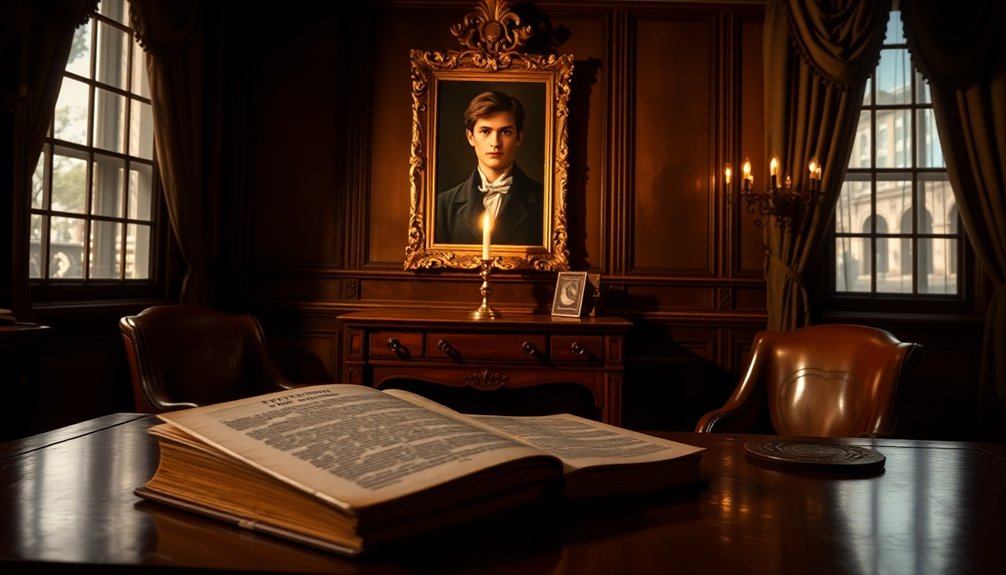
In “The Picture of Dorian Gray,” you watch as Dorian’s wish for eternal youth leads him down a path of moral decay.
The dynamics between Dorian, his mentor Lord Henry, and the tragic Sibyl Vane shape his choices and highlight the influence of hedonism.
As Dorian indulges in excess, the portrait serves as a haunting reminder of his inner corruption. The story’s exploration of class struggles resonates with themes of personal growth and societal challenges, similar to those found in classic literature like “David Copperfield.”
Dorian Gray’s Wish Fulfillment
When Dorian Gray makes his fateful wish for his portrait to age instead of him, he sets off a chain of events that leads to his moral decay.
Under the influence of Lord Henry Wotton, you see Dorian indulge in hedonism, valuing beauty and pleasure over meaningful relationships, particularly with Basil Hallward, who admires him.
Dorian’s obsession with the actress Sibyl Vane leads to tragedy when he cruelly rejects her after a poor performance, causing her to take her own life.
For eighteen years, Dorian engages in vices, hiding the portrait that reflects his corrupted soul while he remains outwardly youthful.
James Vane, Sibyl’s brother, seeks revenge for her death, ultimately confronting the consequences of Dorian’s actions.
Character Dynamics and Influence
As Dorian Gray grapples with his newfound desire for eternal youth, the dynamics between him, Lord Henry Wotton, and Basil Hallward become increasingly complex.
Dorian, influenced by Henry’s hedonistic philosophy, begins to embrace a life of indulgence, leading to his moral decay.
Basil, who adores Dorian and creates a portrait that captures his beauty, becomes a tragic figure as he witnesses Dorian’s transformation.
When Dorian cruelly rejects Sibyl Vane, his love interest, her subsequent suicide serves as a turning point, deepening his corruption.
The vengeful pursuit of James Vane, Sibyl’s brother, highlights the consequences of Dorian’s actions, showing how his relationships unravel under the weight of his choices, ultimately reflecting Wilde’s exploration of moral complexities.
Themes of Moral Decay
Although Dorian Gray starts as a symbol of beauty and innocence, his desire for eternal youth quickly spirals into moral decay. Influenced by Lord Henry Wotton’s hedonistic philosophy, Dorian’s life becomes a series of indulgent choices that lead to his downfall.
Key moments in his journey include:
- His obsession with the portrait, which reflects his inner corruption.
- The tragic fate of Sibyl Vane, whose suicide marks Dorian’s descent into vice and guilt.
- The contrasting moral compass of Basil Hallward, who represents the consequences of ignoring moral responsibility.
As Dorian indulges in excess, his portrait bears the weight of his actions, showcasing the devastating effects of a life devoid of ethics.
Major Themes Explored in the Novel
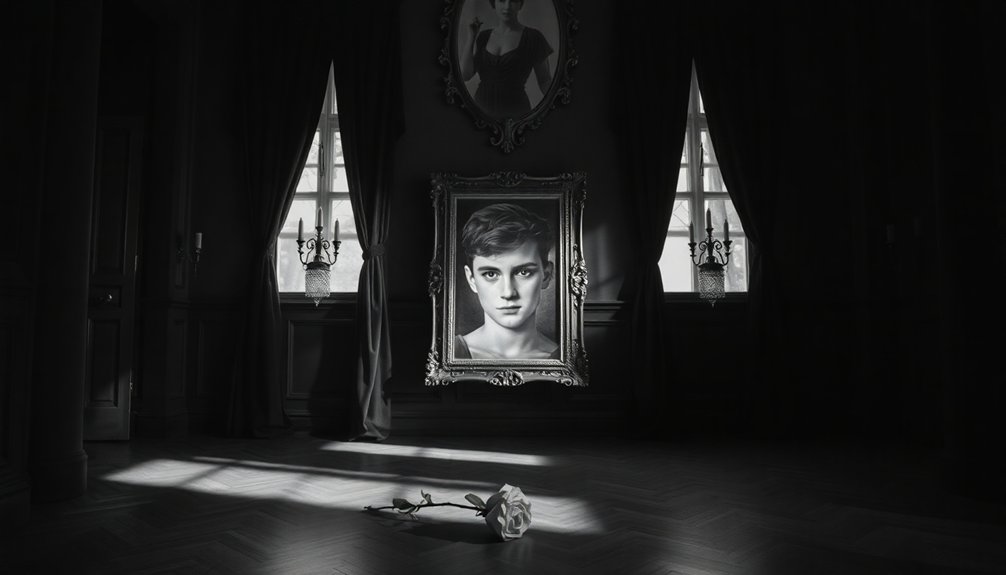
In “The Picture of Dorian Gray,” you’ll find that morality and consequences play an essential role in Dorian’s downfall.
The novel challenges you to reflect on how aestheticism shapes identity and the ethical dilemmas that arise from prioritizing beauty over integrity.
As you explore these themes, you’ll see how they intertwine to reveal the darker sides of human nature and societal expectations. Additionally, the themes of totalitarian regimes and control resonate with Dorian’s struggle against societal norms and the consequences of his choices.
Morality and Consequences
While pursuing pleasure and beauty, Dorian Gray’s story reveals the profound consequences of neglecting morality. His life of hedonism leads to a disturbing moral decay, showcasing the dangers of self-indulgence.
Here are three key aspects of this theme:
- Inner vs. Outer Self: Dorian’s portrait symbolizes his inner corruption, contrasting sharply with his youthful appearance, highlighting the disconnect between ethics and aesthetics.
- Corrupting Influences: Lord Henry Wotton embodies hedonistic philosophies, encouraging Dorian to dismiss the ethical considerations of his actions.
- Societal Superficiality: Dorian’s immersion in elite circles fosters moral hypocrisy, emphasizing how societal values can lead you away from genuine connections and accountability.
Through these elements, Wilde critiques the consequences of prioritizing beauty over morality.
Aestheticism and Identity
Aestheticism plays an essential role in shaping Dorian Gray’s identity, driving him to seek beauty and pleasure above all else. Influenced by Lord Henry, you witness Dorian embrace a hedonistic lifestyle that prioritizes sensory experiences, often overlooking moral implications.
This obsession with beauty leads to his moral decay, as you see the conflict between aesthetic ideals and societal expectations unfold. Dorian’s external appearance remains youthful, contrasting starkly with his corrupted inner self, represented by the aging portrait.
Wilde challenges traditional notions of identity, illustrating the complexities of self-perception. As Dorian grapples with his dual identity—the charming facade versus hidden depravity—you realize the profound consequences of living a life detached from moral accountability.
Influences and Allusions in Wilde’s Work
- Faust Legend: Dorian Gray’s pact with temptation mirrors the Faustian quest for eternal youth and beauty.
- Shakespearean Echoes: Dorian’s quotes from *Hamlet* and comparisons of Sibyl Vane to tragic heroines deepen the narrative’s cultural resonance.
- Decadent Influences: Wilde’s acknowledgment of Joris-Karl Huysmans reveals an interconnectedness in exploring aestheticism and moral ambiguity.
- Societal Critique: Through these allusions, Wilde critiques societal norms, revealing the tensions surrounding beauty and the darker aspects of human desire within a framework of Gothic horror, while also reflecting the dangers of materialism and validation.
Legacy and Cultural Impact of The Picture of Dorian Gray
Although it faced significant controversy upon its release, *The Picture of Dorian Gray* has undeniably left a profound mark on literature and culture. Oscar Wilde’s exploration of aestheticism and moral ambiguity challenged the rigid norms of Victorian society, igniting debates that continue today.
The novel’s themes resonate through various adaptations, including films and stage plays, ensuring Dorian Gray remains a cultural touchstone. Its initial backlash, with retailers refusing to stock it due to its perceived indecency, only heightened its notoriety.
Wilde’s preface articulates key ideas about art and morality, further solidifying the book’s cultural legacy. The impact of *The Picture of Dorian Gray* continues to inspire discussions about beauty, ethics, and the human experience, making it a timeless classic. Moreover, Wilde’s work invites reflection on systemic racism and historical legacies, prompting critical examination of societal structures that resonate with contemporary issues.
Conclusion
In the tapestry of literature, *The Picture of Dorian Gray* shines like a brilliant but dangerous jewel, reflecting the depths of human vanity and the shadows of morality. Wilde’s masterful brushstrokes create a vivid portrait of a soul consumed by desire, leaving an indelible mark on our cultural landscape. As you turn the pages, the echoes of his themes resonate, inviting you to ponder the price of beauty and the burden of a life lived in pursuit of pleasure.