

Charles Dickens wrote *David Copperfield*, while Jane Austen authored *Emma*. Both authors made significant contributions to English literature, exploring essential themes like personal growth and social dynamics in their works. Dickens focuses on the struggles of the poor and the journey of self-identity, while Austen highlights women’s roles and social class. Each novel offers rich character development that resonates even today. Stick around, and you’ll uncover more about their enduring influence and themes.
Overview of Charles Dickens and His Works
Charles Dickens, born on February 7, 1812, in England, is one of the greatest writers of the Victorian era, renowned for his vivid characters and sharp social commentary.
His novel *David Copperfield*, published serially from 1849 to 1850, showcases autobiographical elements that reflect his own struggles with poverty. In *David Copperfield*, you’ll find a compelling exploration of social issues, highlighting the plight of the poor and advocating for social reform. Dickens’ works often include themes of personal growth, emphasizing resilience and self-discovery in the face of adversity.
While Dickens tackles complex social matters, Jane Austen’s *Emma* focuses on romantic entanglements and the nuances of domestic life within English society.
Both authors offer unique perspectives on their time, but Dickens’ emphasis on social reform sets him apart as a critical voice during the Victorian era.
Overview of Jane Austen and Her Contributions
Although Jane Austen wrote during a time when women’s voices were often marginalized, her keen insights into early 19th-century British society have made her one of the most celebrated novelists in English literature.
As an English novelist, she expertly navigated themes of women’s roles and social class dynamics in her most famous works, including *Pride and Prejudice* and *Emma*. Her contributions to romantic fiction stand out for their use of irony and social commentary, revealing the complexities of marriage and economic security.
Although published anonymously, her novels have gained immense popularity and critical acclaim, influencing literature and adaptations for generations. Austen’s exploration of social class dynamics mirrors the rigid structures seen in the works of her contemporaries like Dickens.
Jane Austen’s enduring legacy solidifies her status as a pivotal figure in the literary canon.
The Significance of “David Copperfield”
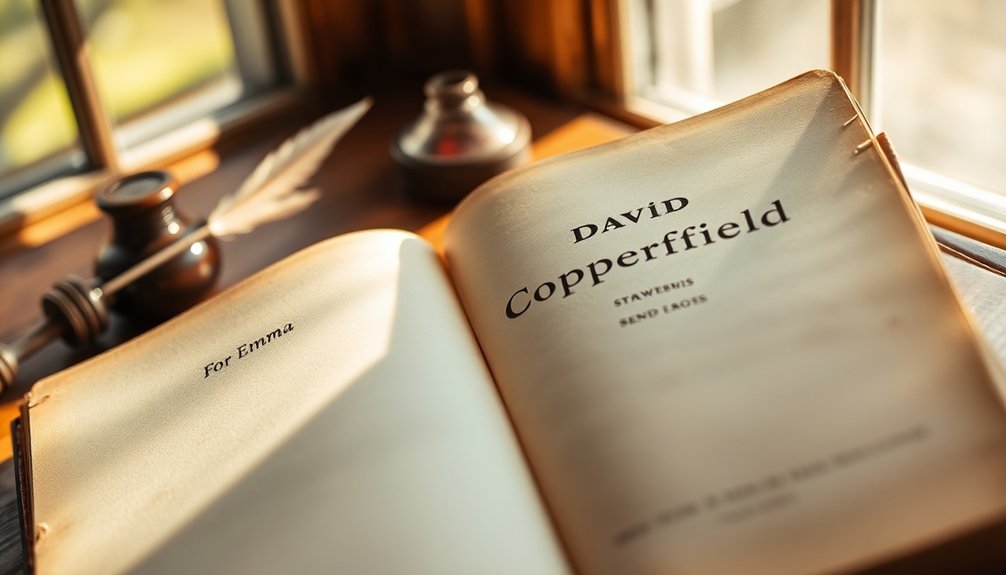
“David Copperfield” stands out as a cornerstone of Victorian literature, illustrating not just the growth of its titular character but also the complexities of the society in which he navigates.
Written by Charles Dickens, this bildungsroman captures David’s journey towards personal redemption, grappling with social class and self-identity. The rich emotional depth of the narrative is evident through characters like Aunt Betsey Trotwood, who embodies support and resilience, and Uriah Heep, representing ambition and deceit.
Dickens cherished this novel, considering it a reflection of his own life experiences, making it pivotal in his literary career. Its exploration of human struggles continues to resonate, influencing countless writers and adaptations, affirming its enduring significance in literature today. The novel’s resilience and growth themes echo the trials of individuals facing adversity, making it a timeless narrative.
The Impact of “Emma” on Literature
While many novels shape literary traditions, Jane Austen’s *Emma* stands out for its innovative narrative techniques and rich character exploration.
Its use of free indirect discourse immerses you in the thoughts of the female protagonist, Emma Woodhouse, who navigates complex social class dynamics and relationships.
This novel not only lays the groundwork for the modern romance genre but also showcases a strong, flawed character whose journey of personal growth and self-awareness resonates deeply with readers.
The impact of *Emma* extends beyond its pages, inspiring countless adaptations in film and television.
Its themes and character development have solidified its place in the literary canon, influencing works like *David Copperfield* and shaping future narratives. *Emma* also explores themes of social class that are similarly present in Dickens’ *Great Expectations*.
Comparative Analysis of Themes in Both Novels

As you explore the themes of *David Copperfield* and *Emma*, you’ll find striking parallels in their exploration of personal growth and social dynamics.
David Copperfield’s transformation from innocence to maturity contrasts with Emma’s journey of self-awareness through her social relationships. Both novels critique social class; Dickens highlights the struggles of the lower classes in Victorian England, while Austen scrutinizes the social maneuvering within the gentry.
David Copperfield and Emma both illuminate personal growth, social class critiques, and the intricate dynamics of relationships in their narratives.
Family dynamics shape their narratives, with David’s abusive stepfather affecting his growth, and Emma’s relationships revealing loyalty and love.
Romantic relationships drive both plots, as David faces love and loss, while Emma learns about genuine connections, ultimately realizing her feelings for Mr. Knightley.
Friendship and loyalty remain central themes throughout their journeys. Additionally, both novels emphasize the importance of self-discovery as a pivotal aspect of character development.
Conclusion
In the literary garden, Charles Dickens and Jane Austen bloom as towering trees, each offering unique fruits to savor. “David Copperfield” invites you to wander through the complexities of growth and identity, while “Emma” entices you with the sweet tang of social maneuvering and romance. Together, these masterpieces not only enrich your understanding of human nature but also remind you that, like their characters, you too are on a journey of self-discovery.