

Humphrey Bogart, born on December 25, 1899, in Manhattan, stands at 5’8″. He transformed cinema with his portrayals of troubled characters, becoming a symbol of film noir. Despite personal challenges, including four tumultuous marriages and substance abuse, his legacy shines brightly. You can’t overlook his defining roles in classics like *The Maltese Falcon* and *Casablanca*. There’s a mystery behind why he remains an enduring icon, and you’ll want to uncover more about his fascinating life.
The Early Years: From Manhattan to the Navy
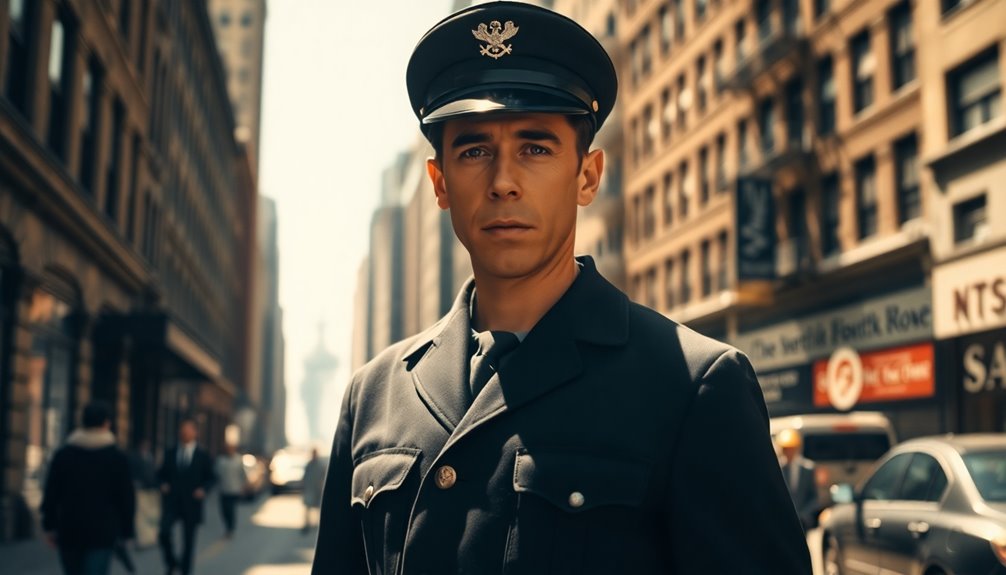
Humphrey Bogart’s journey began in the bustling streets of Manhattan, where he was born on December 25, 1899. Growing up in New York City, he attended prestigious schools like Trinity School and Phillips Academy but struggled academically, failing four out of six classes.
At 18, he enlisted in the U.S. Navy during World War I, serving as a model sailor and earning the rank of Petty Officer 2nd Class before leaving the service in June 1919.
After returning, he faced financial challenges at home and took on various jobs, from shipping clerk to bond salesman. Eventually, he decided to pursue acting lessons, setting the stage for a career that would lead him to become a Hollywood legend. His early experiences reflect themes of survival and resilience that are often found in compelling narratives of individuals who overcame adversity.
Navigating the Stage: Bogart’s Theatre Beginnings

Stepping onto the stage in 1921, Bogart began a transformative journey through the world of theatre. He appeared in 18 Broadway productions by 1935, often in juvenile and romantic supporting roles.
His breakthrough came with the role of Duke Mantee in the 1935 production of *The Petrified Forest*, earning him critical acclaim and shifting his career trajectory. Despite early struggles with harsh reviews and typecasting, Bogart honed his craft under the guidance of his stage manager, learning through experience rather than formal training.
However, after the 1929 stock market crash diminished Broadway opportunities, he sought roles in Hollywood. This pivotal performance led to a contract with Warner Bros., establishing him as a prominent figure in American cinema. His journey parallels the acts of courage demonstrated by resistance movements, showcasing how perseverance can lead to remarkable success despite overwhelming odds.
Making Waves: Transitioning From Broadway to Hollywood

Shifting from Broadway to Hollywood, Bogart embraced the challenge of redefining himself in a new medium. His film debut in 1928 was a minor role in *The Dancing Town*, but he didn’t let that discourage him.
After the Broadway decline post-1929 crash, he signed with Fox Films for $750 a week, enthusiastic to pursue a career in the film industry. His breakthrough came in 1936 with his acclaimed performance as Duke Mantee in *The Petrified Forest*, which landed him a contract with Warner Bros.
Although he faced early typecasting in “B” films, his roles in *High Sierra* and *The Maltese Falcon* in 1941 solidified his status as a leading man.
Bogart’s change showcased his persistence and undeniable talent.
The Rise of a Star: Breakthrough Roles and Film Persona
– His complex characters often mirrored the fragility of moral order found in Golding’s *Lord of the Flies*, emphasizing the internal struggles of humanity.
Love and Turmoil: Bogart’s Personal Life and Marriages
Despite his on-screen charisma and iconic roles, Humphrey Bogart’s personal life was fraught with turmoil and complexity. He married four times, with his first marriage to Helen Menken ending swiftly due to neglect and abuse.
His second union with Mary Philips lasted almost a decade but was marred by dissatisfaction and heavy drinking, leading to divorce. The third marriage to Mayo Methot earned them the nickname “Battling Bogarts” due to public disputes and violence.
However, his love for actress Lauren Bacall blossomed during the filming of *To Have and Have Not*, culminating in marriage in 1945. Despite this happiness, Bogart struggled with substance abuse and health issues, casting a shadow over his personal life until his death in 1957. His experiences mirror the complexities of race and inequality in the early 20th century, reflecting broader societal issues that contribute to personal turmoil.
Iconic Performances: Celebrating Bogart’s Classic Films
These films solidified Bogart’s status in classic American cinema, making him a timeless figure in cinematic history. His performances often reflected the complexities of human identity, much like Baldwin’s exploration of love and sacrifice in *Giovanni’s Room*.
Behind the Scenes: Collaborations and Directorial Partnerships
As Humphrey Bogart navigated the golden age of Hollywood, his collaborations with renowned directors greatly shaped his career and the films themselves.
Working closely with John Huston, Bogart starred in classics like *The Maltese Falcon* and *The African Queen*, solidifying his status as a leading man.
His partnership with Michael Curtiz led to *Casablanca*, where his portrayal of Rick Blaine showcased his talent for embodying complex characters.
The synergy with co-star Lauren Bacall, beginning with *To Have and Have Not*, captivated audiences and enhanced their legacy.
Additionally, his work with William Wyler in *The Desperate Hours* illustrated Bogart’s versatility across genres, contributing to the evolution of film noir and leaving an indelible mark on cinema.
Moreover, the destructive nature of rivalry prominently featured in many of his films resonated with audiences, making his portrayals all the more impactful.
The Impact of Bogart: His Legacy in Cinema and Culture
- He defined the film noir genre, creating a template for troubled characters.
- The American Film Institute recognized him as the greatest male star in cinematic history.
- Bogart’s disdain for Hollywood pretension resonates with audiences, enhancing his legacy.
- His candid criticism of inferior films set him apart as a true cultural icon.
- Documentaries like Bogart: Life Comes in Flashes reveal the depth of his contributions to cinema and culture.
- His influence can be seen in modern films that echo the intricate plots characteristic of classic noir mysteries.
His impact continues to inspire filmmakers and actors alike.
Exploring the Mystery: What Makes Bogart an Enduring Icon?
His tough persona, marked by a trademark scar and unique vocal delivery, made him unforgettable. You can’t help but admire his disdain for Hollywood pretension, which painted him as an authentic and relatable star.
Documentaries like *Bogart: Life Comes in Flashes* reveal lesser-known aspects, further cementing his status as a cultural icon. His legacy continues to thrive, drawing in classic film enthusiasts who appreciate his impact on cinema and the enduring magic of his performances. Additionally, his work exemplifies the resilience of spirit that resonates with audiences, much like the themes found in narratives exploring love and loss.
Conclusion
In exploring Humphrey Bogart’s life, you’ve uncovered a complex figure whose height, both literally and metaphorically, set him apart in Hollywood. His legacy, from iconic roles to unforgettable quotes, continues to influence filmmakers today. Consider how a modern actor, like Leonardo DiCaprio, channels Bogart’s intensity in roles like “The Revenant.” Just as Bogart shaped the film noir genre, today’s stars carry that torch, proving that his impact will never fade.