Mikhail Bulgakov’s “The Master and Margarita” takes you on a satirical journey through Soviet society. You’ll encounter Woland, who exposes the absurdities of life while threading a poignant love story between the Master and Margarita. This fascinating blend of good versus evil, moral struggle, and artistic freedom invites you to reflect on deeper truths. As you explore its vivid narrative, you’ll uncover the rich themes and cultural impact that continue to resonate today.
History and Publication
Mikhail Bulgakov’s journey with “The Master and Margarita” began in the oppressive atmosphere of the Soviet Union, where he wrote the novel from 1928 to 1940.
Despite his efforts, the literary elite largely ignored him during his life, and he faced relentless censorship. In 1930, Bulgakov burned an earlier manuscript due to political repression, leading to multiple drafts without any intentions for publication.
The first censored version appeared posthumously in 1966-1967, with about 12% of the text altered. It wasn’t until 1973 that the complete Russian version emerged, circulated through samizdat.
The final canonical edition, prepared by Lidiya Yanovskaya, reflected Bulgakov’s struggles against censorship and his unwavering dedication to his craft. This battle against literary censorship mirrors the broader struggles faced by other artists and authors in authoritarian regimes throughout history.
Key Characters and Plot Highlights
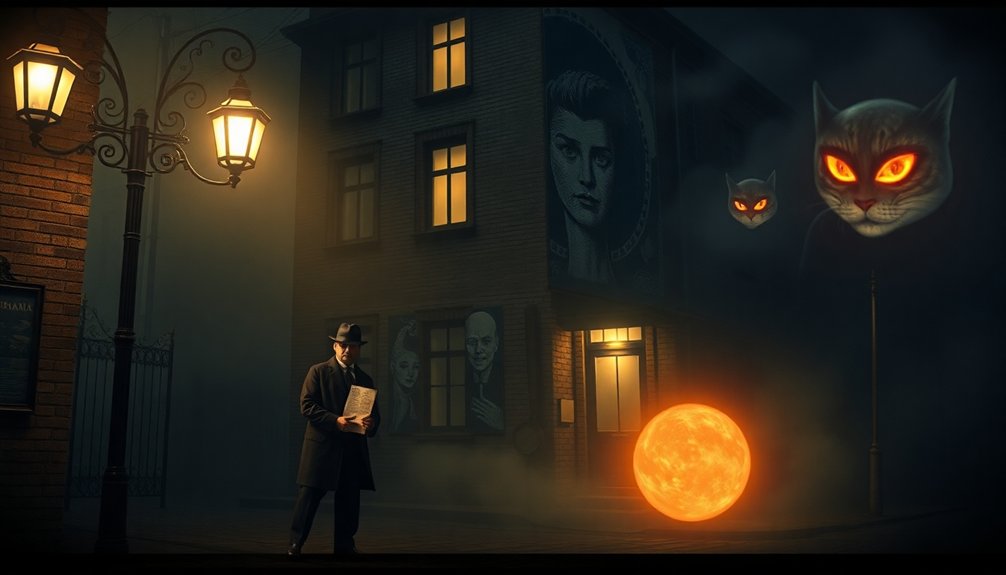
In “The Master and Margarita,” Woland’s chaotic presence disrupts Moscow, exposing the absurdities of life under Soviet rule.
Meanwhile, the passionate love story between the Master and Margarita showcases the transformative power of devotion and sacrifice.
As you explore these key characters, you’ll see how their journeys intertwine with profound themes of good, evil, and artistic freedom. Additionally, the novel’s exploration of collective action resonates with the spirit of resistance against oppressive regimes, mirroring historical struggles for justice.
Woland’s Chaotic Influence
As Woland descends upon Moscow, his chaotic influence begins to unravel the threads of the city’s moral fabric, exposing the absurdities lurking beneath its surface.
Arriving with his entourage, he showcases the rampant corruption of the literary elite through bizarre occurrences, like turning rubles into insects, highlighting the absurdities of Soviet life.
His fantastical midnight ball transforms Margarita into a witch, making her a pivotal player in his intricate plot.
The intertwining of Woland’s antics with the historical trial of Pontius Pilate emphasizes themes of fate versus free will.
Major events, including Mikhail Berlioz’s foretold death and Ivan Bezdomny’s psychological turmoil, illustrate the depth of chaos Woland releases, painting a sharp satire of society’s flaws.
Master and Margarita’s Love
While the chaos of Woland’s influence swirls around them, the love story at the heart of “The Master and Margarita” stands as a beacon of hope and resilience.
The Master, a tortured writer, faces censorship while crafting his novel about Pontius Pilate. Margarita, his devoted lover, demonstrates extraordinary love and sacrifice by making a pact with the devil to save him.
Her journey showcases the power of unwavering loyalty and determination, intertwining their story with themes of fate and moral choices. As their love transcends the chaos, it culminates in a peaceful reunion in the afterlife, symbolizing redemption amidst suffering.
Bulgakov masterfully highlights how love can endure and ultimately triumph over darkness.
Themes and Messages

Exploring the complex themes and messages of “The Master and Margarita” reveals a rich tapestry of ideas that resonate with the human experience.
A profound exploration of good and evil, love, and the quest for authenticity in a corrupted society.
You’ll find a profound examination of good and evil, where characters like Woland and the Master illustrate the blurred lines between the two.
Bulgakov’s satire critiques the moral corruption of Soviet society, exposing themes of betrayal and fear.
Love and forgiveness shine through Margarita’s devotion, offering hope amid despair.
The narrative intertwines absurd humor with philosophical insights, prompting you to reflect on truth, freedom, and artistic expression.
Ultimately, the book asserts that even in an oppressive society, inner peace and moral integrity can triumph over adversity, encouraging a quest for authenticity and resilience. Additionally, the exploration of hope versus despair parallels the resilience found in Mistry’s characters, highlighting the universal struggle for balance amidst chaos.
Interpretations and Societal Criticism
Bulgakov’s “The Master and Margarita” serves as a piercing critique of Soviet society, revealing the stark absurdities and moral dilemmas faced by its characters.
Through Woland, you witness the exposure of moral corruption among the literary elite and bureaucrats, reflecting Bulgakov’s life under a totalitarian regime.
Characters like Mikhail Alexandrovich Berlioz and Ivan Bezdomny embody the consequences of societal chaos fueled by Soviet propaganda and censorship.
The dark comedy and supernatural elements highlight the absurdity of their existence, while the contrasting sins of men and women reveal deep-seated gender biases.
Ultimately, Bulgakov intertwines the tale of Pontius Pilate, illustrating the eternal struggle between good and evil, and prompting you to contemplate your own moral choices in oppressive circumstances. This exploration of moral dilemmas resonates with the themes of personal growth found in literary works like Dickens’ “David Copperfield.”
Cultural Influence and Adaptations
You can’t ignore the cultural impact of “The Master and Margarita,” as it’s sparked numerous adaptations in film, theater, and even music.
Its themes resonate across various mediums, showcasing how Bulgakov’s work continues to inspire artists worldwide.
You’ll find references to its characters and ideas weaving through popular culture, solidifying its place in the literary canon. The novel’s exploration of obsession, jealousy, and power struggles provides a rich foundation for its enduring influence.
Literary Adaptations and Interpretations
While “The Master and Margarita” captivates readers with its intricate narrative and biting satire, its influence stretches far beyond the pages of the novel. Numerous adaptations have emerged across theater, film, and opera, showcasing the story’s satirical elements and the themes of artistic freedom and censorship. Notable productions include the Moscow Arts Theatre and the 1989 film by Vladimir Bortko.
International translations, like the Royal Shakespeare Company’s 2011 stage adaptation, further highlight its cultural impact. Graphic novels and illustrated versions also offer fresh, visual interpretations, broadening the audience.
Critics continue to explore the novel’s representation of good and evil within Soviet society, inspiring reinterpretations that resonate in various cultural contexts today.
Influence on Popular Culture
The lasting impact of “The Master and Margarita” extends into popular culture, where its themes and characters continue to resonate across various forms of media. This cultural touchstone showcases Bulgakov’s life and the complexities of good versus evil, influencing countless adaptations.
Here are some highlights of its influence:
- The 1972 film adaptation by Vladimir Bortko, celebrated for its fidelity to the novel’s narrative.
- Musical interpretations, like the rock opera “The Master and Margarita,” introducing audiences to its themes through contemporary music.
- References in literature and visual arts that spark discussions about morality and human nature.
- The exploration of supernatural elements, inspiring artistic interpretations that emphasize the absurdity of existence.
These adaptations guarantee the novel’s relevance in today’s world, keeping its legacy alive.
Stage and Film Productions
Adaptations of “The Master and Margarita” for stage and film have brought Bulgakov’s complex narrative to life in dynamic ways, showcasing the story’s rich themes and characters.
Notable stage productions, like the 2012 Moscow Art Theatre adaptation, emphasize love and sacrifice while embracing the surreal elements of Bulgakov’s narrative.
The acclaimed 1972 Soviet film by Vladimir Bortko remains a classic, capturing the satirical essence of the novel.
Innovative adaptations, such as the 2016 musical by Dmitry Shostakovich, blend theater, opera, and ballet.
In 2020, the contemporary “Margarita” at London’s Royal Court Theatre reimagined key themes, addressing censorship and artistic freedom, ensuring Bulgakov’s work continues to resonate across cultures and generations.
Legacy and Literary Significance
Although many novels have attempted to capture the complexities of human existence, “The Master and Margarita” stands out for its audacious blend of satire and magical realism. This remarkable novel by Bulgakov critiques the moral bankruptcy of Soviet society and explores the nuances of artistic freedom and morality.
Its intricate narrative interweaves multiple storylines, highlighting the duality of good and evil.
- Celebrated as one of the greatest 20th-century novels
- Symbolizes dissidence against the Stalinist regime
- Inspires ongoing discussions on identity and the human experience
- Reflects the struggles of intellectuals under censorship
The literary significance and enduring legacy of “The Master and Margarita” continue to resonate, making it an essential part of modern literature. Moreover, like Coates’ exploration of systemic racism, Bulgakov’s work prompts readers to confront uncomfortable truths about society and the human condition.
Conclusion
In exploring “The Master and Margarita,” you’ve journeyed through a world where satire and surrealism collide. As the saying goes, “truth is stranger than fiction,” and Bulgakov’s masterpiece proves just that. The characters and themes challenge you to reflect on society’s complexities and the nature of good and evil. Ultimately, this novel isn’t just a story; it’s a mirror held up to humanity, reminding you of the power of literature to provoke thought and inspire change.