
Don Quixote embodies the impossible hero, relentlessly pursuing lofty dreams despite life’s harsh realities. His journey challenges societal norms and showcases the courage to reinvent oneself, even at an advanced age. Through imagination and collaboration with Sancho Panza, he navigates the tension between idealism and pragmatism. Quixote’s adventures resonate with modern seekers of purpose, inspiring individuals to embrace their own quests. Discover how his enduring legacy continues to influence creativity and personal growth today.
The Heroic Quest: Understanding Don Quixote’s Journey
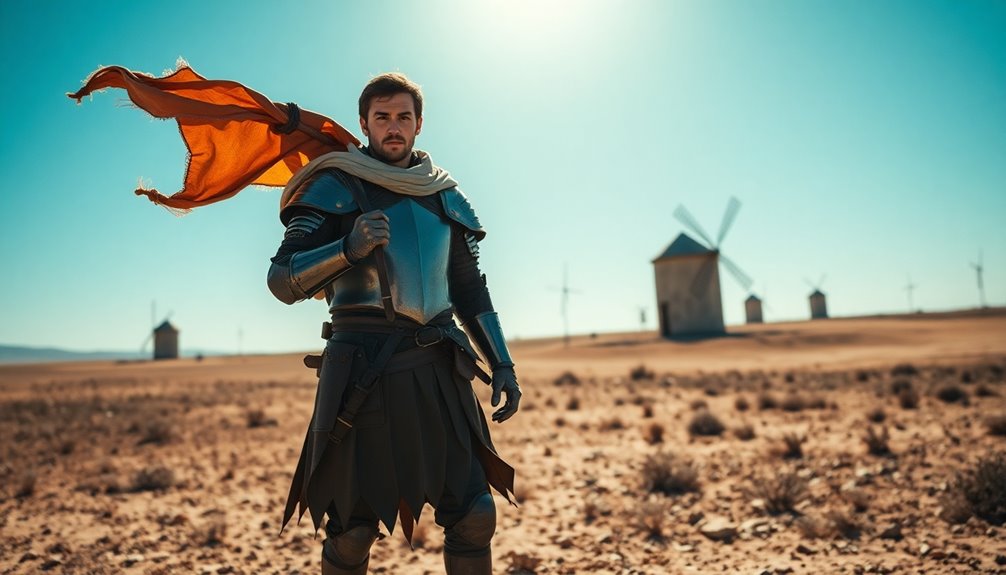
The essence of adventure fuels Don Quixote’s journey as he sets out to revive the ideals of chivalry. His heroic quest immerses you in a world where imagination reigns supreme, even if it leads to misadventures like battling windmills mistaken for giants.
This struggle symbolizes the clash between his idealism and harsh reality. Alongside him, Sancho Panza brings a pragmatic perspective, highlighting the contrast between lofty dreams and everyday life.
As you follow their dynamic relationship, you witness Don Quixote’s unwavering commitment to his noble goals, despite facing inevitable setbacks. Ultimately, his story resonates with your own aspirations, reminding you that the pursuit of dreams, however unattainable, defines the human experience. In many ways, he embodies the same themes of resilience that mark the journey of characters like the Joad family in Steinbeck’s ‘The Grapes of Wrath.’
What Makes Don Quixote a Modern Character?

When you think about Don Quixote, you see a character who challenges age expectations and bravely reinvents himself.
His adventures blur the lines between reality and imagination, showcasing the importance of creative risk.
This blend of idealism and practicality makes him resonate with modern artists facing similar struggles in their own journeys. His unwavering courage mirrors the acts of courage displayed by resistance movements, emphasizing the enduring power of defiance in the pursuit of justice.
Defying Age Expectations
While many might expect that reaching fifty means settling into a predictable routine, Don Quixote defies this notion by fearlessly pursuing his dreams of chivalry and adventure. His courage to redefine oneself in a society that imposes age-related expectations showcases that reinvention is possible at any stage of life.
Instead of conforming to societal norms, he initiates Don Quixote’s adventures, embracing his lifelong ambition to be a knight errant. This choice challenges the conventions of 17th-century Spain and resonates with modern creatives who seek transformation and self-discovery.
Cervantes highlights the tension between madness and vision, illustrating that the pursuit of lofty ideals can lead to profound insights, making Don Quixote a timeless symbol of ambition and resilience.
Blurring Reality and Imagination
Although reality often clashes with imagination, Don Quixote navigates this tension with a fervor that makes him a remarkably modern character. His madness reveals a unique lens through which he perceives a world brimming with chivalric ideals, despite the absurdity surrounding him.
This interplay between his passionate vision and Sancho Panza’s pragmatic outlook showcases the complexities of human perception, reflecting modern existential dilemmas. Cervantes masterfully employs unreliable narration, challenging you to question the nature of reality both in the novel and in your own life.
As Don Quixote relentlessly pursues his dreams, he embodies a timeless theme: the courage to chase the impossible, demonstrating that imagination can be a powerful force for personal and artistic reinvention.
Embracing Creative Risk
Don Quixote’s journey challenges you to embrace creative risk, proving that age and societal expectations shouldn’t limit your ambitions.
At fifty, Quixote embodies the courage to redefine himself, showing that creativity can flourish at any stage of life. His “tilting at windmills” symbolizes radical optimism and the necessity of daring to pursue seemingly delusional ideas in your creative endeavors.
Cervantes critiques the overconsumption of romantic tales, reminding you that the creator’s mindset determines whether tools like AI enhance or hinder your artistry.
Through Quixote and Sancho Panza’s dynamic relationship, you learn the importance of diverse expertise and adaptability.
Ultimately, Quixote’s adventures serve as a timeless roadmap, encouraging you to boldly explore your personal vision in an ever-evolving cultural landscape.
The Role of Imagination in Don Quixote’s Adventures

Imagination fuels the thrilling adventures of Don Quixote, transforming mundane reality into a domain of heroic quests and noble ideals. His vivid imagination leads him to see ordinary objects, like windmills, as grand foes, showcasing the power of creative adventure.
While his delusions reflect a fine line between vision and madness, they also highlight how imagination inspires individuals to chase seemingly unattainable dreams. By embracing his knightly identity, Don Quixote transcends his ordinary life, illustrating that imagination can be a tool for self-reinvention and personal agency.
Cervantes critiques the risks of unchecked fantasy, reminding us that while imagination drives creativity, a balance with reality is essential to avoid the pitfalls of delusion. This theme of complex protagonists is also evident in works like “The Girl with the Dragon Tattoo,” where characters navigate their intricate realities in pursuit of truth.
How Does Don Quixote Challenge Social Norms?
Don Quixote challenges age expectations by embracing a new identity at fifty, showing that it’s never too late to pursue your dreams.
His quest for knighthood pushes against the rigid social structures of his time, urging you to question what it means to be truly individual.
Through his adventures, Cervantes invites you to reflect on how societal norms can limit personal growth and creativity. As readers engage with untold stories, they are reminded of the importance of challenging traditional perspectives to foster individual expression.
Defying Age Expectations
Though society often dictates that adventure and growth are the domains of youth, Don Quixote boldly steps beyond these confines at the age of fifty, commencing on a quest to reclaim the ideals of knighthood.
Cervantes crafts a character that defies age expectations, illustrating that courage and self-definition aren’t limited to the young.
Don Quixote’s journey resonates with modern creatives grappling with the stigma of aging, urging you to challenge societal norms. His idealism and refusal to conform critique the limitations imposed by age, emphasizing the importance of dreams at any life stage.
Embracing Individual Identity
Many individuals find themselves constrained by societal expectations, yet Cervantes’ portrayal of Don Quixote encourages you to break free from those limitations.
At fifty, Don Quixote rebels against the norms of 17th-century Spain, embodying the courage to redefine his identity. He challenges traditional masculinity by pursuing a chivalric ideal instead of conforming to societal pressures.
Cervantes critiques the overconsumption of romantic tales, urging you to forge your own identity rather than passively accept the status quo. The interplay between Don Quixote’s idealism and Sancho Panza’s pragmatism highlights the tension between individual aspirations and societal limitations.
Through Don Quixote’s adventures, Cervantes invites you to embrace your inner knight errant, promoting self-direction and the pursuit of your unique narrative in a changing world.
The Duality of Reality and Illusion in Cervantes’ Narrative
While Cervantes’ “Don Quixote” presents a whimsical tale, it intricately explores the complex interplay between reality and illusion.
You see, through the journey of Don Quixote and Sancho Panza, Cervantes’ masterpiece investigates the tension between lofty ideals and the mundane world.
Don Quixote’s chivalric fantasies often clash with the practical wisdom Sancho embodies, challenging your perception of reality and fiction.
When Don Quixote battles windmills, it symbolizes the struggle between perceived truths and objective realities, prompting you to question what’s real.
Furthermore, Cervantes employs metafictional techniques, encouraging reflection on storytelling itself and how narratives can blur the lines between truth and fabrication.
This duality invites a deeper inquiry into the human condition and the value of embracing one’s illusions. Notably, the exploration of themes of power and corruption in literature has echoes in various historical narratives, including the intricate plotting found in works like “The Daughters of Night.”
Lessons for Today’s Creatives From Don Quixote
Don Quixote teaches you the power of radical optimism in your creative journey, reminding you that even the wildest ideas can spark breakthroughs.
Balancing your vision with reality is essential, as it can lead to both failures and successes along the way.
As you redefine your personal identity boldly, let his adventures inspire you to pursue your artistic goals without needing approval from others. Embracing self-reflection can help you navigate the challenges you face in your creative endeavors.
Embrace Radical Optimism
Although it might seem impractical to chase dreams that others deem absurd, embracing radical optimism can be a powerful catalyst for creativity.
Don Quixote exemplifies this mindset, relentlessly pursuing his idealistic vision, even when facing imaginary foes. His daring quests remind you that creativity often flourishes from seemingly delusional ideas.
Cervantes emphasizes that it’s not just the tools of storytelling that matter, but your approach as a creator that shapes your narrative’s impact.
Balance Vision and Reality
As you navigate the creative landscape, balancing vision and reality becomes essential for success.
Don Quixote’s quest against windmills illustrates this struggle. It shows that your daring ideas might seem delusional at first but can lead to innovative breakthroughs. Embracing your unique vision is critical; it fuels your creativity, even if it sometimes results in failure.
Cervantes critiques the overconsumption of romantic tales, emphasizing that technology can aid your artistic process, but it’s your mindset that truly matters. Flexibility and adaptability are fundamental in a world driven by new technologies.
Redefine Personal Identity Boldly
In a world where societal norms often dictate who you should be, you can take inspiration from the bold journey of Cervantes’ protagonist.
Don Quixote, at fifty, teaches you that it’s never too late to redefine personal identity. His audacious pursuit of lofty dreams, despite their delusional nature, mirrors the artistic struggles you face today. Embrace failure as a stepping stone to breakthroughs.
Like a modern knight errant, you can stay true to your values while adapting to the ever-evolving landscape of technology and creativity.
The Importance of Idealism in a Cynical World
When you navigate a world often clouded by cynicism, Don Quixote’s idealism shines as a powerful reminder of the importance of dreaming big. His unwavering belief in chivalric values, despite societal disillusionment, challenges you to pursue your lofty aspirations.
Embracing idealism empowers you to exercise personal agency, redefining your identity in a world that often prioritizes pragmatism over dreams. Cervantes critiques the overconsumption of romantic tales, highlighting how creativity and innovation can flourish even amidst technological distractions.
Don Quixote’s adventures illustrate that retaining a sense of imagination leads to meaningful experiences. Aspiring for ideals, despite inevitable failures, can inspire you to push beyond cynicism and embrace a life filled with purpose and passion. The importance of resilience in facing challenges resonates deeply, reminding us that pursuing dreams often involves navigating obstacles along the way.
Embracing Failure: Don Quixote as a Role Model
Though society often values success and conformity, Don Quixote stands as a testament to the power of embracing failure. He relentlessly pursues his dreams, undeterred by setbacks and mockery.
His iconic “tilting at windmills” encapsulates the bravery required to challenge perceived obstacles, reminding you that lofty goals often come with imaginary foes.
Cervantes’ character illustrates that personal reinvention can be messy and filled with ridicule, yet it’s crucial for creative growth and self-discovery.
True madness might lie in conformity, while embracing your unique vision—failure and all—can lead to profound fulfillment.
Don Quixote’s unwavering conviction and resilience inspire you to dream big and take risks in your artistic endeavors, proving that failure is just a stepping stone toward greatness. Just as Francie Nolan in A Tree Grows in Brooklyn demonstrates resilience in the face of adversity, Don Quixote embodies the spirit of pursuing dreams despite challenges.
The Relevance of Chivalry in Modern Society
While many might argue that chivalry belongs to a bygone era, its ideals still resonate deeply in modern society. You can see traces of chivalric values in various aspects of life, from personal quests to social movements.
Just like Don Quixote, you can embody the spirit of the knight-errant, championing your beliefs and values. Consider these points:
- Chivalry encourages bravery and moral courage in facing today’s challenges.
- The pursuit of personal integrity inspires you to stand against injustices, much like Don Quixote did.
- Modern narratives often revive noble quests, keeping the essence of chivalry alive in popular culture.
- Embracing these ideals can lead to a more fulfilling and principled life, connecting you with a rich tradition of heroism, much like the themes of isolation explored in Baldwin’s *Giovanni’s Room*.
How Does Don Quixote Inspire Personal Reinvention?
Don Quixote’s journey serves as a powerful reminder that it’s never too late to reinvent yourself, especially in a world that often discourages change.
At fifty, he embodies the courage to redefine who you are, encouraging personal reinvention against societal norms. His radical optimism, displayed through his whimsical battles with windmills, inspires you to embrace daring ideas and pursue breakthroughs despite setbacks.
Cervantes critiques the consumption of romantic tales, urging you to navigate the conflict between ideals and reality on your quest for self-discovery.
The dynamic relationship between Don Quixote and Sancho Panza highlights the importance of collaboration and diverse perspectives in your journey.
Ultimately, Don Quixote’s story serves as a metaphor for asserting your own narrative in a rapidly changing world. Embracing inner strength can unlock personal potential and foster self-discovery, enabling you to navigate the challenges of reinvention with resilience.
The Impact of Don Quixote on Contemporary Literature
As you explore contemporary literature, you’ll find that “Don Quixote” has left an indelible mark on its evolution. This pioneering modern novel reshaped narrative techniques and character development, influencing countless authors. Its exploration of idealism versus reality resonates deeply with today’s themes, reflecting our complex human experiences.
- Cervantes’ metafiction and unreliable narration paved the way for modern literary movements, like postmodernism.
- Iconic authors such as Dostoyevsky and Kafka have acknowledged the profound impact of Don Quixote on their works.
- The term “quixotic” now symbolizes the pursuit of lofty ideals, showcasing the novel’s relevance in discussions about ambition and human nature.
Through these influences, Don Quixote continues to inspire contemporary literature.
Why Can Every Artist Find Their Inner Knight Errant?
How can every artist tap into their inner knight errant? By embracing the courage to pursue lofty ideals, you can redefine your identity and express your unique vision.
Don Quixote inspires you to balance idealism with pragmatism, allowing you to adapt your ambitions while staying true to your creativity. The interplay between Quixote and Sancho Panza reminds you that collaboration can ground your dreams in reality.
Cervantes encourages you to challenge conventional boundaries and embrace your “madness,” leading to groundbreaking artistic breakthroughs. As a modern knight errant, you must embody continuous learning and versatility, especially in a rapidly evolving landscape.
Ultimately, it’s about claiming personal agency, taking control of your narrative, and forging your artistic path, regardless of societal distractions.
The Enduring Legacy of Don Quixote in Today’s Culture
Legacy often shapes our understanding of the world, and few works have left as profound an imprint as Cervantes’ *Don Quixote*. Its enduring legacy is evident in how it challenges you to navigate the delicate balance between idealism and reality.
The character of Don Quixote has become a cultural icon, inspiring countless adaptations across various art forms.
The iconic figure of Don Quixote continues to inspire a myriad of artistic adaptations across diverse mediums.
- The term “quixotic” describes noble yet impractical pursuits in everyday life.
- Modern narratives often echo its themes, encouraging you to define your own story amid chaos.
- Scholars continue to study its rich themes, reinforcing its relevance in today’s society.
Don Quixote remains a mirror reflecting our struggles, reminding us of the power of imagination in a complex world.
Conclusion
In the tapestry of modern storytelling, Don Quixote remains a vibrant thread, weaving dreams and delusions into the fabric of our lives. His relentless pursuit of honor and justice invites you to don your own armor and initiate a quest for meaning. As you navigate the blurred lines between reality and imagination, remember: every artist has a knight within, ready to charge into the fray, challenging the mundane with the courage to dream. Embrace your inner hero!