
Henry Miller’s *Tropic of Cancer* embodies a defiant spirit that challenges societal norms and censorship. Set against the backdrop of 1930s Paris, it captures the struggle and liberation of artists through its raw narrative and explicit themes. The book faced numerous legal battles that sparked debates on freedom of expression, ultimately reshaping American literature. This controversial masterpiece not only influenced generations of writers but also transformed public attitudes toward artistic freedom. Discover more about its impact and legacy.
The Life and Times of Henry Miller
Although Henry Miller faced numerous challenges throughout his life, his journey from a lower-middle-class upbringing in New York City to a celebrated writer is nothing short of remarkable.
In 1930, you’d find Miller in Paris, grappling with financial struggles and homelessness. Yet, these hardships fueled his creativity, leading to the creation of *Tropic of Cancer*, published in 1934 with the support of Anaïs Nin.
In Paris, poverty ignited Henry Miller’s creativity, culminating in the groundbreaking *Tropic of Cancer*.
This autobiographical work broke conventions and pushed against censorship, marking a pivotal moment in American literature. Miller’s unique narrative style and exploration of personal struggle resonated through his earlier works, like *Tropic of Capricorn* and *Black Spring*.
Ultimately, his experiences in Paris shaped him into an enduring figure in literary history. His resilience in the face of adversity reflects the growth mindset that is crucial for achieving personal success.
Exploring the Themes of Tropic of Cancer
In *Tropic of Cancer*, struggle becomes a powerful catalyst for creativity, vividly illustrating Henry Miller’s life as a struggling writer in the vibrant yet harsh landscape of 1930s Paris.
This autobiographical novel captures the bohemian lifestyle, showcasing the artistic fight for self-liberation amid hunger and homelessness.
Miller’s non-linear narrative shifts between past and present, reflecting his personal turmoil and the complexities of human relationships.
The explicit sexual encounters offer a raw glimpse into male perceptions of women, blending low comedy with visceral appeal.
Music and dance symbolize liveliness and existential reflections, emphasizing emotional resurrection.
Ultimately, *Tropic of Cancer* immerses you in the human condition, blurring societal boundaries and liberating your exploration of identity and existence, even amidst the American literary obscenity trials. The themes of power and corruption resonate with those found in historical narratives like *The Daughters of Night*.
The Journey to Publication and Legal Battles

In the journey to publish *Tropic of Cancer*, you’ll see how Anaïs Nin’s financial support played an essential role amidst overwhelming censorship challenges.
The book quickly sparked a series of legal battles that highlighted the tension between artistic freedom and societal standards.
As you explore these events, you’ll understand the significant impact this novel had on discussions about literature in America. The controversies surrounding *Tropic of Cancer* echo those found in works like Richard Wright’s *Native Son*, which also faced scrutiny for its portrayal of systemic racism and social injustices.
Financial Support From Nin
Anaïs Nin’s unwavering support played a pivotal role in bringing Henry Miller’s *Tropic of Cancer* to the public eye. Her financial support allowed the manuscript to be published in Paris by Jack Kahane’s Obelisk Press, despite looming concerns over French censorship laws.
Initially completed in 1934, the publication faced delays but eventually thrived, generating significant royalties even after being banned by the U.S. Customs Service.
When Grove Press published the book in the U.S. in 1961, it ignited a wave of obscenity lawsuits, prompting a national conversation about freedom of expression.
Ultimately, a landmark Supreme Court decision in 1963 lifted the ban on Miller’s works, marking a vital victory for artistic freedom and challenging censorship.
Censorship Challenges Faced
Despite the initial excitement surrounding the publication of *Tropic of Cancer*, the book faced immediate censorship challenges that threatened its very existence.
The U.S. Customs Service banned it due to obscenity concerns, forcing an underground market to emerge. Frances Steloff sold smuggled copies at Gotham Book Mart, leading to lawsuits against her and Obelisk Press.
By the early 1960s, nearly 60 obscenity lawsuits spanned 21 states, raising questions about the book’s literary merit. Grove Press published a legal edition in 1961, igniting further controversy.
This culminated in a landmark Supreme Court decision in 1963, lifting the ban on Miller’s works and sparking essential discussions on censorship and artistic freedom in America.
Legal Battles Overview
Although *Tropic of Cancer* was published in 1934, its journey to legal acceptance was anything but straightforward. Banned in the United States due to obscenity concerns, the book circulated in smuggled copies.
In 1940, an unauthorized edition led to the jailing of Jacob Brussel, the publisher. The legal battles intensified in the early 1960s, with nearly 60 obscenity lawsuits filed across the country.
Grove Press took an essential step by publishing the book legally in 1961, triggering over 60 lawsuits in 21 states. Prominent literary figures rallied to defend Miller’s work, culminating in the Supreme Court ruling in 1964, which upheld the right to read *Tropic of Cancer*.
This ruling marked a significant victory for artistic expression and freedom against censorship.
Critical Reception and Literary Influence
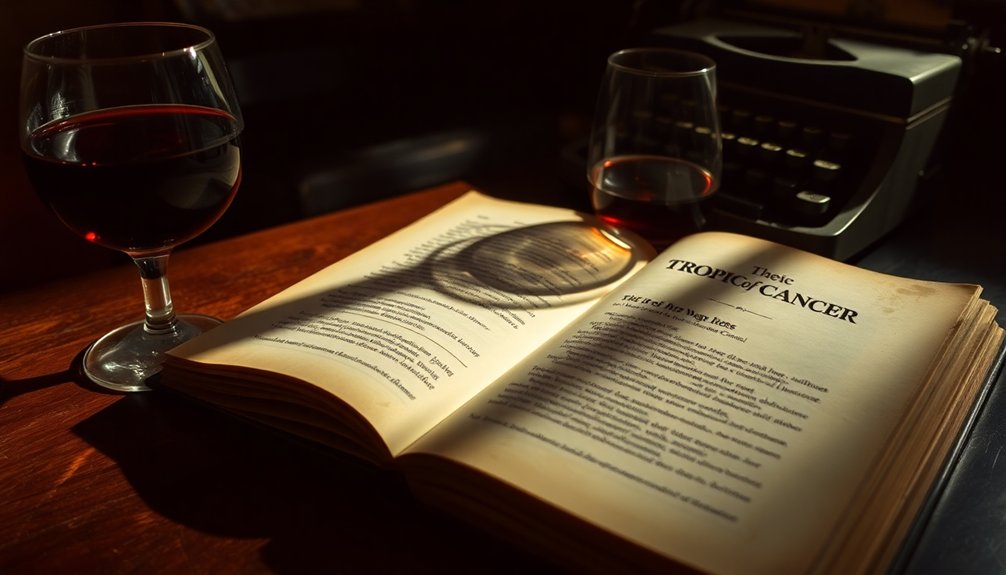
When *Tropic of Cancer* hit the literary scene, it didn’t just garner attention; it sparked fervent discussions about artistic expression and censorship. Acclaimed by figures like H. L. Mencken and George Orwell, the novel challenged perceptions of literary merit.
Samuel Beckett called its release a pivotal moment in modern literature, while Norman Mailer hailed it as one of the century’s greatest novels.
The controversies surrounding *Tropic of Cancer* greatly influenced the U.S. legal landscape, culminating in a landmark Supreme Court decision in 1963 that lifted the ban on Miller’s works.
This shift not only transformed societal attitudes toward censorship but also inspired generations of writers, including William S. Burroughs and Jack Kerouac, reshaping the narrative of artistic freedom in literature. Additionally, the discussions around Miller’s work parallel the struggles of social change advocates, who have historically challenged oppressive systems and pushed for broader artistic expression.
Adaptations and Cultural Impact
As Henry Miller’s *Tropic of Cancer* shifted from page to screen, it sparked a new wave of interest and debate around its themes and explicit content.
The 1970 film adaptation, directed by Joseph Strick and featuring Rip Torn and Ellen Burstyn, aimed to capture Miller’s unique narrative style. Despite being initially rated X, it later received an NC-17 rating, highlighting the ongoing challenges of censorship in American society.
The 1970 film adaptation of *Tropic of Cancer* navigated censorship challenges, evolving from an X to an NC-17 rating.
Though reviews were mixed, the adaptation reflected Miller’s philosophical outlook. Additionally, influential authors like William Gaddis and Kurt Vonnegut drew inspiration from *Tropic of Cancer*, showcasing its lasting cultural impact. Its themes of artistic freedom continue to resonate, inspiring music and art across various media. Moreover, the exploration of moral and ethical dilemmas in literature, as seen in various genres, mirrors the complexities found in Miller’s work.
The Legacy of Tropic of Cancer
You can see how *Tropic of Cancer* shaped American literature and inspired writers like Burroughs and Kerouac to explore deeper themes of individuality and struggle.
Its battles against censorship not only transformed legal landscapes but also sparked essential conversations about freedom of expression in art.
Ultimately, this novel left a lasting legacy, symbolizing the ongoing fight for artistic freedom in literature and culture. Additionally, the collective action of writers and artists championing for their rights reflects the enduring spirit of resistance against oppressive forces in society.
Impact on American Literature
The legacy of *Tropic of Cancer* is a reflection of the power of literary rebellion and its profound impact on American literature. By challenging censorship and obscenity laws, Miller opened the door for artistic freedom, inspiring the Beat Generation and writers like William S. Burroughs and Jack Kerouac.
His raw, autobiographical style and exploration of sexuality and individuality resonated deeply, shaping mid-20th-century narratives. The novel’s themes of civilization’s decay and personal liberation encouraged a new wave of authenticity in storytelling, prioritizing emotional truth over conventional structures.
Miller’s battles against societal norms sparked significant discussions about literary expression, leading to landmark Supreme Court decisions that expanded creative boundaries, ultimately allowing future writers to embrace provocative themes without fear.
Influence on Subsequent Writers
While many writers have sought to break free from societal constraints, few have done so as boldly as Henry Miller in *Tropic of Cancer*. His unapologetic exploration of sexuality and human experience profoundly influenced subsequent American writers.
The Beat Generation, including Jack Kerouac and Allen Ginsberg, embraced Miller’s themes of personal liberation and candid expression. Norman Mailer hailed the novel as one of the century’s greats, likening its impact to Hemingway’s work.
William S. Burroughs cited Miller’s challenge to conventional narratives as pivotal in shaping his own writing. By tackling taboo subjects without fear of censorship, Miller opened doors for future authors, fostering a more liberated and honest approach to literature that continues to resonate today.
Censorship and Freedom of Expression
Miller’s groundbreaking approach in *Tropic of Cancer* didn’t just inspire writers; it ignited heated debates about censorship and freedom of expression.
Upon its release in 1934, the book faced immediate censorship, leading to significant legal battles across the U.S. These tensions peaked with nearly 60 lawsuits during the early 1960s, culminating in a landmark Supreme Court decision in 1963 that lifted the ban.
Grove Press, under Barney Rosset, played an essential role in advocating for literary freedom by publishing the book legally in 1961.
The eventual acceptance of *Tropic of Cancer* not only transformed the legal landscape for controversial literature but also shifted public attitudes, emphasizing the necessity of free access to diverse ideas in a liberal society.
Conclusion
In the end, “Tropic of Cancer” is like a wild river, carving its path through the landscape of literature, sometimes chaotic but always powerful. You can’t help but be swept along its currents, feeling the raw energy and unfiltered emotion Miller poured into every page. Just as a river shapes its banks, Miller reshaped the literary world, leaving behind a legacy that continues to inspire and provoke thought. His genius lies in embracing the tumultuous waters of life itself.