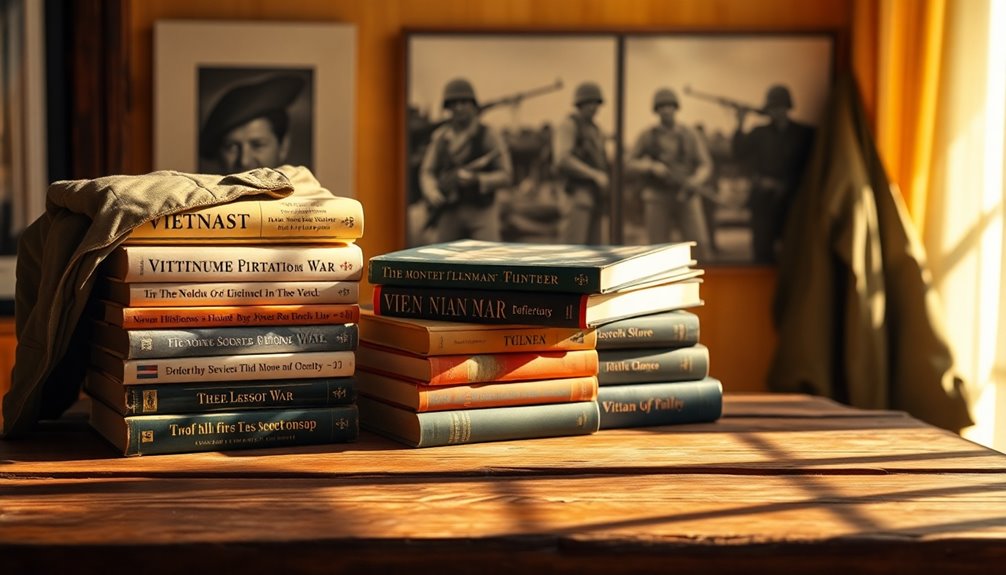
The burden of memory in Vietnam War literature weighs heavily on both veterans and readers alike. Tim O’Brien’s *The Things They Carried* captures the emotional turmoil and trauma faced by soldiers, blending fact and fiction. You’ll also find essential titles like *If I Die in a Combat Zone* and works by authors like Stuart O’Nan that explore themes of guilt and memory. Discover how these narratives continue to shape our understanding of the past and its effects today.
The Emotional Weight of War Literature

When you plunge into Vietnam War literature, you’ll quickly feel the emotional weight that these stories carry.
Immerse yourself in Vietnam War literature and feel the profound emotional weight these powerful stories convey.
Tim O’Brien’s “The Things They Carried” investigates deep into the trauma faced by soldiers, revealing how personal items symbolize their struggles and memories. Each item they carry reflects the heartbreak of war and the burden of loss.
Similarly, Stuart O’Nan’s “The Names of the Dead” explores the terror and devastation experienced by American soldiers, further emphasizing the difficult nature of these narratives.
As you read, you’ll encounter themes of collective grief and individual coping mechanisms, showcasing the diverse responses to trauma. The exploration of faith and doubt in relation to personal identity is also a prominent theme in many Vietnam War narratives, deepening the emotional resonance of these accounts.
The profound emotional engagement readers experience highlights how these works reshape understanding of the psychological toll of the Vietnam War.
Tim O’Brien’s Impact: A Deep Dive Into His Works

Although many authors have tackled the subject of war, Tim O’Brien stands out as an essential voice in Vietnam War literature. His debut book, *If I Die in a Combat Zone, Box Me Up and Ship Me Home*, launched his career in 1973, establishing a powerful narrative style.
In *The Things They Carried*, you’ll find a profound exploration of soldiers’ emotional burdens, blending personal experiences with fiction to reveal deeper truths about war and memory. O’Brien’s emphasis on emotional truth over factual accuracy resonates with readers, showcasing the complexities of guilt and connection, as seen in characters like Norman Bowker. The narrative reflects themes of systemic oppression similar to those explored in Richard Wright’s *Native Son*, highlighting the struggle against societal constraints.
His recent novel, *America Fantastica*, promises to further solidify his impact as a crucial chronicler of the Vietnam War experience.
Essential Reads: Top Vietnam War Novels
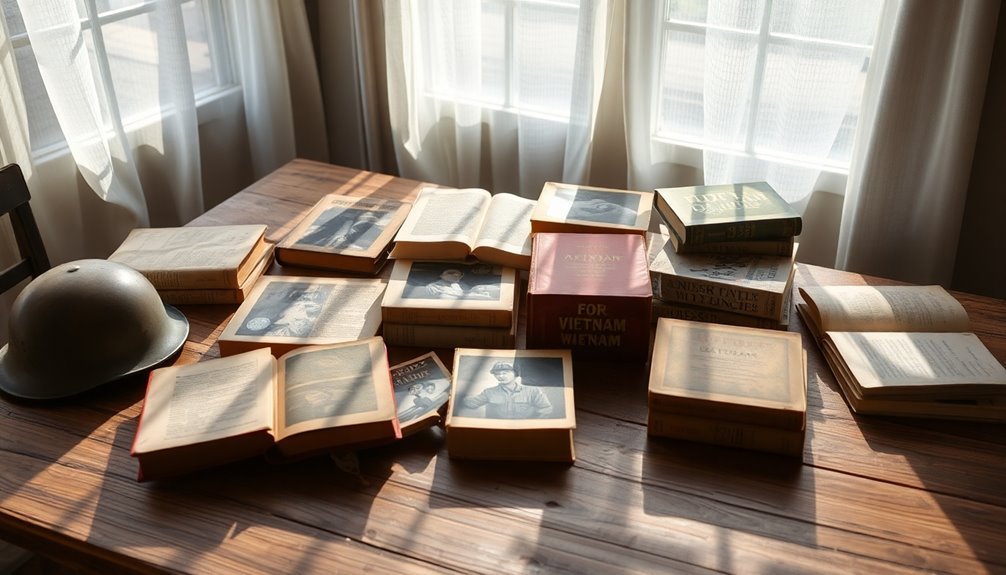
Exploring the Vietnam War through literature reveals a diverse array of voices, each offering unique insights into the complexities of conflict and its aftermath.
Two essential reads are:
- “The Things They Carried” by Tim O’Brien: This seminal work captures the emotional weight and burdens of Vietnam veterans, blending fiction with O’Brien’s own experiences.
- “The Names of the Dead” by Stuart O’Nan: This poignant novel examines the terror and heartbreak faced by soldiers, shedding light on the emotional toll of war.
These novels emphasize themes of guilt, memory, and the struggle to reconcile wartime experiences with civilian life, fostering a deeper understanding of the Vietnam War’s enduring impact on both soldiers and society. They remind us that emotional truth often transcends mere facts in war narratives, much like the psychological impacts of systemic oppression explored in Richard Wright’s *Native Son*.
Personal Narratives: Voices of Veterans
When you explore personal narratives from Vietnam veterans, you uncover the raw emotions and experiences that shaped their lives.
These stories highlight the weight of remembrance, as veterans grapple with their past while sharing the deep bonds formed during the war.
You’ll gain a unique perspective on the complexities of their identities and the lasting impact of their service. Additionally, the theme of redemption and dignity resonates throughout these narratives, as veterans seek to find meaning in their experiences and reclaim their sense of self.
Personal Experiences Highlighted
Personal narratives from Vietnam veterans offer powerful insights into their unique experiences during the war. These personal experiences highlight the complexities faced by American soldiers, portraying raw emotions and the harsh realities of combat.
Through their stories, you’ll discover:
- The camaraderie that developed among soldiers, emphasizing the bonds formed in battle.
- The psychological toll of war, showcasing the mental health struggles many veterans faced.
- The profound impact of the war on families, reflecting the challenges of home life during turbulent times.
Books like “Everything We Had,” “The Soldiers Story,” and “Dispatches” capture these personal accounts, allowing you to connect with the soldiers’ journeys and understand the burdens they carried long after the fighting stopped.
The Weight of Remembrance
As memories echo in the minds of Vietnam veterans, the weight of remembrance becomes a profound burden they carry long after the conflict ends.
You’ll find that personal narratives, like those in Tim O’Brien’s “The Things They Carried,” vividly capture the psychological toll of combat. Veterans, such as Norman Bowker, struggle with guilt and isolation, often depicted through haunting metaphors like circling a lake.
Collections like “Everything We Had” present diverse perspectives, revealing how these experiences shape their lives long after the war.
Additionally, Michael Herr’s “Dispatches” immerses you in the chaos of battle, illustrating the confusion and trauma that linger.
These voices serve as powerful reminders of the complexities of memory and the enduring impact of war.
The Role of Memory in War Literature
Memory profoundly shapes war literature, influencing how stories are told and felt. In Tim O’Brien’s works, like “The Things They Carried,” memory serves as both burden and guide, revealing the emotional weight soldiers carry.
This impact is evident in several ways:
- Non-linear storytelling reflects the fragmented nature of war memories.
- Symbolic actions, such as Norman Bowker’s circular drive, illustrate the struggle veterans face reconciling their past with civilian life.
- Emotional truth over factual accuracy emphasizes how personal memories shape narratives more profoundly than objective accounts.
Through these elements, O’Brien reveals how the burden of memory isolates veterans, leaving them grappling with guilt and unexpressed experiences, ultimately shaping their identities beyond the battlefield. Additionally, the role of storytelling as resistance in war literature underscores the power of words to convey complex emotions and experiences.
Historical Context: Understanding the Vietnam War
To fully grasp the complexities of the Vietnam War, one must consider its intricate historical context, which shaped both the conflict and its repercussions.
Beginning in 1950, with a $15 million commitment from President Truman, the war escalated dramatically by 1965 as American troops deployed to defend South Vietnam. Cold War dynamics fueled fears of communism and the domino theory, justifying U.S. involvement.
By early 1968, nearly half a million American soldiers were in Vietnam, facing brutal realities and growing anti-war sentiment at home. Events like the My Lai massacre revealed moral complexities of U.S. actions.
By 1968, the presence of U.S. troops in Vietnam exposed harsh realities and ignited domestic anti-war sentiment.
The war’s legacy continues to spark debate, prompting historians to explore both American and Vietnamese perspectives on its lasting impact on national identity and foreign policy. Additionally, the narratives of marginalized individuals during this period highlight the importance of informed consent in understanding the broader implications of wartime actions.
Exploring the Themes of Guilt and Trauma
- Trauma traps veterans in a cycle of guilt and regret.
- Bowker’s repetitive driving around the lake symbolizes his inability to escape the past.
- His tragic suicide underscores the severe toll of war on mental health.
Through Bowker’s interactions with his father, O’Brien highlights the disconnect between societal expectations of valor and the unaddressed emotional scars.
This exploration reveals how guilt and trauma profoundly impact soldiers long after the war ends, paralleling the experiences of Bigger Thomas in *Native Son*, who grapples with his own systemic oppression and the resulting isolation.
Diverse Perspectives: Beyond American Narratives
When you explore Vietnam War literature, you’ll find rich narratives that go beyond American viewpoints.
Works like *The Vietnam War as a Vietnamese War* and *Hanoi’s War* highlight the complexities of Vietnamese experiences and international influences.
These diverse perspectives not only expand historical narratives but also deepen your understanding of the conflict’s impact on various societies.
Vietnamese Voices and Experiences
What does it mean to truly understand the Vietnam War from a Vietnamese perspective?
It means recognizing the unique experiences and voices of the Vietnamese people who lived through the Vietnam Wars.
Key works shed light on these narratives, emphasizing their agency and contributions.
Consider these pivotal insights:
- Edward Miller and Tuong Vu highlight the war as a Vietnamese conflict, focusing on societal impacts.
- Lien-Hang Nguyen’s “Hanoi’s War” explores diplomatic efforts in Vietnam’s broader context.
- Dang Thuy Tram’s diary, “Last Night I Dreamed of Peace,” reveals the intimate realities faced by individuals during the war.
These perspectives offer a deeper comprehension of the conflict, allowing you to appreciate the resilience and strength of the Vietnamese people amidst adversity.
International Perspectives on Conflict
Understanding the Vietnam War requires you to look beyond American narratives and consider the multitude of international perspectives that shaped the conflict. Since the 1990s, the internationalization of the Vietnam War has revealed the significant roles of foreign powers like China and the Soviet Union.
Vietnamese perspectives are increasingly recognized, with works like Edward Miller and Tuong Vu’s *The Vietnam War as a Vietnamese War* emphasizing the agency of various Vietnamese groups. Lien-Hang Nguyen’s *Hanoi’s War* further illustrates the intricate dynamics of peace negotiations and Vietnam’s global interactions.
Additionally, Joseph Fry’s *The American South and the Vietnam War* highlights regional experiences, challenging the dominance of American-centric narratives and promoting a more inclusive understanding of this complex conflict.
Expanding Historical Narratives
While American narratives have long dominated discussions around the Vietnam War, a growing body of scholarship is shifting the focus to more diverse perspectives. This evolving historiography emphasizes the importance of understanding the conflict through the eyes of various Vietnamese groups and individuals.
Consider these key points:
- Agency and Contributions: Works like *The Vietnam War as a Vietnamese War* highlight the significant societal roles played by Vietnamese people.
- International Context: The involvement of foreign powers, such as China and the Soviet Union, broadens our understanding of the war.
- Public Awareness: There’s often a gap between professional historiographical developments and public understanding, indicating a need for ongoing education.
The Influence of Vietnam War Literature on Society
Vietnam War literature has profoundly influenced societal perceptions of conflict and its aftermath, as it captures the emotional struggles of soldiers and the complexities of their experiences.
Works like Tim O’Brien’s *The Things They Carried* and *Speaking of Courage* resonate deeply, showcasing the guilt and memory veterans wrestled with for years after returning home.
Stuart O’Nan’s *The Names of the Dead* also offers poignant insights, challenging readers to confront the harsh realities of the war.
This literature extends beyond personal stories, sparking broader discussions about the morality of war and its consequences.
As you engage with these narratives, you’ll find that they foster a deeper empathy for veterans and highlight the lasting impacts of combat on individual lives and society as a whole. Additionally, the themes of systemic injustice present in works like *A Lesson Before Dying* echo the emotional and moral complexities faced by soldiers returning from Vietnam.
Key Authors Shaping Vietnam War Literature Today
When you think about key authors shaping Vietnam War literature today, Tim O’Brien stands out with his powerful narratives that capture the emotional weight of soldiers’ experiences. His focus on emotional truth resonates deeply, influencing how we perceive the complexities of war. Alongside voices like Stuart O’Nan, these authors enrich our exploration of guilt, memory, and identity in the context of the Vietnam War. Their works often evoke themes of love and loss, reflecting the profound impact of trauma on personal relationships during times of conflict.
Tim O’Brien’s Impact
The profound impact of Tim O’Brien on Vietnam War literature can’t be overstated. His narratives, particularly in “The Things They Carried,” investigate the emotional burdens faced by soldiers.
You can see how O’Brien’s deep personal experiences as a Vietnam veteran shape his work, making it resonate powerfully with readers.
Key aspects of his impact include:
- The exploration of guilt and memory, which reveals the psychological toll of war.
- A focus on the struggles veterans face when reintegrating into civilian life.
- His recent novel, “America Fantastica,” showcasing his ongoing relevance in contemporary discussions about the Vietnam War.
Through these elements, O’Brien remains an essential voice in understanding the complex realities of the Vietnam War.
Diverse Voices in Literature
Tim O’Brien’s narratives opened the door to a wider conversation about the Vietnam War, inviting other voices to contribute their perspectives. His works, especially *The Things They Carried* and *America Fantastica*, explore the emotional truths of soldiers, setting a precedent for diverse voices in literature.
Authors like Stuart O’Nan, with *The Names of the Dead*, highlight the psychological toll of war, while Lien-Hang Nguyen’s *Hanoi’s War* brings essential Vietnamese perspectives into the mix.
Additionally, Edward Miller and Tuong Vu emphasize the agency of various Vietnamese groups, showcasing a shift towards a more inclusive historiography. Together, these voices—from Joseph Fry to Douglas Pike—enrich our understanding of the Vietnam War, moving beyond American-centric narratives.
The Legacy of Vietnam Literature in Modern Culture
Though often overlooked, the legacy of Vietnam literature shapes modern culture in profound ways. Works like Tim O’Brien’s “The Things They Carried” not only explore the Vietnam War’s emotional toll but also challenge your understanding of memory and truth.
This literature influences how you view veterans and their experiences, fostering empathy through narratives that resonate today.
- It highlights the psychological complexities of war.
- It inspires contemporary authors to address ongoing themes of trauma.
- It enriches discussions on military history and identity.
- These narratives remind you that the Vietnam War’s legacy persists, shaping societal perceptions and encouraging deeper conversations about the past and its impact on modern life, much like the transformative power of empathy seen in other significant literary works.
Recommendations for Further Reading
Exploring Vietnam War literature opens up a wealth of powerful narratives that continue to resonate today.
One must read Tim O’Brien’s *The Things They Carried*, which masterfully captures the emotional impact of soldiers’ experiences during the Vietnam War.
Margie Donohue-Donovan recommends *The Names of the Dead* by Stuart O’Nan, a poignant exploration of the harsh realities faced by veterans.
O’Brien’s latest work, *America Fantastica*, is a significant addition to his legacy, especially as it may be his last due to health issues.
Together, these titles highlight the heartbreak and toll of the Vietnam War, making them essential for anyone seeking a deeper understanding of this era.
Engage with these narratives to appreciate their lasting significance.
Engaging With the Community: Sharing Your Thoughts
Engaging with others about Vietnam War literature can deepen your understanding and appreciation of the genre. By participating in discussions, you can uncover diverse perspectives and insights that enrich your reading experience.
Here are a few ways to connect with the community:
- Share your thoughts on impactful books like “The Things They Carried.”
- Recommend lesser-known titles and learn from others’ suggestions.
- Explore how discussions shift into other genres, reflecting varied interests.
With strong engagement, like the 107 reactions and 28 comments seen in recent posts, you’ll find that sharing your opinions fosters a vibrant environment.
Embrace the opportunity to engage with the community and enhance your appreciation for Vietnam War literature—it’s a rewarding journey!
Conclusion
As you traverse the landscape of Vietnam War literature, think of it as a vast forest, each book a towering tree offering shade and insight. The stories you encounter are roots intertwined with memory, teaching you the weight of experience and the power of voice. Just as the forest thrives with life, so too does the legacy of these narratives continue to grow. Embrace this journey, share your thoughts, and let the echoes of the past guide your understanding.