

In John Steinbeck’s “Of Mice and Men,” you witness the deep friendship between George and Lennie as they navigate the troubled landscape of the Great Depression. Their dream of owning a piece of land symbolizes hope amidst despair. However, their aspirations are constantly challenged by loneliness, societal pressures, and tragedy, especially when Lennie’s innocence leads to devastating consequences. You’ll discover how these themes intertwine to reflect the harsh realities of life and the importance of companionship.
Overview of the Characters
In John Steinbeck’s “Of Mice and Men,” the characters are vividly drawn, each embodying distinct hopes and struggles.
George Milton, a quick-witted caretaker, looks after his friend Lennie Small, who, despite his imposing size, has a childlike mentality and dreams of tending to rabbits on the land they aspire to own.
In a world of dreams, George protects Lennie, whose innocent aspirations reveal the fragility of hope.
Candy, the old handyman, seeks companionship and security, offering his savings to join George and Lennie in their dream.
In contrast, Curley, the boss’s aggressive son, presents a threat with his confrontational nature, especially towards Lennie.
Curley’s wife, lonely and flirtatious, yearns for attention and dreams of stardom, illustrating the theme of unfulfilled dreams that permeates the novella.
Each character’s desires intertwine, shaping their destinies. The struggles in “Of Mice and Men” echo the immigrant experience depicted in other literary works, highlighting a broader narrative of resilience and hope.
Setting and Initial Situation
As you explore the setting of “Of Mice and Men,” you find George and Lennie arriving at a California ranch, seeking work during the Great Depression. They camp by a tranquil pool near the Salinas River, a place that symbolizes their dreams of owning land and living a better life. This initial situation highlights their vulnerability as migrant workers and sets the stage for their quest for belonging and stability. The backdrop of the Great Depression exacerbates their struggles, mirroring the harsh realities faced by characters in Steinbeck’s other works.
Migrant Workers’ Journey
Traveling through the dust and uncertainty of the Great Depression, George and Lennie arrive at a California farm with hopes of finding work and a chance at a better life.
As migrant workers, they embody the struggles faced by many during this harsh era, driven by a shared dream of owning land and raising rabbits.
George, ever protective of Lennie, who’s an intellectual disability, worries about how their new employer will react to his friend’s condition.
Their friendship anchors them amid the chaos, providing comfort and support as they navigate the challenges of their transient lifestyle.
Together, they aim to carve out a slice of happiness in a world that often seems indifferent to their plight.
Camp by the Pool
What could be more serene than camping by a pool after a long journey? You find George and Lennie nestled in this peaceful setting, a stark contrast to their transient lifestyle during the Great Depression.
As they sit by the water, their companionship shines through, offering solace amidst uncertainty. They dream of owning a piece of land, a sanctuary where Lennie can tend to rabbits, symbolizing their hope for a better future.
- The tranquility of the pool contrasts with their struggles.
- George’s worries about Lennie’s disability loom over them.
- This moment encapsulates their shared dreams and aspirations.
In this serene moment, you sense the fragility of their dreams, foreshadowing the challenges that lie ahead.
Dream of Land Ownership
The peaceful moment by the pool gives way to the stark reality of George and Lennie’s life as they arrive at a California ranch, a place that embodies both their hopes and hardships.
They share a dream of land ownership, envisioning a farm where they can achieve self-sufficiency. Lennie dreams of tending to rabbits, a simple yet powerful symbol of their aspirations.
However, the ranch starkly contrasts their idealized vision with the harshness faced by itinerant workers. George worries about how the boss will view Lennie’s intellectual disability, adding tension to their pursuit of the American Dream.
Amidst these struggles, their friendship remains a beacon of hope, reminding them of the possibility of stability and belonging in an unforgiving world.
Key Events at the Ranch
When George arrives at the ranch, he quickly fabricates a story about his relationship with Lennie to shield him from judgment.
The harsh realities of ranch life become evident through the death of Candy’s dog and Curley’s aggressive confrontation with Lennie.
These key events set the stage for the unfolding drama and highlight the struggles faced by the characters. Additionally, the setting of the ranch reflects the social realities that many individuals faced during the Great Depression, amplifying the themes of friendship and dreams.
George’s Deception About Lennie
To protect Lennie from potential discrimination at the ranch, George deceives the boss by claiming they’re cousins. This clever lie allows George to create a narrative that highlights their companionship and shields Lennie from prejudice due to his intellectual disability.
- George emphasizes their long history together, fostering reliability.
- The deception alleviates the boss’s concerns about hiring Lennie.
- This act reflects George’s protective nature in a harsh society.
Ultimately, George’s lies not only serve to safeguard Lennie but also underscore the broader theme of loneliness. In a world where companionship is scarce, George’s commitment to Lennie shines, illustrating the lengths one will go to maintain a bond amid adversity.
Candy’s Dog’s Death
Candy’s dog serves as a poignant symbol of aging and obsolescence on the ranch. When Carlson suggests that Candy’s dog should be euthanized to relieve its suffering, you can feel Candy’s deep emotional attachment to his only companion.
Reluctantly, he agrees, reflecting his fears of being discarded himself as he watches the dog die. This moment foreshadows the tragic fate awaiting Lennie, who, like the dog, is viewed as a burden by others.
After the dog’s death, Candy becomes increasingly drawn to George and Lennie’s dream of owning a ranch, seeing it as a chance to find purpose and belonging in a world that so easily discards the old and the vulnerable.
Curley’s Confrontation With Lennie
Curley storms into the bunkhouse, his hostility palpable as he targets Lennie, viewing him as an easy mark due to his size. The tension rises as Curley confronts Lennie, believing he poses a threat.
- Curley’s aggression highlights his insecurity and need to assert dominance.
- Lennie’s gentle nature makes him hesitant to retaliate, showcasing his internal struggle.
- George’s protective instincts come to the forefront as he urges Lennie to defend himself.
In a moment of panic, Lennie reacts with overwhelming strength, crushing Curley’s hand. This violent outburst not only intensifies Curley’s hostility but also foreshadows the tragic consequences of Lennie’s lack of control.
The confrontation reveals the complex dynamics of power, friendship, and vulnerability on the ranch.
Conflict and Tragedy
Although conflicts arise from the characters’ struggles with loneliness and their dreams, the most poignant tragedy in “Of Mice and Men” unfolds through Lennie’s unintentional actions.
Curley’s wife’s flirtation with Lennie reveals her own dissatisfaction and isolation, creating tension among the characters. When Lennie accidentally kills his puppy, it symbolizes his inability to control his strength, foreshadowing the impending tragedy.
After she allows Lennie to touch her hair, panic ensues, leading to her accidental death at his hands. This moment marks a critical turning point, pushing Lennie to flee to the Salinas River, showcasing his childlike fear.
Ultimately, George faces a heartbreaking conflict, deciding to shoot Lennie in the back of the head out of mercy, sealing their dreams’ fate. This tragic ending resonates with themes of systemic oppression that highlight the broader struggles faced by marginalized individuals.
Climax and Resolution
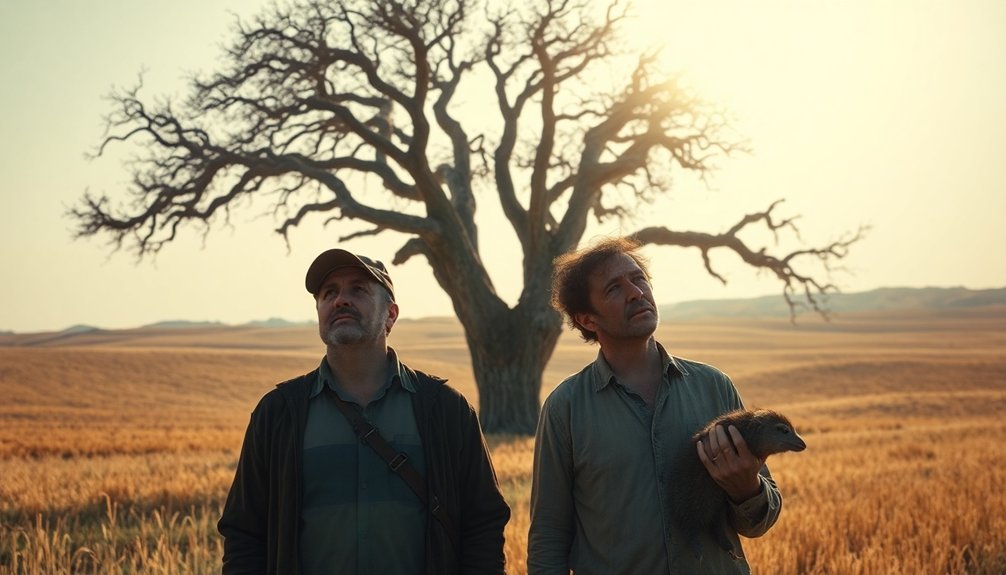
As the story reaches its climax, the tension escalates dramatically when Lennie accidentally kills Curley’s wife in the barn. This tragic decision plunges both him and George into a desperate situation.
Knowing what’s coming, Lennie flees to their prearranged hiding spot by the Salinas River, where George will meet him.
Lennie rushes to the Salinas River, seeking refuge in their secret spot as danger looms near.
- George arrives just before the lynch mob can find Lennie.
- In a moment of mercy, George recounts their shared dream of owning a farm.
- George’s actions, perceived as self-defense, allow him to escape the consequences.
In that heart-wrenching moment, George’s choice to take Lennie’s life spares him from a more brutal fate, sealing their bond in tragedy. The themes of resilience amidst adversity resonate strongly, reflecting the profound connection between friendship and the harsh realities of life.
Central Themes Explored
The tragic events that unfold in “Of Mice and Men” set the stage for exploring profound themes that resonate throughout the novella.
At the heart of the story lies the theme of friendship, embodied in George and Lennie’s bond. Their companionship stands as a beacon against the loneliness faced by itinerant workers.
The American Dream is another central theme, represented by their aspiration to own land, symbolizing hope and stability during the Great Depression.
However, characters like Curley’s wife and Crooks reveal the pervasive isolation and disillusionment that accompanies their unfulfilled dreams.
Ultimately, Steinbeck critiques how societal pressures shatter aspirations, illustrating the fragility of dreams and the harsh realities of life for marginalized individuals. This mirrors the struggles faced by the Joad family in “The Grapes of Wrath,” who also encounter social injustice as they seek a better life.
Historical Context and Reception

Set against the backdrop of the Great Depression, “Of Mice and Men” captures the struggles of its characters, reflecting the harsh realities faced by many Americans during the 1930s.
Steinbeck’s work sheds light on the lives of migrant workers, illustrating their economic struggle, dreams, and the value of friendship.
Steinbeck illuminates the plight of migrant workers, exploring their dreams, economic hardships, and the profound importance of friendship.
- Published in 1937, the novella was a Book of the Month Club selection, highlighting its immediate acclaim.
- Despite its popularity, “Of Mice and Men” has faced censorship due to its language and themes, particularly regarding violence and mental disabilities.
- The themes resonate today, reminding readers of loneliness and the fragility of dreams in society, making it a timeless piece of literature. Additionally, the importance of collective action in achieving dreams is echoed in the characters’ experiences, showcasing the need for solidarity during challenging times.
Conclusion
In the end, you see that dreams can be as fragile as glass, and true friendship often faces the harshest tests. George and Lennon’s bond teaches you that loyalty and sacrifice come at a cost. As you reflect on their journey, you realize that while hopes may shatter, the memories of companionship linger. Life may not always go as planned, but it’s the connections you forge that truly define your path. After all, no man is an island.