When you explore movies based on Shakespeare, you’ll discover over 1,800 adaptations that keep his timeless narratives alive. From classics like *West Side Story* to modern teen comedies, each film brings fresh perspectives to themes of love, power, and tragedy. Directors use innovative cinematic techniques, making these stories visually striking and relevant. With evolving cultural interpretations, Shakespeare’s influence remains strong in contemporary cinema. There’s so much more to uncover about his enduring legacy on screen.
The Enduring Legacy of Shakespeare in Film
Shakespeare’s influence in film is undeniable, as his works have been adapted over 1,800 times, making him the most filmed author in history. With over 410 feature-length film and TV adaptations, his narratives resonate deeply across cultures and genres.
The earliest known adaptation, *King John*, debuted in 1899, paving the way for a rich tradition of reinterpreting his plays. Significant Shakespeare adaptations like *West Side Story* and *10 Things I Hate About You* show how timeless themes can connect with modern audiences.
Innovative cinematic techniques, as seen in Akira Kurosawa’s *Ran* and Baz Luhrmann’s *Romeo + Juliet*, further highlight the artistic potential of translating Shakespeare’s text into engaging visual storytelling. His legacy continues to thrive on the big screen, much like the enduring popularity of intricate plots found in classic mystery novels.
Iconic Adaptations: From Stage to Screen
When you explore iconic adaptations of Shakespeare, you’ll see how timeless themes are reimagined for new audiences. Filmmakers employ innovative techniques to bring these classic stories to life, often within unique cultural contexts. This blend not only honors the original works but also highlights their relevance in today’s world. Many adaptations, like those of Richard Wright’s *Native Son*, challenge audiences to confront systemic injustice that resonates across different narratives and time periods.
Timeless Themes Reimagined
Although his works were penned centuries ago, the themes found in Shakespeare’s plays continue to resonate in today’s cinema. With over 410 feature-length film and TV adaptations, Shakespeare remains the most filmed author, proving the timeless appeal of his narratives.
Notable adaptations like *West Side Story* reimagine *Romeo and Juliet*, tackling contemporary issues such as racism and violence while preserving the original essence.
Kurosawa’s *Throne of Blood* and *Ran* adapt *Macbeth* and *King Lear*, respectively, using Japanese settings to explore ambition and tragedy.
Even modern rom-coms like *10 Things I Hate About You* showcase how Shakespeare’s character dynamics thrive in today’s storytelling, demonstrating the enduring relevance of his works in diverse artistic formats.
Innovative Cinematic Techniques
Adapting Shakespeare for the screen often involves innovative cinematic techniques that breathe new life into his timeless narratives. Directors push boundaries, transforming stage plays into visual spectacles.
Here are some standout examples:
- Orson Welles’ *Macbeth* (1948) used expressionist stagecraft and voiceover to create a haunting atmosphere.
- Akira Kurosawa’s *Throne of Blood* (1957) stripped the narrative down to its core, exploring ambition and fate through atmospheric elements.
- Roman Polanski’s *Macbeth* (1971) employed wide angles and sweeping camera movements for a visceral experience.
- Kenneth Branagh’s *Hamlet* (1996) showcased the complete text, resulting in a visually rich, four-hour film featuring a star-studded cast.
These techniques redefine how you experience Shakespeare, merging the theatrical with the cinematic.
Cultural Context and Impact
Shakespeare’s influence on cinema is profound, as filmmakers continue to reinterpret his works through various cultural lenses. With over 410 feature-length films adapted from his source material, he stands as the most filmed author globally.
The 1935 film *A Midsummer Night’s Dream* not only won two Academy Awards but also showcased innovative effects, proving Shakespeare’s relevance in American culture.
Akira Kurosawa’s *Throne of Blood* transforms *Macbeth* into a feudal Japanese setting, illustrating the adaptability of these narratives.
Similarly, Baz Luhrmann’s *Romeo + Juliet* modernizes the tale while keeping Shakespeare’s dialogue intact, appealing to today’s audiences.
Vishal Bhardwaj’s *Omkara* brings *Othello* into a Bollywood context, further demonstrating the versatility of Shakespeare’s stage creations across cultures.
Unique Cultural Interpretations of Shakespeare’s Works
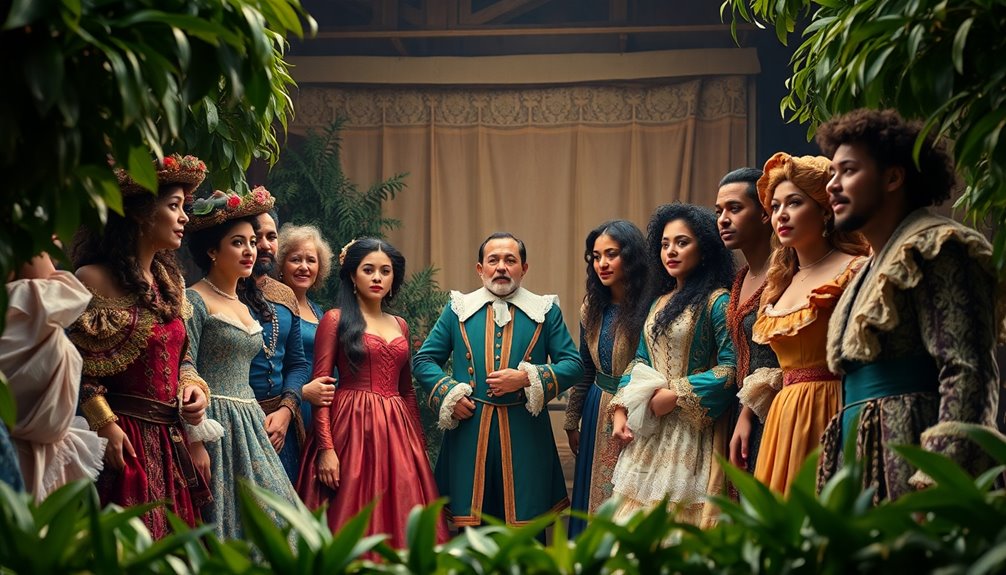
Here are some standout adaptations:
- Vishal Bhardwaj’s *Omkara* (2006) reinterprets *Othello*, addressing jealousy and colorism in India.
- *10 Things I Hate About You* (1999) transforms *The Taming of the Shrew* into a modern teen rom-com, highlighting love and rebellion.
- Akira Kurosawa’s *Throne of Blood* (1957) adapts *Macbeth* to feudal Japan, focusing on ambition and fate.
- Baz Luhrmann’s *Romeo + Juliet* (1996) updates the classic with contemporary themes of teenage angst and cultural clashes.
These adaptations showcase the versatility and enduring relevance of Shakespeare’s narratives, like those in *A Midsummer Night’s Dream*. Furthermore, they reflect the power of storytelling as a means of expressing cultural resilience and identity.
The Best Animated Shakespeare Adaptations
When you think about animated adaptations of Shakespeare, you’ll find some truly creative interpretations.
From the innovative puppet animation of *A Midsummer Night’s Dream* to the vibrant world of *The Lion King*, these films showcase unique storytelling techniques.
Each one not only captures the essence of Shakespeare’s themes but also reimagines them for a new generation. Notably, the spirit of collective action and unity in these adaptations resonates with the courage found in historical resistance movements, inspiring audiences to stand against adversity.
Visual Storytelling Techniques
Animated adaptations of Shakespeare’s works often employ innovative visual storytelling techniques that breathe new life into classic tales. These adaptations not only captivate audiences but also reimagine the narratives in engaging ways:
- The 1959 *A Midsummer Night’s Dream* used puppet animation, earning a spot at Cannes.
- *As You Like It* (1994) employed paint on glass animation, merging Shakespearean themes with a unique 19th-century aesthetic.
- *The Lion King* (1994) loosely adapts *Hamlet*, using vibrant visuals and music to convey themes of responsibility and revenge.
- *Strange Magic* (2015) draws from *A Midsummer Night’s Dream*, featuring a diverse voice cast to modernize Shakespearean characters.
These visual storytelling techniques highlight the timeless relevance of Shakespeare plays while making them accessible to new generations.
Unique Interpretative Approaches
Shakespeare’s works have inspired a myriad of unique interpretative approaches, especially in animation. The 1959 adaptation of *A Midsummer Night’s Dream* by Jiří Trnka stands out for its artistic puppetry, earning special recognition at Cannes.
In 1994, *As You Like It* used innovative paint-on-glass techniques, setting the story in a late 19th-century European colony in Japan. The animated film *Strange Magic* (2015) reimagines *A Midsummer Night’s Dream* through a fantasy lens, featuring classic songs and star-studded voice performances.
*The Lion King* (1994) loosely adapts *Hamlet*, turning revenge into a colorful tale of responsibility.
Finally, *Get Over It* (2001) brings a contemporary twist to *A Midsummer Night’s Dream*, showcasing its adaptability through a high school stage production’s format.
Modern Takes on Classic Plays: A Fresh Perspective
While classic plays often feel distant in time and context, modern adaptations breathe new life into their timeless themes. You’ll find that these films connect Shakespeare’s ideas with today’s audiences through relatable settings and characters.
Here are some standout examples:
- *10 Things I Hate About You* (1999) reimagines *The Taming of the Shrew* as a teen comedy.
- *Get Over It* (2001) brings *A Midsummer Night’s Dream* into a high school environment.
- Baz Luhrmann’s *Romeo + Juliet* (1996) infuses a vibrant urban aesthetic into the classic tale.
- *Omkara* (2006) adapts *Othello* within an Indian context, preserving Shakespeare’s language.
These fresh perspectives guarantee Shakespeare’s works remain relevant and engaging, much like the way food symbolism in *Like Water for Chocolate* enhances emotional narratives in literature.
Notable Directors Who Brought Shakespeare to Life
In exploring the impact of notable directors on Shakespearean cinema, you’ll find a rich tapestry of innovative adaptations and cultural significance.
From Georges Méliès’ groundbreaking *Hamlet* in 1907 to Kenneth Branagh’s ambitious four-hour version, these filmmakers transformed how we experience Shakespeare’s works. Their unique visions not only brought the plays to life but also shaped the cinematic landscape in profound ways. This evolution mirrors the transformative journey of erotic fiction through adaptations like *Fifty Shades of Grey*, which challenged societal norms and redefined genres.
Pioneering Shakespearean Filmmakers
Bringing Shakespeare’s works to the screen has long captivated filmmakers, who’ve found innovative ways to translate his complex narratives into visual storytelling.
Here are some pioneering directors who’ve made significant contributions in the domain of Motion Pictures:
- Georges Méliès – Directed the first multi-scene adaptation of Hamlet in 1907, setting a structural precedent.
- Laurence Olivier – His 1948 Hamlet was the first English sound film version, earning numerous accolades.
- Akira Kurosawa – With Throne of Blood (1957), he reimagined *Macbeth* in a mythic Japanese context.
- Kenneth Branagh – His 1996 Hamlet featured the full text, making it an ambitious four-hour cinematic experience.
These filmmakers have redefined how we experience classic texts like *Henry IV*, proving Shakespeare’s timeless relevance.
Innovative Adaptation Techniques
When filmmakers adapt Shakespeare’s works, they often employ innovative techniques to bridge the gap between stage and screen, making the timeless stories resonate with contemporary audiences.
Orson Welles’ 1948 *Hamlet* showcased striking expressionist stagecraft and voiceover, blending theatricality with cinematic techniques.
Akira Kurosawa’s *Throne of Blood* transformed *Macbeth* into a feudal Japanese setting, exploring ambition and fate while preserving the narrative’s essence.
Kenneth Branagh’s 1996 *Hamlet* was groundbreaking, using the entire text and a four-hour runtime to enhance visual richness.
Tim Carroll’s 2013 *Twelfth Night* with its all-male cast retained original staging while adding modern sensibilities.
Roman Polanski’s 1971 *Macbeth* employed sweeping camera movements to create a visceral experience, reflecting personal grief.
Cultural Impact of Directors
While many directors have interpreted Shakespeare’s works, a few stand out for their profound cultural impact. You might find their unique approaches inspiring:
- Georges Méliès – His 1907 adaptation of Hamlet was the first multi-scene cinematic interpretation, setting a milestone in film history.
- Laurence Olivier – His 1948 Hamlet won multiple awards and was the first English sound adaptation, showcasing advanced techniques.
- Michael Almereyda – In 2000, his modern Hamlet used video cameras and surveillance to recontextualize the story effectively.
- Tim Carroll – His 2013 Twelfth Night featuring an all-male cast, highlighted historical performance practices, much like Sir John’s era.
These directors show how creative interpretations can breathe new life into Shakespeare’s timeless works, like *Much Ado About Nothing*.
Memorable Performances: Actors Who Shone in Shakespearean Roles
Actors have a unique ability to breathe life into Shakespeare’s timeless characters, and some performances resonate so deeply that they become unforgettable.
Judi Dench’s portrayal of Titania in the 1968 *A Midsummer Night’s Dream* showcased her incredible depth, while Orson Welles’ haunting Macbeth in 1948 used voiceover to blend theatricality with cinematic flair.
Kenneth Branagh’s 1996 *Hamlet* made history by presenting the entire text, demonstrating his dedication to authenticity.
Kenneth Branagh’s 1996 *Hamlet* redefined adaptation by delivering the complete text, showcasing unparalleled dedication to Shakespeare’s authenticity.
Vanessa Redgrave’s emotional complexity in *As You Like It* (1978) captivated audiences, and Tatsuya Nakadai’s Hidetora in Kurosawa’s *Ran* (1985) stands as one of cinema’s greatest performances.
These memorable performances, combined with stunning costume design, continue to inspire and define Shakespearean adaptations on the big screen. Furthermore, the themes of social justice in Shakespeare’s works resonate with actors, encouraging them to explore the nuances of their characters.
Cinematic Techniques That Elevate Shakespearean Stories
Shakespeare’s stories come alive not just through stellar performances but also through innovative cinematic techniques that enhance their emotional and thematic depth.
These techniques can transform a classic play into a visually engaging experience:
- Sound Design: In *Hamlet (1948)*, sound amplifies emotional weight, setting a new adaptation standard.
- Atmospheric Elements: *Throne of Blood (1957)* uses stark visuals to explore ambition and fate, crucial themes in the Scottish play.
- Multimedia Elements: *Prospero’s Books (1991)* merges visual artistry with different art forms, creating an immersive adaptation of *The Tempest*.
- Dynamic Shots: *Chimes at Midnight (1965)* employs low-angle shots and dramatic lighting to elevate emotional intensity, enhancing visual storytelling.
- Gothic Elements: Many adaptations, like *The Phantom of the Opera*, showcase how Gothic themes can enrich narrative depth, reflecting on love and obsession through a visually stunning lens.
These cinematic techniques enrich the Bard’s timeless narratives, making them resonate even more deeply.
Thematic Explorations: Love, Power, and Tragedy in Adaptations
When exploring adaptations of Shakespeare’s works, you’ll find that themes of love, power, and tragedy remain as relevant today as they were in the Bard’s time.
Take *West Side Story*, for instance; it reinterprets *Romeo and Juliet* to tackle contemporary issues of love amid racism and violence.
In *Throne of Blood*, the power dynamics of *Macbeth* shift to feudal Japan, showcasing ambition and fate in a mythic context.
Similarly, *Omkara* blends jealousy and manipulation from *Othello* with societal issues like colorism in India.
Even *The Lion King* captures the essence of *Hamlet*, focusing on responsibility and revenge.
Orson Welles’ *Macbeth* emphasizes tragedy, using expressionist techniques to heighten the emotional impact of power and ambition.
Moreover, like Kamila Shamsie’s *Home Fire*, which reimagines classical themes of identity and loyalty, these adaptations reflect modern societal struggles while retaining their core narratives.
Audience Reception: How Are Adaptations Viewed Over Time?
While adaptations of Shakespeare’s works often spark debate, their reception can change dramatically over time. You might find that audience reception evolves as cultural contexts shift and new interpretations emerge.
Consider these points:
- Critics often weigh fidelity to the original text against artistic merit, as seen with Branagh’s *Hamlet* versus Luhrmann’s *Romeo + Juliet*.
- Meryl Streep’s *Kiss Me, Petruchio* showcases how theatrical adaptations can reshape perceptions over time.
- Films like *10 Things I Hate About You* resonate with younger viewers, reflecting contemporary themes.
- Kurosawa’s *Throne of Blood* is celebrated as a masterpiece, transcending its source material and influencing global views of Shakespeare.
- The evolution of audience perception mirrors the way systemic oppression in literature has been challenged and discussed over time.
These factors highlight how audience reception of adaptations can vary, revealing the dynamic nature of Shakespeare on screen.
The Future of Shakespeare on Screen: Trends and Innovations
As adaptations of Shakespeare evolve, filmmakers are increasingly reimagining his works to resonate with contemporary audiences.
Modern adaptations tackle pressing social issues, like the 2021 *West Side Story*, which explores themes of racism and violence.
Innovative cinematic techniques enhance these retellings, as seen in Kenneth Branagh’s *Hamlet*, the first film to embrace the entire text, creating a visually stunning four-hour experience.
Directors like Vishal Bhardwaj weave traditional narratives into local cultures, exemplified by *Omkara*, which adapts *Othello* in a Bollywood context.
Meanwhile, animated films like *Strange Magic* introduce Shakespeare to younger viewers, emphasizing creativity and accessibility.
The ongoing integration of technology and visual effects continues to transform storytelling, ensuring Shakespeare remains relevant on screen.
Conclusion
As you plunge into the world of Shakespeare on screen, you might just find yourself captivated by the timeless themes and fresh interpretations that breathe new life into the Bard’s words. What will you discover next? Will a modern twist make you see a classic in a whole new light? The legacy of Shakespeare isn’t just preserved; it’s evolving. So, keep watching—who knows what emotional journey awaits you in the next adaptation?