Recent book bans have skyrocketed, especially in states like Florida, where over 4,500 titles are censored. Key reasons include concerns over sexual content, language, and LGBTQIA+ themes. Notable banned titles like *Gender Queer* and *The Bluest Eye* highlight the societal struggle for representation. This censorship suppresses diverse voices and stifles important narratives. There’s a growing movement against these bans, and you’ll want to explore the implications for intellectual freedom and literature’s future.
The Rise of Book Bans: A Historical Perspective
Since the 1960s, book bans in the United States have surged, reflecting ongoing societal struggles over what constitutes acceptable literature.
Book bans in the U.S. have escalated since the 1960s, highlighting enduring debates over acceptable literature.
You may notice that states like Florida have seen over 4,500 banned books, showcasing a significant push against diverse cultural themes. This trend often aligns with political viewpoints, where local community standards dictate what’s acceptable for schools and libraries.
The American Library Association emphasizes the importance of freedom of information, yet book challenges continue to rise, particularly against works addressing LGBTQIA+ content and social justice.
Historical contexts reveal that these bans aren’t new; they’ve manifested repeatedly, indicating deeper tensions regarding race, identity, and education in America. Notably, the banning of texts like *Native Son* underscores systemic racism as a critical issue in discussions surrounding literature and representation.
Understanding this history is vital as you navigate today’s literary landscape.
Key Reasons Behind Recent Book Challenges
As societal values shift, the reasons behind recent book challenges have become increasingly pronounced. A staggering 92.5% of challenged books in recent years faced scrutiny for sexual content, raising concerns about age-appropriateness.
Offensive language prompted 61.5% of challenges, reflecting a push against perceived vulgarity in literature. Almost half of the books challenged are deemed unsuitable for their intended age group, indicating local standards for educational content.
Additionally, 23.5% of challenges target books with LGBTQIA+ themes, highlighting ongoing societal tensions over representation and sexual orientation.
With the American Library Association tracking 1,269 challenges in 2022, it’s clear that censorship in schools and libraries is on the rise, driven by these sensitive issues and community reactions. These challenges often reflect deeper societal issues, such as a refusal to confront systemic racism, which is a central theme in many contemporary works like Coates’ *Between the World and Me*.
Notable Titles Targeted for Censorship in 2023
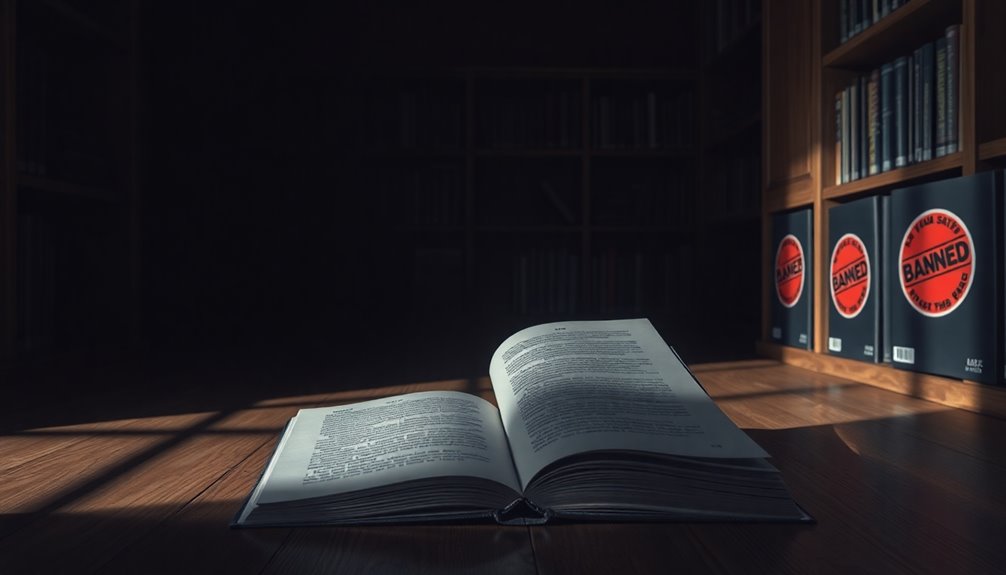
In 2023, you might notice several notable titles facing censorship due to their challenging themes.
Books like “Gender Queer” and “The Bluest Eye” have stirred up significant controversy around LGBTQIA+ content and racial issues, respectively.
These challenges reflect a broader societal struggle over what literature should be accessible to readers. The ongoing debates echo the discussions sparked by Richard Wright’s *Native Son*, which faced censorship challenges due to its graphic content and exploration of systemic racism.
LGBTQIA+ Content Challenges
While debates about sexual orientation and gender identity heat up, books with LGBTQIA+ content are facing unprecedented challenges in 2023. Titles like “Gender Queer” by Maia Kobabe and “All Boys Aren’t Blue” by George M. Johnson are among the most challenged, often targeted for censorship due to their exploration of sexual orientation and identity.
According to the American Library Association, LGBTQIA+ content accounted for 23.5% of all book challenges this year, reflecting a growing concern over representation in school libraries.
These book challenges not only threaten intellectual freedom but also stifle critical conversations about LGBTQIA+ experiences. As societal tensions persist, the fight for these narratives continues, emphasizing the importance of diverse voices in literature.
Racial Themes Controversies
The fight against censorship extends beyond LGBTQIA+ content, with racial themes also facing significant scrutiny in 2023. Notable books like *The Bluest Eye* by Toni Morrison have been banned due to their explicit exploration of race, incest, and abuse.
Similarly, *To Kill a Mockingbird* has been removed from school curriculums for its use of racial slurs, igniting debates on its educational value.
*The Hate U Give* faced challenges for its anti-police message and themes of racial inequity, reflecting tensions in contemporary social justice narratives.
These book bans exemplify a broader trend, with 1,269 challenges in 2022 alone. Such controversies highlight how community values shape educational content and the ongoing struggle to address sensitive racial themes in literature.
The Impact of Censorship on Literature and Society
Censorship limits the voices we hear in literature, stifling important perspectives that enrich our understanding of the world. When you restrict access to diverse narratives, you’re not just eroding intellectual freedom; you’re also shaping a society that lacks empathy and awareness. It’s vital to recognize how these bans affect both readers and the broader cultural landscape. Such restrictions can silence stories of systemic racism, ultimately hindering progress towards social justice and equality.
Diminished Diversity Of Voices
As book bans proliferate, the diversity of voices in literature faces a troubling decline, limiting your access to a rich tapestry of perspectives.
Censorship efforts have targeted many books, particularly those addressing LGBTQIA+ themes, with nearly a quarter of challenged works highlighting the need for representation. This stifles not only literary voices but also the crucial freedom of expression that fosters empathy and understanding.
Authors like Maia Kobabe and George M. Johnson exemplify the risks faced when diverse narratives are banned or challenged, leading to altered content that diminishes authenticity.
In public schools, restricted access to information weakens the cultural fabric, depriving you of the varied experiences and viewpoints essential for a vibrant society.
Erosion Of Intellectual Freedom
While many may not realize it, the erosion of intellectual freedom threatens to reshape the landscape of literature and society. Censorship is on the rise, with 1,269 book challenges in 2022 alone, targeting diverse literature that addresses LGBTQIA+ themes, racial issues, and social justice.
This stifling of freedom of expression limits your access to varied perspectives and discourages authors from tackling sensitive topics for fear of backlash. Advocacy organizations stress that intellectual freedom is essential for education, as it allows students to engage with different viewpoints.
When community standards impose restrictions, you lose the richness of diverse voices, ultimately undermining the integrity of education and the very fabric of a free society.
Responses From Authors and Advocates Against Censorship
Amid growing concerns over book bans, many authors and advocates are passionately speaking out against censorship. They emphasize that literary freedom is crucial for fostering empathy in young readers and ensuring diverse voices are heard.
Authors and advocates unite against censorship, championing literary freedom as essential for empathy and diverse voices in literature.
Here are some key responses:
- Maia Kobabe and George M. Johnson highlight how challenges to their LGBTQIA+ content reflect societal tensions.
- The American Library Association reported 1,269 challenges in 2022, showcasing the urgent need for advocacy organizations to fight for intellectual freedom.
- Public figures and educators argue that exposing students to complex issues through banned books is fundamental for understanding and acceptance.
- Notably, Richard Wright’s *Native Son* has faced censorship challenges, illustrating the ongoing struggle against systemic racism and the importance of diverse narratives in literature.
Together, these voices advocate for the right to read, pushing back against the restrictions imposed by conservative groups and championing the inclusion of diverse narratives in literature.
The Future of Intellectual Freedom in Literature
The fight against censorship is more important than ever, especially as book bans continue to escalate.
With over 10,046 instances recorded by PEN America, the threat to intellectual freedom in literature is undeniable.
You’ll notice that challenges to diverse literature, particularly LGBTQIA+ content, have surged, compromising students’ access to essential perspectives.
Advocacy organizations are working tirelessly to combat this trend, emphasizing that diverse voices are essential for education.
The First Amendment protects your right to express and receive information, yet the rise in book bans raises uncomfortable questions about balancing community standards and intellectual freedom.
As censorship grows, it’s critical to stand up for literature that reflects all experiences, ensuring future generations have access to a rich tapestry of ideas. Recent discussions around systemic racism echo Richard Wright’s profound impact on literature and highlight the necessity of confronting uncomfortable truths.
Conclusion
In a world where books are being banned faster than you can say “freedom of speech,” it’s essential to stand up for the stories that shape our lives. Imagine a future where libraries are nothing but empty shells, their shelves stripped bare of significant voices! You can’t let censorship win. Join the fight for intellectual freedom, because every book you save is a battle cry against ignorance. Let’s guarantee literature remains a vibrant, unshackled force that inspires generations!