
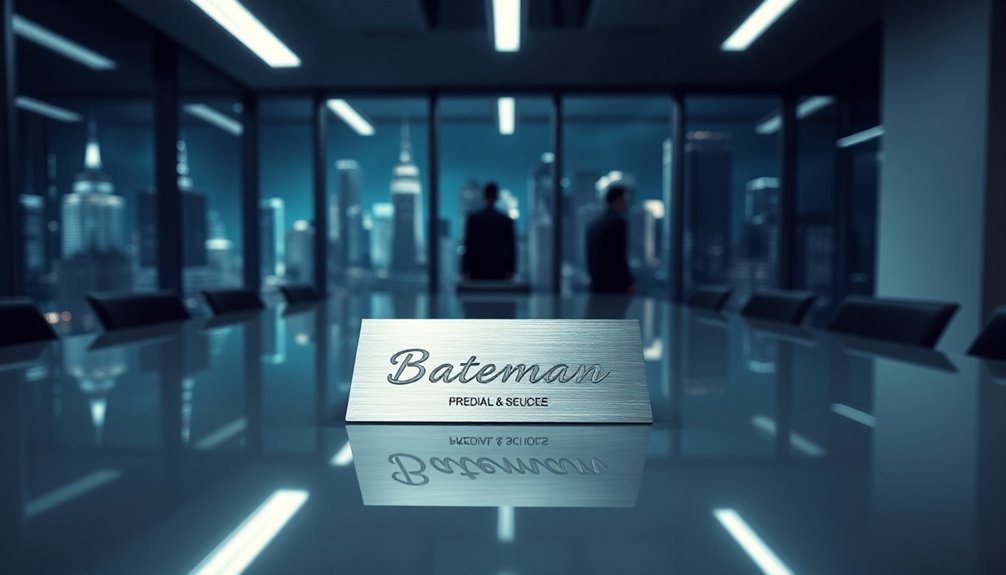
Patrick Bateman embodies the dark side of American consumer culture. By day, he’s a polished banker, but at night, he grapples with a violent identity crisis fueled by materialism. His obsession with wealth leads to superficial relationships and chilling acts of brutality. Women in his world are merely objects, reflecting deep-seated misogyny and emotional disconnection. Through Bateman’s eyes, you see the moral decay of a society fixated on status and appearances, and there’s much more to uncover.
The Duality of Patrick Bateman: A Closer Look at His Character

When you explore the character of Patrick Bateman, you quickly see the stark duality that defines him. By day, he’s a polished investment banker, embodying the success celebrated in consumerist culture.
But as night falls, Bateman reveals his sadistic side, showcasing a chilling lack of empathy. This duality highlights his internal conflict, oscillating between a desperate need for societal acceptance and a profound emptiness that fuels his violent tendencies.
His obsession with luxury goods and personal appearance serves as a façade, masking his inability to form genuine connections.
Bateman’s fixation on opulence conceals his profound isolation, revealing a hollow existence beneath the glittering surface.
As Bateman spirals into madness, the lines between reality and fantasy blur, exposing the moral decay hidden beneath the glittering surface of the 1980s, ultimately critiquing the emptiness of his existence. This reflects the same predatory view of love seen in “Fifty Shades of Grey,” where characters engage in unhealthy dynamics masked as romance.
Materialism and Identity Crisis: How Consumer Culture Shapes Bateman

As Patrick Bateman navigates the relentless landscape of consumer culture, he becomes a living embodiment of an identity crisis fueled by materialism. His obsession with material goods reflects a hollow existence, as he equates self-worth with ownership of luxury items.
Here are key aspects of this identity crisis:
- Superficial Relationships: Bateman objectifies others, reducing them to mere appearances.
- Social Anxiety: His status hinges on designer items, triggering feelings of inadequacy.
- Fragmented Self: He perceives himself as an “entity,” lacking depth and authenticity.
- Moral Decay: The pursuit of wealth leads to alienation, highlighting the emptiness of American consumerist culture.
In this psychological thriller, Bateman’s struggle illustrates the detrimental effects of valuing appearances over genuine human connection. Moreover, his character serves as a critique of the moral bankruptcy inherent in 1980s Manhattan’s consumer culture, emphasizing the fragility of individual identity amidst relentless materialism.
Violence as a Reflection of Superficiality: Understanding Bateman’s Actions

When you look at Patrick Bateman’s violent acts, it’s clear they’re not just random outbursts; they’re his way of asserting identity in a world obsessed with surface-level connections.
His brutality reflects the isolation that comes from a life driven by materialism, where genuine relationships take a backseat to superficial status.
In this twisted landscape, violence becomes a tool for Bateman to confront his own emptiness and envy. This mirrors the systemic racism that perpetuates violence in marginalized communities, highlighting how societal pressures can distort identity and lead to destructive behaviors.
Violence As Identity Assertion
Violence embodies Patrick Bateman’s struggle for identity in a world obsessed with superficiality. His violent actions reflect deep insecurities and an insatiable need for dominance, showcasing how intertwined violence and identity can be in a consumer-driven society.
Consider these points:
- Bateman’s brutality mirrors his obsession with status, revealing the hollowness of his materialistic pursuits.
- His meticulous planning of murders highlights a chilling detachment from empathy, reinforcing his predatory identity.
- Targeting women and marginalized groups, he views them as objects, asserting superiority in a society fixated on appearances.
- The contrast between his polished exterior and gruesome acts underscores the theme of superficiality, illustrating how his identity collapses under his moral decay.
Superficial Connections And Isolation
Despite his seemingly perfect life, Patrick Bateman’s superficial connections reveal a profound isolation that drives his violent tendencies.
You see, he objectifies others, treating them as mere extensions of his status rather than recognizing their humanity. This stark contrast between his polished public persona and his gruesome private life underscores the emptiness of his relationships.
Bateman’s contempt for women and marginalized groups stems from his insecurities, as violence becomes his only means of feeling empowered in a world where he feels deeply disconnected.
His confession, dismissed as a joke, highlights the hollowness of his social interactions and society’s indifference to his actions, reinforcing the theme of isolation in a culture obsessed with superficiality.
Materialism Fuels Brutality
Bateman’s superficial existence doesn’t just isolate him; it fuels his brutality, revealing how materialism distorts his reality. His violent actions stem from a deep emptiness, driven by his obsession with possessions and status.
Here’s how consumer culture shapes his brutality:
- The murder of Paul Owen highlights envy and competition, pushing Bateman to extreme violence.
- He objectifies women, reducing them to physical attributes, using violence to assert control.
- His killings are devoid of personal motivation, reflecting a materialistic society’s values.
- Scenes like the business card comparison showcase the emotional turmoil linked to status, reinforcing his violent tendencies.
In this warped world, Patrick Bateman’s brutality is a chilling reflection of relentless superficiality.
Gender Dynamics and Objectification: The Role of Women in Bateman’s World
In Bateman’s world, women aren’t seen as individuals but rather as objects defined by their looks. His violent behavior towards them reveals a disturbing link between his misogyny and his perception of femininity. This toxic view not only reflects his personal failings but also critiques the broader societal attitudes that allow such objectification to thrive. The consequences of this dehumanization echo similar themes found in Richard Wright’s exploration of systemic racism and its impact on identity and societal dynamics.
Objectification of Women
As you explore Patrick Bateman’s world, you’ll quickly notice how he reduces women to mere physical entities, labeling them “hardbodies” and stripping away their individuality. This objectification of women reflects his deep-seated misogyny and lack of emotional connection.
Here are key aspects of Bateman’s perspective:
- He perceives women solely as objects for sexual gratification.
- Their professional accomplishments mean nothing to him; he views them through a superficial lens.
- Bateman’s relationships lack depth, focusing only on physical allure.
- His violent tendencies blur the line between desire and dehumanization, treating women as disposable.
In this warped reality, the objectification of women serves as a disturbing commentary on societal misogyny and the devaluation of female identity.
Violence Against Femininity
While traversing the twisted landscape of Patrick Bateman’s psyche, you’ll find that violence against femininity isn’t just a byproduct of his character but a fundamental aspect of his worldview.
Bateman’s misogyny manifests through his objectification of women, reducing them to “hardbodies,” stripped of individuality. His violent acts often intertwine with sexual encounters, highlighting a disturbing correlation between desire and brutality.
The narrative portrays women as passive objects, reflecting a broader dehumanization prevalent in his male-dominated, capitalist society. Relationships lack emotional depth, as Bateman views women as trophies to bolster his status.
This systemic disregard for femininity extends beyond women, illustrating a dangerous mindset that marginalizes anyone outside his narrow view of worth.
The Consequences of Psychopathy: What Drives Bateman’s Criminal Behavior?
Driven by an insatiable desire for status and validation, Patrick Bateman’s criminal behavior stems from his deep-rooted psychopathic traits. His actions reveal how psychopathy intertwines with societal pressures and the obsession with material wealth.
You can identify the key drivers behind his violent tendencies:
- Lack of empathy: Bateman feels no remorse for his actions, viewing victims as mere objects.
- Envy and competition: His violence often arises from a need to surpass his peers, like Paul Owen.
- Superficiality: He prioritizes appearances over authentic connections, leading to disconnection from reality.
- Moral decay: The pursuit of capitalist ideals contributes to his distorted view of identity and self-worth.
These elements fuel Bateman’s disturbing descent into criminal behavior. Additionally, his story echoes the themes of systemic oppression found in dystopian narratives, reflecting how societal structures can distort individual morality.
Societal Commentary: What American Psycho Reveals About Our Values
Materialism permeates the narrative of “American Psycho,” revealing a society obsessed with wealth and status. As you watch Patrick Bateman navigate his world, you see how his relentless pursuit of material possessions leads to profound identity loss.
Relationships become superficial, grounded in appearances rather than genuine connections, highlighting societal apathy toward authentic emotional engagement. Bateman’s violent acts symbolize the dehumanization inherent in a capitalist culture, where people are reduced to mere commodities, valued solely for their financial worth.
This indifference towards marginalized groups underscores the interchangeable nature of human lives within a consumerist framework. Ultimately, “American Psycho” critiques how the relentless chase for wealth erodes empathy and individual identity, suggesting that such pursuits can lead to self-destruction. This critique echoes themes of systemic oppression found in works like Richard Wright’s “Native Son,” illustrating how societal structures can distort personal identity and values.
Conclusion
In examining Patrick Bateman’s character, you see a chilling reflection of our society’s obsession with materialism and superficiality. Like a mask slipping to reveal a hollow shell, Bateman embodies the emptiness lurking beneath the surface of consumer culture. His violent tendencies and objectification of women highlight the dangers of detachment in a world driven by appearance. Ultimately, “American Psycho” serves as a stark warning about the moral decay that can arise when identity is tied solely to possessions and status.