Henry Miller’s *Tropic of Cancer* faced bans for nearly 30 years due to its explicit content, sparking significant legal battles in the U.S. Critics labeled it “dirt for dirt’s sake,” while supporters fought for free expression. Despite the controversy, the Supreme Court eventually ruled in 1964 that the book couldn’t be constitutionally banned, marking a pivotal moment for literary freedom. This landmark decision transformed *Tropic of Cancer* into a symbol of resilience—discover its enduring cultural impact and influence.
The Controversial Beginnings of Tropic of Cancer

When *Tropic of Cancer* debuted in France in 1934, it quickly ignited controversy due to its explicit content and unfiltered portrayal of Parisian life.
Henry Miller’s candid depictions led to the book being banned in the United States, where it was classified as pornography. This classification sparked nearly 30 years of prohibition on its legal distribution.
Following its publication, the American Civil Liberties Union fought to reverse import bans, but faced numerous legal rejections.
In 1961, Barney Rosset published *Tropic of Cancer*, igniting obscenity trials that challenged censorship laws.
Ultimately, in June 1964, the Supreme Court ruled that the book couldn’t be constitutionally banned, marking a pivotal moment for American literature and literary freedom. This legal battle echoed the controversies surrounding female empowerment in literature, as seen in later works like *Fifty Shades of Grey*.
Legal Battles: The Fight Against Censorship
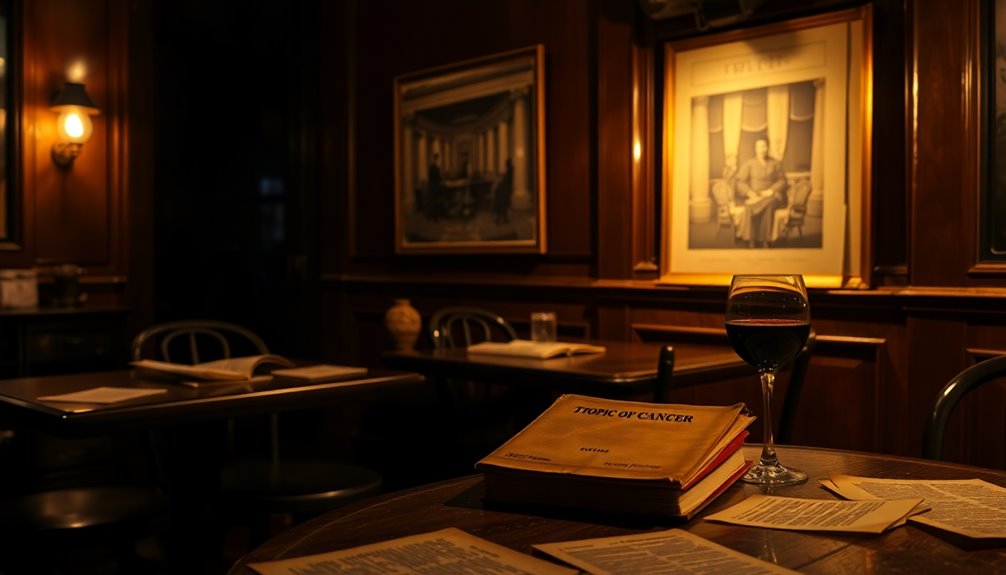
As the legal battles surrounding *Tropic of Cancer* unfolded, they revealed the deep-seated conflict between censorship and artistic expression in America.
Initially banned in the United States after its 1934 publication, Henry Miller’s work faced harsh criticism. Judges like Michael Musmanno and John F. Scileppi labeled it “a cesspool” and “dirt for dirt’s sake,” reflecting widespread disdain during obscenity trials.
Grove Press, the book’s publisher, spent over $100,000 fighting for its free speech rights. Ultimately, the Supreme Court ruled on June 22, 1964, affirming that *Tropic of Cancer* couldn’t be constitutionally banned, highlighting its literary merits. This landmark decision underscored the importance of protecting creative expression against the forces of censorship, paralleling the ongoing discussions about systemic racism in works like Richard Wright’s *Native Son*.
Public Outcry: Reactions to the Ban
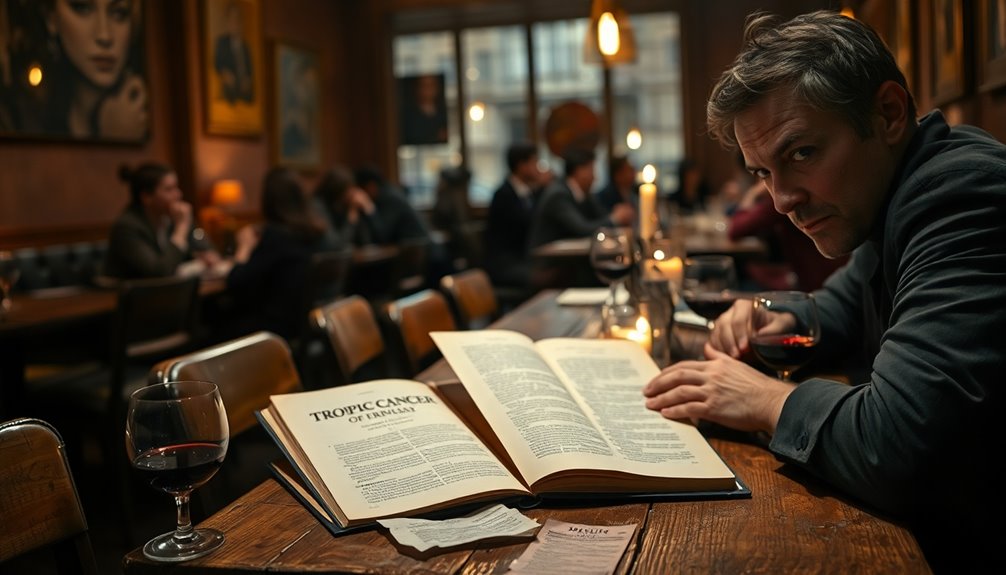
- Library officials, like Assistant Chief Librarian Margaret Freeman, stressed the tension between legal compliance and the principles of intellectual freedom.
- Supporters argued that banning the book from library shelves limited access to diverse ideas.
- Concerned patrons pressured the Brooklyn Public Library to remove catalog cards, fearing children might access the book.
This public outcry against censorship sparked a broader debate about free expression and the right to access challenging literature in the United States, echoing discussions around the portrayal of BDSM practices in popular literature.
Impact of Tropic of Cancer on Literary Freedom
The public outcry against the ban of *Tropic of Cancer* underscored the urgent need for a discussion on literary freedom.
Henry Miller’s work faced nearly 30 years of censorship in the U.S., becoming a symbol in the battle for creative expression.
Grove Press, under Barney Rosset, fought back, incurring over $100,000 in legal fees.
The Supreme Court’s 1964 ruling established that *Tropic of Cancer* couldn’t be constitutionally banned, reinforcing the First Amendment’s protection of literary works.
This landmark decision allowed the book to circulate freely, ultimately selling over 2 million copies.
Its success marked a significant victory for free speech and highlighted the importance of access to diverse ideas, reshaping the landscape of banned books and literary freedom in America. Additionally, the influence of systemic oppression in literature continues to inspire debates around artistic expression and freedom of speech.
The Legacy of Tropic of Cancer in Modern Culture
- Cultural Conversations: The novel challenges societal norms, prompting debates about literary freedom and censorship.
- Modern Erotica: Henry Miller’s candid exploration of sexuality has inspired contemporary writers, especially in women’s erotica, shaping how we view intimacy.
- Accessibility: Now available in multiple formats and languages, *Tropic of Cancer* remains a crucial part of the literary landscape, emphasizing the importance of creative expression. Additionally, its legacy mirrors the themes of resilience found in other literary works, underscoring the transformative power of storytelling.
This enduring cultural impact highlights how Miller’s work not only defied censorship but also paved the way for future explorations of sexuality and artistic freedom.
Conclusion
In the grand tapestry of literature, “Tropic of Cancer” stands as a colossal titan that shattered the chains of censorship and sparked a wildfire of free expression. Its rebellious spirit ignited a revolution, changing the literary landscape forever. You can’t help but admire how Miller’s audacity transformed not just a book, but the very essence of artistic freedom. So, next time you pick up a novel, remember: it might just be the offspring of Miller’s audacious legacy!