
Cormac McCarthy’s novels reflect a wide range of despair. You’ll find *The Road* as a beacon of hope, emphasizing love amidst darkness. In contrast, *Blood Meridian* plunges into brutal nihilism and explores humanity’s worst impulses. Other novels like *Suttree* and *No Country for Old Men* navigate themes of poverty and moral decay. Each work reveals profound insights into the human condition, encouraging deeper contemplation of despair’s complexities as you explore McCarthy’s literary landscape.
The Darkest Tales: Ranking McCarthy’s Novels by Despair
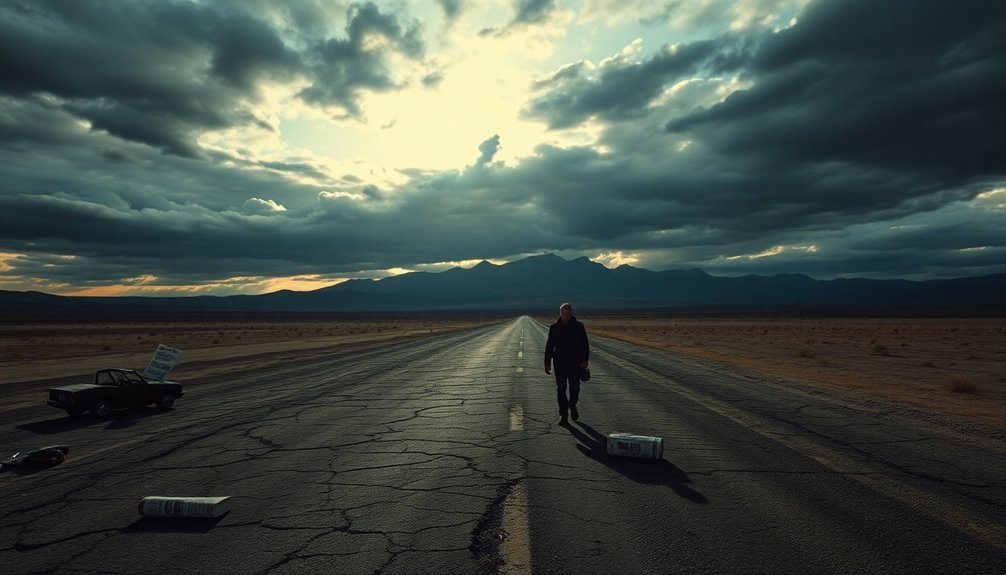
When you plunge into Cormac McCarthy’s novels, you’ll quickly discover that despair permeates his work, each story more haunting than the last.
At the pinnacle of this darkness lies *Blood Meridian*, often hailed as his darkest work, revealing the brutal realities of the American frontier and the depths of human nature.
At the apex of despair, *Blood Meridian* unveils the savage truths of the American frontier and human nature’s abyss.
Following closely, *No Country for Old Men* presents a chilling reflection of moral decay in contemporary society.
Then there’s *Suttree*, which starkly depicts the despair of poverty and homelessness, while *Outer Dark* dives into themes of abandonment and sin, exposing humanity’s darkest impulses.
Each tale showcases McCarthy’s unique ability to weave profound despair into narratives that resonate deeply, leaving an indelible mark on readers.
Notably, the exploration of psychological themes in McCarthy’s work echoes the complexity found in acclaimed mystery novels like *Gone Girl*.
What Makes “The Road” a Beacon of Hope in Darkness?
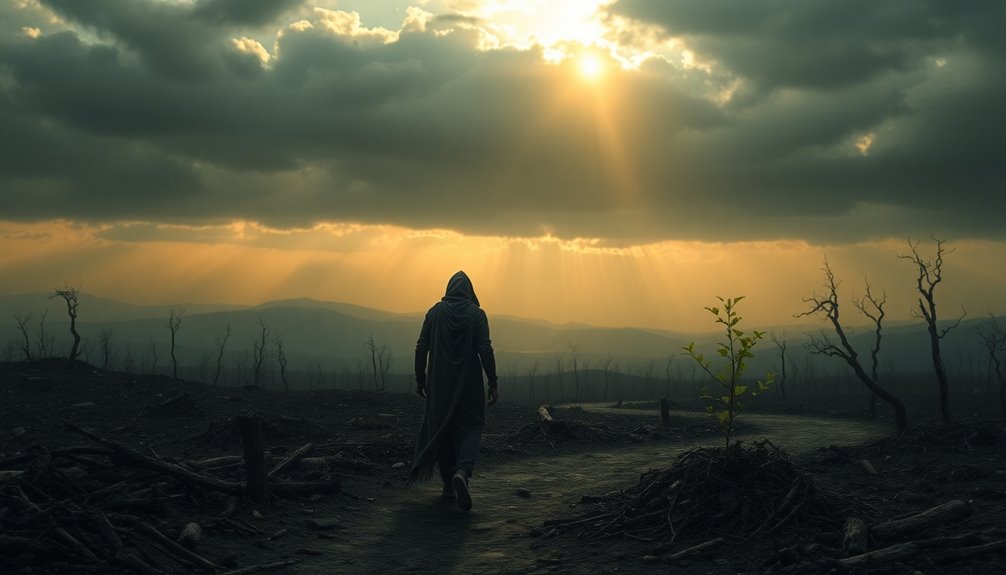
- The enduring love between the father and son symbolizes survival against all odds.
- McCarthy’s exploration of morality challenges readers to find goodness in darkness.
- The stripped-down prose emphasizes the beauty of their relationship amidst despair.
- The Pulitzer Prize-winning narrative hints at renewal and redemption, leaving readers with a glimmer of hope.
- In *The Road*, love truly triumphs over adversity, reflecting the importance of critical thinking in understanding complex human experiences.
Exploring the Brutality and Philosophy of “Blood Meridian”
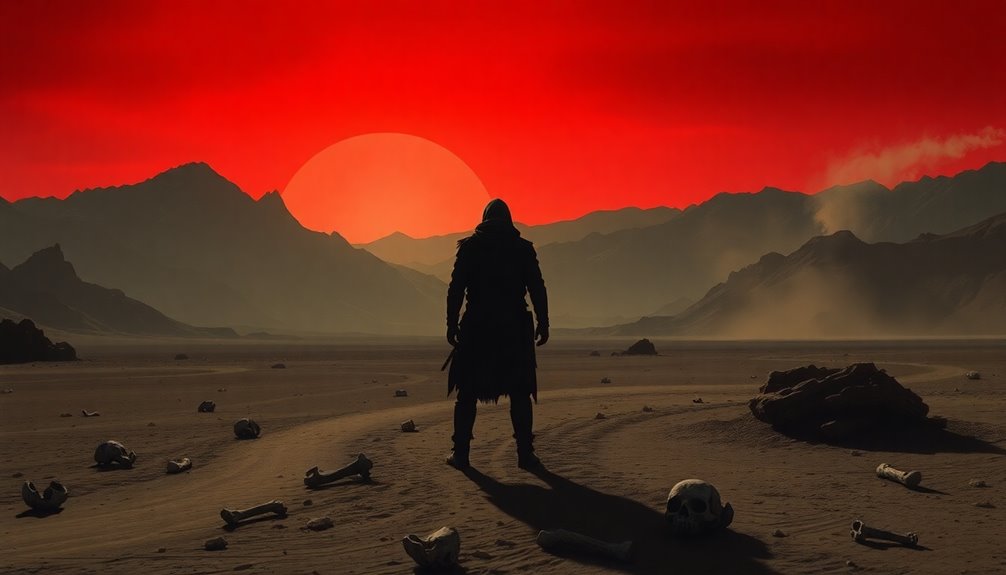
While *Blood Meridian* may seem like a relentless descent into violence and moral ambiguity, it ultimately serves as a profound exploration of humanity’s darkest impulses.
You witness the brutal realities of the mid-19th century through the kid, a reluctant participant in the scalp-hunting gang. Judge Holden embodies evil, promoting a twisted existential philosophy that elevates war as the pinnacle of human power, dismissing notions of good and evil as mere illusions.
The pervasive brutality and moral decay in the novel expose the complexities of the human condition, particularly in the kid’s struggle against the gang’s horrific acts. This narrative mirrors the themes of systemic racism found in Richard Wright’s *Native Son*, which also examines the depths of human despair and moral conflict.
The novel’s relentless brutality reveals the intricate nuances of humanity, highlighting the kid’s internal battle against the gang’s atrocities.
Ultimately, the closing scenes suggest the kid’s spiritual defeat against the judge, leaving you to ponder the bleak nature of evil and hopelessness.
The Evolution of Themes: From Hope to Existentialism
- Hope vs. Despair: *The Road* emphasizes love and resilience, while *Blood Meridian* embraces a nihilistic view.
- Violence: *Blood Meridian* presents violence as intrinsic to the human condition, contrasting with the survival struggle in *The Road*.
- Morality: In *The Road*, morality offers a glimmer of redemption, whereas *Blood Meridian* questions its very existence.
- Existentialism: McCarthy’s later works explore deeper into existential themes, reflecting a continuous exploration of despair and the human condition, similar to how Pi’s journey in *Life of Pi* illustrates the complexities of spirituality and survival.
Which McCarthy Novel Should You Read First?
Wondering where to start with Cormac McCarthy’s works? For new readers, *The Road* is often the best choice. Its straightforward narrative and universal themes of love and survival make it accessible and poignant, and it even won the Pulitzer Prize for Fiction in 2007.
If you prefer a gripping plot with deeper philosophical inquiries, *No Country for Old Men* is another solid entry point, blending action with moral complexity.
On the other hand, if you feel adventurous, you might tackle *Blood Meridian*, McCarthy’s greatest achievement, known for its intricate prose and graphic violence.
Ultimately, your first pick should reflect your taste in narrative style and thematic exploration, with *The Road* and *No Country for Old Men* providing a welcoming introduction.
Conclusion
In the end, Cormac McCarthy’s novels are like a treacherous journey through a dark forest. Each path you take reveals a different shade of despair, yet some lead you to a flicker of hope, like a firefly in the gloom. Whether you find solace in “The Road” or confront the abyss in “Blood Meridian,” you’re bound to emerge transformed. Trust your instincts; let the stories guide you through the shadows to a deeper understanding of the human condition.