Cormac McCarthy’s “Blood Meridian” starkly showcases violence, nihilism, and existential dread in the unforgiving landscape of the American West. The recurring symbols of blood and dirt highlight humanity’s brutal reality and the quest for meaning amidst chaos. Characters like Judge Holden exemplify malevolence, challenging notions of morality in a godless world. As you explore the narrative’s complexities, you’ll encounter deeper insights into the Gnostic themes that shape its dark vision.
The Discovery of Gnostic Texts and Their Significance
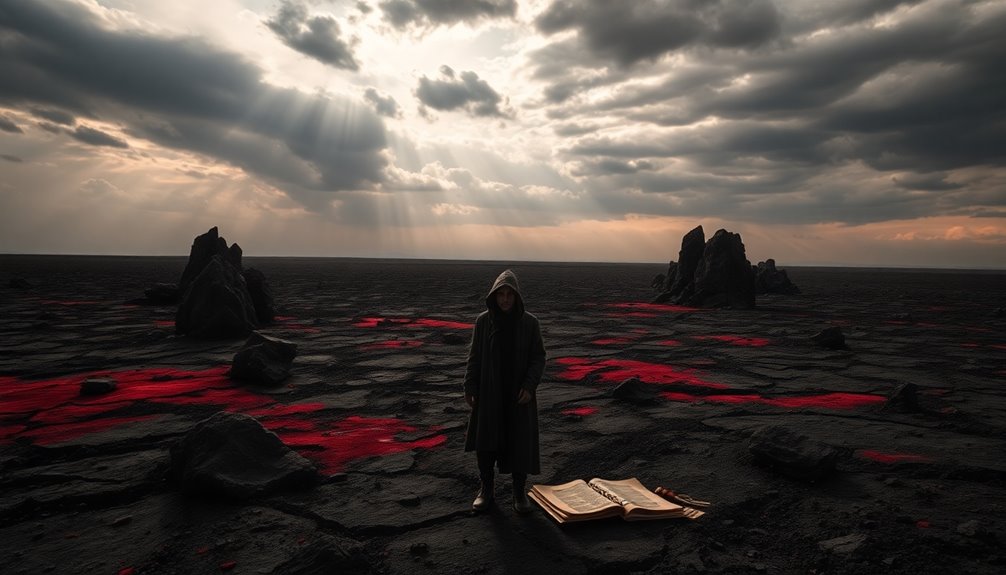
When a peasant boy stumbled upon an earthenware jar in 1945, he unwittingly set off a chain of events that would reshape our understanding of early Christianity.
Inside were 13 Gnostic papyrus books, originally dismissed as kindling by his mother. Years later, an old man, once a priest, safeguarded these texts before they slipped into the black market, where they were ultimately rediscovered by museum curators.
These writings, often deemed heretical, present alternative theological perspectives that challenge mainstream beliefs. They explore dualism and emphasize gnosis as essential for spiritual liberation. The significance of these texts lies in their ability to illuminate the philosophical debates of their time, revealing the rich complexity of early Christian doctrine and the varied perceptions of evil. Additionally, the exploration of systemic racism in literature, exemplified by Richard Wright’s *Native Son*, parallels the Gnostic texts’ challenges to orthodoxy, as both encourage a confrontation with uncomfortable truths.
Understanding Gnosticism: Core Beliefs and Themes

Gnosticism presents a fascinating worldview that contrasts sharply with traditional Christian beliefs. At its core, Gnostic cosmology posits a flawed creator, the demiurge, responsible for the material world, while the true god embodies the spiritual domain.
You’ll find that Gnostics emphasize the duality of humanity; the body and soul stem from the demiurge, but the divine spirit, or pneuma, comes from the true god.
Central to this belief system is the pursuit of divine knowledge, or gnosis, essential for achieving spiritual awakening and escaping the flawed material existence.
Gnostics challenge conventional ideas about evil, attributing it to the incompetence of the demiurge rather than a benevolent creator, revealing a deeply critical perspective on existence and spirituality. This perspective resonates with the ethical questions surrounding informed consent in medical research, highlighting the complexities of human existence and morality.
The Gnostic Gospels: Insights Into Jesus and Knowledge
The Gnostic Gospels offer a unique perspective on Jesus, portraying him not just as a messianic figure but as a conduit for secret knowledge that reveals humanity’s divine potential.
These texts, particularly the Gospel of Thomas, emphasize Gnostic enlightenment through self-knowledge and spiritual awakening. Unlike orthodox Christianity, which focuses on external salvation, Gnosticism invites you to explore the internal nature of the kingdom of God.
It presents a dualistic worldview, suggesting the flawed material domain stems from a lesser creator, the demiurge. This challenges traditional notions of divine benevolence and positions knowledge (gnosis) as crucial for transcending the material and reconnecting with the true God.
Fundamentally, these teachings empower you to uncover your divine essence, reflecting the themes of systemic inequities highlighted in Richard Wright’s *Native Son*.
Exploring Evil Through a Gnostic Lens in Blood Meridian
When you look at Judge Holden in “Blood Meridian,” you see a figure who embodies pure malevolence, acting as a demiurge that controls and manipulates the world around him. His relentless evil raises questions about the nature of existence and the flawed creation that Gnosticism warns us about. This mirrors the intense rivalry between Kane and Abel as they navigate their ambitions, illustrating how unchecked desires can lead to profound moral degradation.
Judge Holden’s Malevolence
While exploring the depths of evil in Cormac McCarthy’s *Blood Meridian*, Judge Holden emerges as a chilling embodiment of malevolence, reminiscent of the Gnostic demiurge.
His entrance into the gang serves as a dark parody of the Last Supper, showcasing his manipulation and charisma. You see him relishing chaos and control, viewing war as a divine game, orchestrating human suffering for his amusement.
Through Holden, Gnostic despair manifests as he perpetuates violence, embodying the archons that maintain a flawed world.
The stark contrast between his relentless cruelty and the kid’s fleeting compassion highlights the moral struggle inherent in Gnostic narratives, forcing you to grapple with the profound implications of good and evil in a world dominated by an incompetent deity.
The Nature of Evil
Evil pervades Cormac McCarthy’s *Blood Meridian*, challenging readers to confront its unsettling nature. Through Judge Holden, the novel embodies the Gnostic demiurge—a malevolent force exerting control and perpetuating violence.
This portrayal leads you to grapple with moral relativism, as the judge’s merciless actions starkly contrast the kid’s fleeting compassion. Amidst the relentless brutality, characters seek meaning, often succumbing to existential despair and the realization of cosmic indifference.
The prairie setting amplifies this exploration, symbolizing both civilization’s expansion and a landscape rife with moral ambiguity. In this world, evil isn’t just a force but a pervasive reality, compelling you to question the nature of existence and the true essence of good and evil.
The Role of Judge Holden: A Gnostic Archetype
Judge Holden’s malevolent nature stands out as a chilling embodiment of Gnostic themes throughout “Blood Meridian.” His actions reveal a chaotic force, akin to the demiurge, that manipulates others and reinforces a brutal worldview. This mirrors Ta-Nehisi Coates’ exploration of systemic violence in racial contexts, highlighting how power dynamics can dehumanize and oppress individuals.
Judge Holden’s Malevolent Nature
As you explore the character of Judge Holden, you’ll find a malevolent force that embodies the darkest aspects of human nature. His presence reveals the unsettling power dynamics at play:
- Holden’s sadism manifests in his enjoyment of violence and control over others.
- He represents the flawed demiurge, manipulating existence while sowing existential dread.
- His philosophy equates war with divine purpose, suggesting brutality is a natural state.
- The contrast between Holden and the kid emphasizes the struggle for moral identity amid chaos.
Through his relentless evil, Judge Holden serves as a chilling reminder of humanity’s capacity for cruelty and the search for meaning in a world stripped of compassion.
Gnostic Symbolism in Actions
While exploring the depths of “Blood Meridian,” you’ll quickly notice that Judge Holden embodies a Gnostic archetype, representing the flawed demiurge that shapes a chaotic and violent world.
His entrance to the gang mirrors a dark parody of the Last Supper, subverting traditional notions of divinity. Through Gnostic symbolism, Holden’s actions reveal his desire for control, painting war as a divine game, reflecting the flawed creation of existence.
As you follow the narrative, you’ll see him as a relentless force of evil, starkly contrasting with the kid’s existential struggle for compassion.
Holden epitomizes the archons’ oppressive nature, emphasizing the conflict between the pursuit of knowledge and the dark realities of the material world.
The Kid: Struggling Between Violence and Redemption
Struggling to find his place in a world steeped in brutality, the Kid in “Blood Meridian” embodies the tension between violence and the yearning for redemption. You witness his inner conflict as he confronts moral ambiguity in a landscape dominated by chaos. His relationship with Judge Holden forces you to grapple with profound questions:
- The duality of human nature: compassion versus brutality
- The impact of environment on personal choices
- The struggle to define one’s identity amidst violence
- The possibility of redemption in a nihilistic world
As the Kid navigates this tumultuous existence, his quest for redemption becomes a central theme, challenging you to reflect on humanity’s capacity for both destruction and salvation. Much like Bigger Thomas in “Native Son,” the Kid’s struggle is influenced by systemic racism that shapes his interactions and choices in a brutal environment.
Symbolism of Blood and Dirt in McCarthy’s Narrative
The Kid’s journey through a landscape rife with violence leads to a deeper examination of the symbols that permeate McCarthy’s narrative, particularly blood and dirt.
Blood embodies both violence’s reality and humanity’s fundamental nature, illustrating the brutal existence in the lawless American West.
Blood symbolizes the harsh truth of violence and the intrinsic nature of humanity, reflecting the savage life of the untamed American West.
Meanwhile, dirt signifies the earth’s harshness and the relentless struggle for survival, intertwining life and death in a desolate setting.
The act of digging, especially post hole digging, reflects a search for meaning amid chaos, echoing the artist’s existential quest.
McCarthy’s portrayal of blood’s duality and dirt’s significance emphasizes a relentless cycle of creation and destruction, highlighting a universe indifferent to suffering, ultimately underscoring the pervasive nihilism in the narrative. Additionally, this exploration of systemic oppression resonates with Bigger Thomas’s journey in “Native Son,” as both characters grapple with the harsh realities imposed by their environments.
Nihilism and the Absence of Divine Purpose
Nihilism pervades Cormac McCarthy’s “Blood Meridian,” creating a bleak landscape where divine purpose is conspicuously absent. The narrative embodies a nihilistic philosophy, emphasizing divine indifference and existential despair through its characters and themes.
Judge Holden epitomizes this malevolent force, highlighting humanity’s struggle against a chaotic universe devoid of inherent meaning.
- The futility of human existence is illustrated through relentless violence.
- The kid’s internal conflict reflects the tension between brutality and a faint hope for redemption.
- The world is depicted as a godless purgatory, reinforcing moral ambiguity.
- Gnostic symbolism deepens the sense of entrapment within a flawed creation.
In this unforgiving setting, McCarthy challenges your understanding of purpose and morality, much like Ta-Nehisi Coates’ exploration of systemic racism that underscores the harsh realities faced by marginalized communities.
The Prairie as a Stage for Existential Inquiry
As you traverse the vast expanse of the prairie in “Blood Meridian,” you’re confronted with more than just a desolate landscape; it becomes a stage for profound existential inquiry.
The chaotic landscapes reflect the existential dread felt by the characters, who struggle against the harsh realities of a godless world. The figure digging post holes symbolizes humanity’s deeper quest for truth amidst the relentless expansion driven by human ambition.
McCarthy masterfully illustrates the conflict between this ambition and the unforgiving nature surrounding them, prompting you to question morality and existence. Through the prairie, he invites you to grapple with the philosophical implications of creation and destruction, mirroring the inner turmoil of characters like the kid and Judge Holden. This struggle resonates with the ideals of collective action as seen in historical resistance movements, emphasizing the importance of unity in confronting overwhelming odds.
Artistic Interpretation: The Role of the Artist in Meaning-Making
In “Blood Meridian,” you see how the act of creation transforms chaos into meaning, reflecting the artist’s role in shaping understanding.
As you explore the characters and their struggles, you can’t help but notice how their search for significance mirrors your own quest for truth.
Ultimately, McCarthy challenges you to confront the darker aspects of existence while still believing in the power of art to illuminate the way. The narrative’s exploration of systemic racism resonates with the emotional toll of black identity, urging you to reflect on broader societal injustices.
Transformative Power of Art
Art possesses a transformative power that shapes our understanding of existence, especially in the brutal landscape of Cormac McCarthy’s “Blood Meridian.”
Through the character of the kid, you see how the chaos of violence can spark artistic expression, revealing deeper moral questions that resonate with the human experience.
- The act of digging post holes symbolizes the quest for truth and meaning.
- Relentless violence serves as a backdrop for necessary artistic interpretation.
- McCarthy’s godless wasteland invites existential questioning, akin to an artist’s struggle.
- The kid embodies the tension between violence and a divine spark, showcasing how chaos transformation leads to artistic alchemy.
In this way, art becomes a vessel for meaning exploration amidst adversity.
Searching for Meaning Through Creation
Creating meaning in a chaotic world often falls to the artist, who must navigate the harsh realities surrounding them. In “Blood Meridian,” the act of digging post holes serves as a powerful metaphor for existential creation, reflecting your own struggles in seeking truth amid turmoil.
This metaphoric labor embodies the artist’s challenge to infuse meaning into a landscape rife with violence and despair. McCarthy illustrates that through artistic interpretation, you can re-examine historical events, revealing the moral ambiguities of existence.
The kid’s character embodies the tension between violence and compassion, highlighting the artistic struggle to create amidst destruction. Ultimately, McCarthy’s portrayal of the prairie as a site of inquiry emphasizes the importance of artistic expression in confronting life’s inherent absurdities.
Gnostic Dualism: Body, Soul, and the Quest for Truth
While traversing the brutal landscapes of “Blood Meridian,” you encounter a profound struggle between the body and the soul, emblematic of Gnostic dualism. The narrative vividly illustrates the existential conflict inherent in this struggle, with characters like the kid seeking spiritual ascendance amid material bondage.
- The judge represents the demiurge, embodying chaos and control.
- The kid grapples with violence while yearning for a divine spark.
- Knowledge (gnosis) emerges as essential for escaping the flawed material domain.
- The relentless cycle of violence emphasizes the conflict between physical existence and spiritual enlightenment.
In this harsh world, McCarthy challenges you to confront the complex relationship between body and soul, prompting you to ponder your own quest for truth and meaning.
Historical Context: The American West as a Gnostic Landscape
The American West in “Blood Meridian” serves as a harsh but fitting backdrop for exploring Gnostic themes. The 19th-century American Frontier embodies existential struggles, where characters confront a brutal landscape rife with violence and lawlessness.
This environment reflects Gnostic beliefs, presenting a flawed creation governed by divine indifference. McCarthy’s portrayal of the West illustrates a godless domain, where survival becomes a relentless battle against chaos and evil.
The character of Judge Holden epitomizes these Gnostic philosophies, embodying chaos while challenging moral constructs. In this unforgiving setting, the conflict between the material world and the divine spark of the soul intensifies, making the American West a compelling Gnostic territory that underscores humanity’s plight within a seemingly indifferent universe.
Confronting the Abyss: Reflection on Human Existence and Morality
In confronting the abyss of human existence in “Blood Meridian,” McCarthy challenges readers to grapple with the stark realities of morality and the nature of evil. You witness the tension between the compassionate kid and the nihilistic Judge Holden, reflecting the existential despair that permeates the narrative.
The American West serves as a purgatorial backdrop, questioning the meaning of life amidst historical violence.
- Moral ambiguity defines choices in a chaotic world.
- The judge’s view of war emphasizes humanity’s darker instincts.
- The act of digging post holes symbolizes a quest for truth.
- Amidst brutality, human resilience emerges as a fragile hope.
This exploration invites you to reflect on your own understanding of existence and morality.
Conclusion
In the haunting landscape of *Blood Meridian*, McCarthy drags you through a nightmarish abyss where blood and dirt intertwine, revealing the raw, unvarnished truth of existence. You can’t help but feel the weight of nihilism pressing down like an iron shroud, suffocating any flicker of hope. Judge Holden looms like a monstrous specter, embodying the darkest corners of the human soul, leaving you gasping for meaning in a world where morality is but a fleeting shadow.