
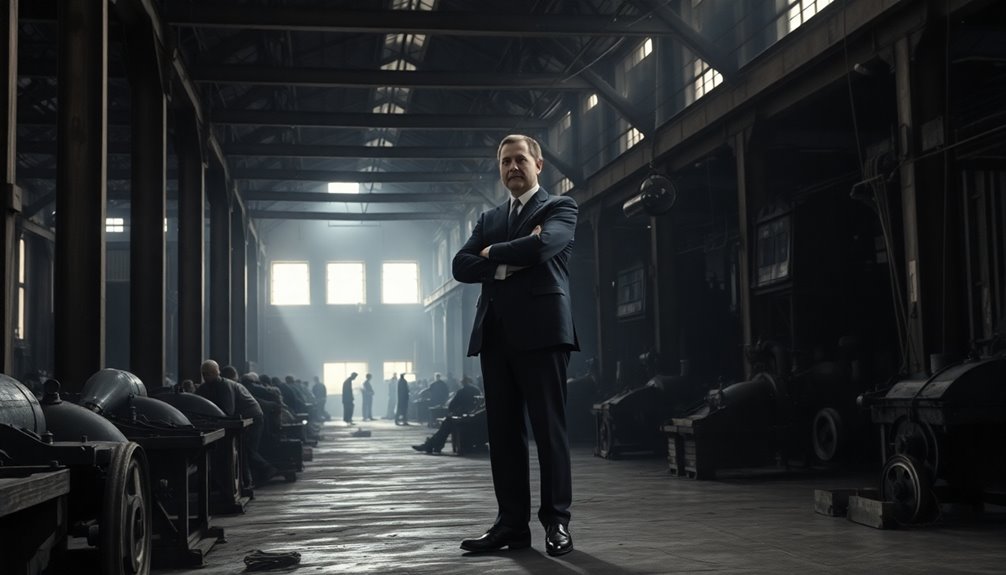
J.P. Morgan treated his workers harshly, subjecting them to long hours, low wages, and unsafe conditions. They often worked 12-hour shifts for just $2.50 a day amidst dangerous environments, leading to high injury and death rates. While Morgan’s wealth grew, worker dissatisfaction festered due to inadequate support and anti-union policies. This setup not only fueled labor unrest but also highlighted the stark inequalities of the Gilded Age. There’s much more to explore about this complex legacy.
The Gilded Age: A Brief Overview of Corporate America

During the Gilded Age, as America transformed into an industrial powerhouse, you’d see a stark contrast between the glittering wealth of a few and the struggles of many.
This era, spanning from 1870 to 1900, was marked by rapid industrial growth, driven by advancements in railroads, factories, and steel production.
Powerful industrialists, often called “robber barons,” amassed fortunes that dwarf those of today’s tech moguls.
However, this wealth came at a cost. Worker welfare often took a backseat to profit, leading to rampant financial inequality.
Mark Twain coined the term “Gilded Age” to highlight the shiny surface that masked serious social issues, including poverty and exploitation, ultimately sparking labor movements and calling for reforms in American industry. The narrative of this period echoes the class struggles faced by the working class in early 20th-century literature.
J.P. Morgan: A Titan of Industry and Finance

The Gilded Age wasn’t just about the rise of industrial power; it also saw the emergence of influential figures like J.P. Morgan. As a titan of industry and finance, he played a pivotal role in shaping the American economy.
Morgan founded U.S. Steel in 1901, creating the world’s first billion-dollar corporation by merging key steel companies, including Andrew Carnegie’s. His financial acumen stabilized markets, particularly bailing out the U.S. government during the Panic of 1907.
However, while he advanced industrial growth, his labor practices often resulted in harsh working conditions and anti-union sentiments. Additionally, the era was marked by systemic racism, which influenced labor dynamics and worker rights in profound ways.
Morgan’s legacy is therefore a complex blend of innovation and exploitation, reflecting the challenges faced by workers during this transformative industrial age.
The Workforce Behind Morgan’s Empire: Who Were They?
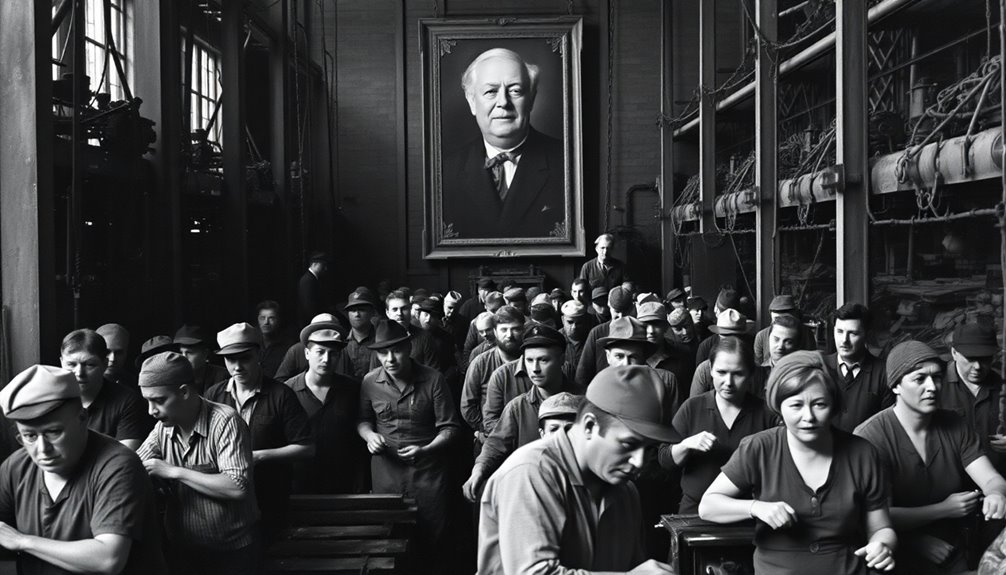
Morgan’s empire rested on the backs of immigrant laborers and unskilled workers, who toiled under grueling conditions. These workers faced harsh realities, including:
- Dangerous working conditions that led to high injury rates, with 195 fatalities reported in 1907 alone.
- Low wages, averaging just $2.50 for a twelve-hour day, barely enough to support families.
- Life in company towns, where they were forced to shop at overpriced company stores, deepening their financial exploitation.
- Despite the struggles, some workers remained loyal, as Morgan’s companies sometimes offered better wages than competitors.
These elements paint a vivid picture of the sacrifices made by those who built Morgan’s empire, revealing a complex relationship between labor and industry during the Gilded Age. Additionally, the systemic discrimination faced by workers during this era mirrored the injustices seen in other historical contexts, underscoring the shared struggle for dignity and rights across different communities.
Long Hours and Low Wages: The Reality for Morgan’s Workers
While many sought opportunities in J.P. Morgan’s industries, the reality for workers was harsh. You faced long hours, often clocking in 12-hour shifts, six or seven days a week, with barely any breaks.
The wages were typically lower than those at competing firms, making it tough to support your family on such meager pay. Cost-cutting measures prioritized profits over worker welfare, leaving you feeling insecure and dissatisfied.
Wages were often below industry standards, forcing families to struggle while profits took precedence over worker welfare.
In 1907 alone, there were 195 reported worker deaths and over 2,000 serious injuries, highlighting the dangerous working conditions you endured.
Despite some management improvements, the oppressive labor practices under Morgan’s oversight exemplified the grim realities of the Gilded Age’s industrial workforce, where your well-being was often an afterthought. The systemic racism and economic disparities faced by many during this era further complicated workers’ struggles for fair treatment and dignity.
Health Hazards in the Workplace: Unsafe Conditions and Their Consequences
Working in J.P. Morgan’s industries meant facing dangerous environments every day.
You’d encounter not just long hours but also serious health risks from inadequate safety measures.
These unsafe conditions didn’t just threaten immediate well-being; they often led to long-term consequences that affected workers for life. Moreover, the legacy of resistance movements in advocating for better working conditions underscores the importance of standing up for justice in the workplace.
Dangerous Working Environments
In an era when industrial expansion often overshadowed worker welfare, employees in J.P. Morgan’s industries faced dangerous working environments that put their lives at risk.
With grueling shifts and inadequate safety measures, the consequences were dire. Consider these chilling facts:
- In 1907, there were 195 reported worker deaths and over 2,000 serious injuries.
- Lack of protective equipment led to numerous workplace accidents.
- Poor ventilation contributed to debilitating respiratory diseases.
- Average wages of $2.50 per twelve-hour day pushed workers into financial hardship.
These harsh conditions normalized danger, prioritizing profits over safety.
Workers endured the relentless toll of unsafe environments, their lives forever altered by the relentless machinery of industry.
Health Risks Faced
Health risks were an ever-present threat for workers in J.P. Morgan’s industries. With grueling 12-hour shifts, seven days a week, many faced chronic fatigue, which heightened the chance of accidents.
In 1907 alone, there were 195 reported injuries and deaths due to hazardous working conditions in the steel and railroad sectors. The absence of safety regulations meant workers operated heavy machinery without adequate protective equipment, further exposing them to health hazards.
Additionally, air pollution from industrial operations plagued company towns, leading to respiratory issues for workers and their families. Cost-cutting measures prioritized profits over safety, normalizing dangerous conditions and fostering a culture of negligence regarding worker welfare.
This created an environment where health risks flourished.
Long-Term Consequences
Though many workers sought to provide for their families, the unsafe conditions in J.P. Morgan’s industries led to devastating long-term consequences. The prioritization of profit over safety resulted in a culture where hazards were normalized.
Here are some stark realities of their working conditions:
- Over 195 deaths and 2,000 serious injuries reported in 1907 alone.
- Chronic health issues from rampant air pollution in company towns.
- Lack of protective equipment put workers at constant risk.
- Inadequate safety regulations highlighted the neglect of workers’ rights.
These monopolistic practices prompted future labor reforms, emphasizing the urgent need for safety regulations to protect the health and rights of workers in industrial settings.
The legacy of these unsafe conditions still echoes in labor history today.
Labor Relations: How Did Morgan Manage Employee Dissatisfaction?
Despite J.P. Morgan’s personal relationships with workers, he managed employee dissatisfaction through strict anti-union policies. His view of organized labor as a threat led to aggressive tactics during labor disputes.
By acquiring U.S. Steel in 1901, he weakened union influence, allowing him to impose harsh working conditions and long 12-hour shifts. Reports from 1907 highlighted 195 deaths and over 2,000 serious injuries, exacerbating worker grievances.
While Morgan introduced some welfare initiatives, his focus on cost-cutting resulted in wage cuts that left workers feeling undervalued. This paradoxical approach fostered a tense labor climate, as employees demanded better conditions and fair treatment, ultimately highlighting the disconnect between profits and worker welfare in Morgan’s empire. The impact of systemic racism on labor dynamics also contributed to the broader challenges faced by workers in his industrial empire.
The Role of Strikebreakers: Morgan’s Tactics During Labor Conflicts
When you look at J.P. Morgan’s approach during labor conflicts, you’ll see he often relied on strikebreakers, including the notorious Pinkerton agents.
These tactics created a climate of fear, where violence and intimidation became tools to suppress union efforts. This method mirrored strategies used in mystery literature, where intricate plots often involve deception and manipulation to achieve desired outcomes.
Use of Pinkerton Agents
As labor unrest escalated in the late 19th century, J.P. Morgan turned to Pinkerton agents to maintain corporate stability at the expense of workers’ rights.
These private security forces were often hired during strikes, intensifying conflicts and fostering a culture of intimidation.
Consider the impact:
- Workers faced violent confrontations, leading to multiple deaths.
- The presence of strikebreakers heightened tensions and hostility.
- Workers felt discouraged from organizing or seeking better conditions.
- Morgan’s tactics reflected a broader trend of industrialists prioritizing profit over people.
2. Violence and Intimidation Tactics
J.P. Morgan’s approach to labor conflicts often relied on violence and intimidation. He employed strikebreakers, such as the infamous Pinkerton agents, to dismantle labor strikes and secure control over his companies.
During the Homestead Strike of 1892, these tactics escalated into violent clashes, resulting in multiple fatalities. Morgan’s use of private security forces not only threatened striking workers but also highlighted his preference for corporate stability over worker rights.
In 1907, his influence led to the dismissal of union sympathizers and the establishment of spy networks to monitor labor organizations. These actions reflected a broader pattern of suppression during the Gilded Age, where corporate interests consistently clashed with the emerging movements advocating for worker rights.
3. Suppression of Labor Unions
Although many viewed labor unions as an essential means for workers to advocate for their rights, Morgan saw them as a direct threat to his corporate efficiency. His firm anti-union stance prioritized profit over people, leading to significant labor conflicts.
To suppress unions, he relied on strikebreakers, including the infamous Pinkerton agents.
Consider the impact of his tactics:
- Violent confrontations during events like the Homestead Strike.
- Erosion of workers’ rights and collective bargaining power.
- Increased tension between labor and management.
- The rise of the labor reform movement in response to oppression.
Morgan’s aggressive approach to suppressing unions left a lasting mark on the workforce, prioritizing stability and profit above all else.
Philanthropy vs. Exploitation: A Dual Legacy
While J.P. Morgan’s philanthropy, like establishing the Morgan Library and Museum, showcases his commitment to culture, it contrasts sharply with the exploitation faced by his workers.
In the steel and railroad industries he controlled, employees endured grueling 12-hour shifts, often in unsafe working conditions. A 1907 report revealed 195 deaths and over 2,000 serious injuries, highlighting the dire realities they faced.
Despite some attempts to improve conditions, Morgan suppressed labor unions and relied on strikebreakers to quell unrest.
His legacy embodies this dual narrative—advancing industrial progress while delaying essential labor reforms.
You see, Morgan’s actions reflected a prioritization of profit over workers’ rights, ultimately contributing to a culture of exploitation that overshadowed his philanthropic efforts.
Comparing J.P. Morgan to His Contemporaries: Rockefeller and Carnegie
When you compare J.P. Morgan to contemporaries like Rockefeller and Carnegie, you see distinct approaches to labor relations and worker treatment.
While Carnegie championed philanthropy and worker welfare, Morgan prioritized financial stability, often sacrificing employee rights.
Rockefeller’s ruthless tactics contrast with Morgan’s focus on consolidation, but all three faced criticism for their treatment of workers.
Additionally, the impact of systemic racism in the broader economic landscape influenced labor practices during this era.
Labor Relations Strategies
In examining labor relations strategies, you’ll find that J.P. Morgan’s approach prioritized financial power over worker welfare. Unlike Carnegie, who offered some benefits, Morgan often implemented harsh measures that impacted working conditions.
Here’s how his strategies differed from his contemporaries:
- Efficiency over Welfare: Layoffs and wage cuts were common under Morgan.
- Aggressive Tactics: Morgan used strikebreakers and security forces to suppress labor unrest.
- Consolidation Consequences: His financial strategies led to industry stabilization, often at workers’ expense.
- Anti-Union Stance: Like Rockefeller, he opposed unions but with greater confrontational methods.
Ultimately, while all three industrialists engaged in exploitative labor practices, Morgan’s approach left a particularly complex legacy regarding worker treatment.
Philanthropic Contributions Compared
J.P. Morgan’s philanthropic contributions mainly focused on arts and culture, exemplified by the establishment of the Morgan Library and Museum.
However, when you compare him to contemporaries like Andrew Carnegie and John D. Rockefeller, his impact appears modest. Carnegie, a staunch advocate for philanthropy through his “Gospel of Wealth,” donated over $350 million to educational and public institutions, promoting broad wealth distribution.
Meanwhile, Rockefeller, despite initial criticism, contributed more than $500 million to various charitable causes.
While Morgan’s efforts were significant, they primarily supported cultural institutions, unlike Carnegie and Rockefeller, who addressed pressing social issues.
This reflects differing priorities among these industrial titans, showing how their approaches to philanthropy shaped their legacies.
Worker Treatment Practices
Worker treatment practices among industrial titans like J.P. Morgan reveal a harsh reality for workers. While Morgan and his contemporaries like Carnegie and Rockefeller amassed wealth, they often neglected labor rights and safety.
Consider these facts:
- Workers faced grueling 12-hour shifts with minimal breaks.
- Injury rates soared, with 195 deaths and over 2,000 serious injuries in 1907.
- Morgan cut costs, leading to lower wages, unlike Carnegie, who later supported better worker treatment.
- Both Morgan and Rockefeller employed anti-union tactics, with Morgan maintaining a surprisingly cordial approach.
Unlike Carnegie’s philanthropic legacy, Morgan’s focus on financial consolidation came at the expense of worker treatment, delaying essential reforms and leaving a troubling mark on working conditions.
The Impact of the Panic of 1907 on Workers’ Rights
While the Panic of 1907 shook the financial foundation of the nation, its effects rippled far beyond the banking sector, leaving countless workers grappling with job insecurity and reduced wages.
As companies struggled under financial strain, layoffs became common, further worsening the already tough conditions of the Gilded Age.
J.P. Morgan’s intervention stabilized banks but didn’t address the plight of workers, whose livelihoods depended on the decisions of powerful financiers.
This crisis highlighted the fragility of workers’ rights, sparking urgent discussions about labor reforms. Systemic oppression that marginalized workers was made even more evident during this time.
The economic expansion that once fueled optimism now revealed the need for better protections, laying the groundwork for future legislation, including the National Labor Relations Act, aimed at securing fair treatment for workers.
Public Perception: How Was Morgan Viewed by Society?
The aftermath of the Panic of 1907 left many questioning the role of powerful financiers in shaping the economy and society. J.P. Morgan‘s public perception was a mixed bag, as he was both revered and reviled. His immense wealth contrasted sharply with the plight of workers, leading to widespread criticism. Many labeled him a “robber baron” for prioritizing profits over people.
Consider these points:
- Workers earned less than $500 annually while Morgan amassed $68 million.
- His anti-union stance fueled labor unrest.
- Philanthropic efforts, like art patronage, didn’t address poor working conditions.
- Calls for reform grew louder as laborers faced exploitation.
Ultimately, Morgan’s legacy remains complicated, shaped by societal struggles and disparities. Additionally, the theme of dignity in literature often parallels the fight for fair treatment and respect in the workforce.
The Influence of Morgan’s Practices on Modern Corporate Culture
Although J.P. Morgan’s focus on efficiency often resulted in harsh working conditions, it also sparked a shift in modern corporate practices. Today, businesses recognize that prioritizing employee welfare alongside productivity is essential for success.
While Morgan suppressed labor unions and emphasized shareholder interests, his legacy highlights the ongoing tension between management and organized labor. This struggle continues to challenge employee rights in contemporary corporations.
Despite his anti-union stance, Morgan’s belief in investing in worker satisfaction foreshadowed a growing understanding of employee engagement’s importance. As discussions about corporate responsibility evolve, companies are increasingly called to balance economic growth with fair treatment of workers, shaping a more ethical corporate culture today.
Worker Surveillance: Monitoring and Control Tactics
Employee surveillance under J.P. Morgan was extensive and relentless. His tactics aimed to maintain control over workers while prioritizing corporate interests. You’d find yourself under constant monitoring, where every action was scrutinized.
Here are some chilling aspects of this environment:
- Spy Networks: Secretive systems were in place to identify union sympathizers.
- Private Security: The Pinkerton agents suppressed labor organization efforts with intimidation.
- Close Scrutiny: Management tracked your activities to prevent any dissent.
- Culture of Fear: This pervasive surveillance fostered anxiety, discouraging any protest against exploitative conditions.
In this oppressive atmosphere, worker autonomy was sacrificed for efficiency, leaving you feeling trapped and powerless.
The Role of Unions in the Gilded Age: A Response to Morgan’s Policies
During the Gilded Age, you’d see workers banding together to form unions as a direct response to J.P. Morgan’s harsh policies.
These organizing efforts led to significant strikes, like the Homestead Strike, where workers fought for better conditions.
Unions became a powerful force, challenging the exploitative practices that defined the era.
Union Organizing Efforts
As the Gilded Age progressed, workers increasingly organized to combat the oppressive conditions imposed by industrial giants like J.P. Morgan.
Union organizing efforts emerged as an essential response to the harsh realities they faced, including:
- 12-hour workdays for minimal pay.
- Unsafe working conditions that put their lives at risk.
- Wage cuts that squeezed their already meager earnings.
- An anti-union stance that crushed their attempts for collective bargaining.
Despite Morgan’s financial clout and his deployment of strikebreakers, these labor movements laid the groundwork for future reforms.
Workers united against his oppressive policies, working towards better rights and conditions, proving that change was possible even in the face of immense resistance.
Strikes and Labor Conflicts
While many workers faced dire conditions in the Gilded Age, strikes became a powerful tool for challenging the oppressive policies of industrial magnates like J.P. Morgan. Labor unions emerged to combat poor working conditions, often resorting to strikes to demand better wages and safer environments.
Importantly, the Homestead Strike of 1892 showcased the violent clashes between workers and management, reflecting Morgan’s anti-union stance. He hired private security forces, like the Pinkertons, to suppress union activities, prioritizing profit over labor rights.
The Panic of 1907 intensified financial volatility, leading to layoffs and wage cuts, further fueling labor unrest. Morgan’s resistance to unionization ultimately sparked a labor reform movement, paving the way for future legislation to protect workers.
Lessons From J.P. Morgan: What Can Modern Corporations Learn?
Understanding J.P. Morgan’s approach reveals key lessons for modern corporations. His legacy teaches us that balancing profits with workers’ rights is essential. Here are four important takeaways:
J.P. Morgan’s legacy highlights the critical balance between profitability and prioritizing workers’ rights in today’s corporate landscape.
- Prioritize Safety: Inadequate working conditions led to high injury rates; prioritize employee safety to boost morale.
- Fair Wages: Paying competitive wages supports families and reduces frustration, enhancing loyalty and productivity.
- Foster Communication: Suppressing labor unrest through force backfired; open dialogue with employees can prevent conflicts.
- Invest in Welfare: Morgan’s focus on efficiency overlooked worker welfare; investing in your team creates a happier, more productive workforce.
Conclusion
In the shadow of J.P. Morgan’s towering empire, you see the struggles of workers who toiled like cogs in a relentless machine. Their long hours and meager wages paint a stark picture of ambition’s cost. While Morgan’s legacy persists in today’s corporate world, his treatment of labor serves as a cautionary tale. Remember, every titan’s rise can cast a long shadow—let’s guarantee that light shines on fair treatment and dignity for workers in every corner of industry.