
“Fahrenheit 451” is often banned due to its explicit language, controversial themes, and societal critiques. Some communities find its content inappropriate for younger audiences or fear it might challenge traditional values. The irony lies in censoring a book that critiques censorship, highlighting a contradiction between promoting intellectual freedom and seeking to limit exposure to difficult ideas. This ongoing debate reflects broader issues of censorship and freedom in education. You’ll discover more insights on these vital themes when you explore further.
The Surprising History of “Fahrenheit 451”
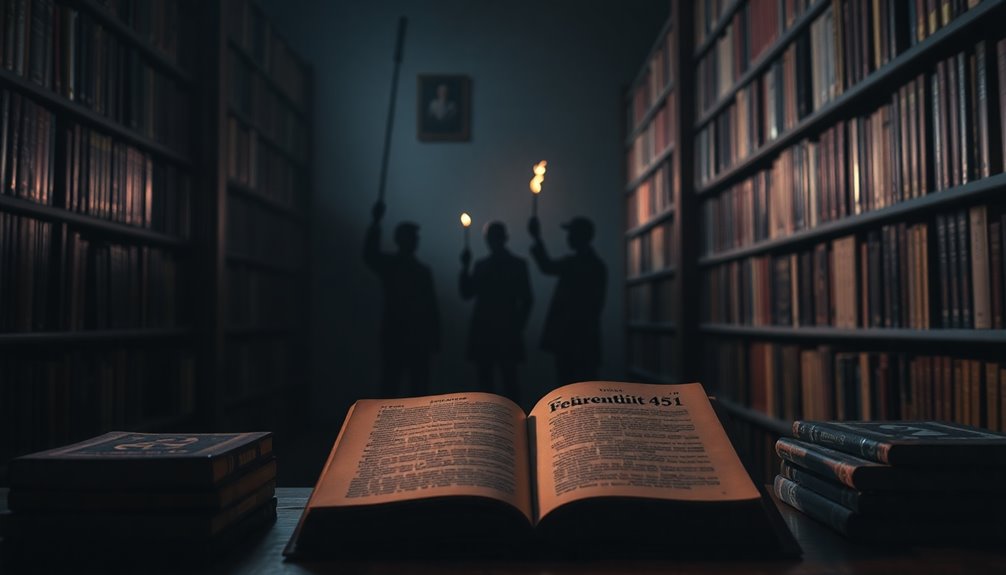
When you plunge into the surprising history of “Fahrenheit 451,” you’ll find that Ray Bradbury’s 1953 novel has faced significant censorship and challenges across the globe.
This banned book has been targeted due to its use of vulgar language and themes considered offensive by some. In places like South Africa and various U.S. states, certain chapters have been removed from educational curricula.
Critics often cite concerns over profanity, religious sentiments, and its portrayal of societal norms as reasons for these challenges.
Ironically, a book that critiques censorship itself becomes a victim of it, sparking vital discussions on the importance of intellectual freedom. This ongoing struggle highlights the need for diverse ideas in education and society, much like the way Richard Wright’s *Native Son* ignited discussions about systemic racism and representation in literature.
Key Themes Addressing Censorship in “Fahrenheit 451”

In “Fahrenheit 451,” key themes addressing censorship reveal the profound consequences of suppressing knowledge and ideas.
You see a dystopian world where books are banned, and firemen burn any they find, showcasing the dangers of ideological repression.
Guy Montag’s transformation from a conforming fireman to a questioning individual highlights how literature fuels personal growth and critical thinking.
Clarisse McClellan acts as a catalyst for Montag’s awakening, emphasizing curiosity’s role in challenging censorship and societal norms.
The novel critiques mass media’s distractions, reminding you of the necessity for intellectual freedom and diverse ideas.
Ultimately, Bradbury’s work serves as a stark irony, as banning a book about censorship contradicts its core message about the importance of freedom of expression. Additionally, the themes of moral ambiguity in literature, as seen in works like “The Secret History,” further underscore the significance of exploring complex ideas without fear of retribution.
Why Do Some Communities Call for the Book’s Ban?

Some communities push to ban “Fahrenheit 451” because they see its language as inappropriate for children, citing profanity that raises concerns about behavior and morality.
Others voice religious objections, arguing that the book promotes anti-Christian sentiments.
This desire to control reading material often stems from a fear of the book’s ideological influence on young minds. Additionally, this mirrors a broader societal issue regarding systemic censorship, which is often enforced in response to fear of challenging established norms.
Language and Profanity Concerns
While many consider “Fahrenheit 451” a classic of literature, its language has sparked significant controversy among communities concerned about profanity. Critics argue that phrases like “Good Christ,” “goddam,” and “damn” are inappropriate for students, claiming they endorse bad behavior. This leads to calls for the book to be banned, as some believe it sends mixed messages about acceptable language in schools.
Furthermore, challengers suggest that the language reflects anti-Christian sentiments, reinforcing their push for censorship. Previous instances of censorship have even led to modifications of the text, like blacking out profanity in educational editions.
The ongoing debate highlights broader concerns about protecting children from literature that includes challenging language, prompting persistent calls for the book’s ban.
Religious and Moral Objections
As concerns about the moral implications of literature rise, many communities grapple with the decision to ban “Fahrenheit 451.” Critics argue that its portrayal of anti-Christian sentiments undermines fundamental beliefs, prompting parents and community leaders to demand censorship.
Key reasons for these religious and moral objections include:
- The book’s use of profanity, like “Good Christ” and “goddam,” which some find offensive.
- The belief that its language endorses bad behavior, leading to mixed messages in schools.
- A desire to impose community moral standards on educational materials, pushing for control over content deemed inappropriate.
These calls to ban the book reflect broader issues of censorship, raising questions about the freedom of expression in society while ironically challenging a book about censorship itself.
Fear of Ideological Influence
Communities often express a fear of ideological influence when discussing the ban of “Fahrenheit 451.” Critics worry that the book’s themes might shape young minds in ways that conflict with their values.
They argue that profanity and controversial subjects, like censorship and violence, could endorse bad behavior among children. In regions like Mississippi and Texas, some have labeled the book as “filth,” fearing its impact on morality and religious beliefs.
These concerns often lead to calls for censorship, echoing the very book burnings the story critiques. While some advocate for its removal from curricula, many school committees stress the importance of intellectual freedom and diverse literature, recognizing that exposure to challenging ideas can foster critical thinking.
The Irony of Banning a Book About Censorship
When you think about it, banning “Fahrenheit 451,” a book that warns against censorship, creates a striking contradiction. This irony highlights not just historical issues but also modern challenges in upholding free expression. As you explore this topic, consider how these actions reflect ongoing tensions between community standards and intellectual freedom, similar to the way ethical questions arise regarding consent and ownership in the context of marginalized narratives that shape history.
Historical Context of Censorship
Though it might seem paradoxical, the act of banning “Fahrenheit 451” serves as a powerful demonstration to the very themes of censorship that Ray Bradbury critiques in his novel.
Written during the McCarthy era, this book reflects the fear of ideological repression and the historical context of censorship.
Consider these points:
- The Nazi book burnings symbolize the extreme consequences of suppressing dissenting voices.
- The novel’s provocative themes challenge conformity, exposing the dangers of censorship.
- Despite its intent to critique censorship, “Fahrenheit 451” has faced numerous challenges in educational settings due to its controversial language.
Modern Challenges and Responses
While the act of banning “Fahrenheit 451” might seem like a misguided attempt to control content, it ironically underscores the very issues of censorship that Bradbury warns against.
In recent years, this classic has faced challenges in schools across the U.S., primarily due to concerns about profanity, violence, and perceived anti-Christian sentiment. In 2017, an eighth-grade curriculum faced scrutiny, yet a school committee recommended keeping the book.
This highlights the contradictions in censorship efforts, as critics argue they attempt to limit access to literature, thereby contradicting the book’s core themes of freedom of expression.
Ongoing debates about “Fahrenheit 451” in educational settings reflect the broader implications of censorship and the necessity of diverse literature in fostering critical thinking.
Voices of Dissent: Arguments Against Censorship
Censorship stifles the very essence of literature, as critics argue that banning books like “Fahrenheit 451” directly contradicts the novel’s warning against suppressing free thought.
Here are three compelling arguments against censorship:
- Context Matters: Critics emphasize understanding the context of literature, arguing that challenges based on profanity or perceived anti-Christian sentiment miss the broader messages.
- Intellectual Freedom: The American Library Association highlights that censorship often limits access to diverse perspectives, undermining critical thinking.
- Support for Retention: Some school committees advocate for keeping “Fahrenheit 451” in curricula, showcasing a commitment to intellectual freedom despite censorship pressures.
Ultimately, these voices of dissent remind us that literature should inspire discussion and challenge societal norms, not be silenced. Moreover, the themes of systemic racism explored in works like *Native Son* reinforce the necessity of confronting uncomfortable truths through literature.
The Role of Educational Institutions in Book Challenges
When it comes to book challenges like those against “Fahrenheit 451,” educational institutions play an essential role in shaping curriculum choices.
You might see schools balancing the need for intellectual freedom with community concerns, which often leads to heated debates.
This tension highlights the importance of maintaining access to diverse literature while respecting parental input.
Impact on Curriculum Choices
- Censorship Concerns: Challenging books often reflects broader societal debates about what’s appropriate for students.
- Alternative Assignments: Many schools offer alternatives for students uncomfortable with certain texts, balancing community values and educational goals.
- Critical Thinking: Keeping *Fahrenheit 451* in the curriculum promotes discussions about censorship and societal issues, fostering critical thinking.
Ultimately, the ongoing debates surrounding *Fahrenheit 451* reveal the tension between promoting diverse literature and responding to community pressures.
Balancing Intellectual Freedom
While educational institutions endeavor to uphold intellectual freedom, they often find themselves traversing the complexities of community values and parental concerns regarding book content.
You’ll notice that districts like the Elizabeth School District in Colorado have required parental permission for various titles, showcasing the tension between intellectual freedom and parental control.
Schools generally resist censorship pressures, advocating for diverse literature while offering alternative assignments for students who may feel uncomfortable.
Review committees, such as those in Santa Rosa, Florida, support retaining controversial works like “Fahrenheit 451,” underlining the importance of intellectual freedom in education.
This ongoing debate highlights the necessity for schools to balance community standards with students’ rights to access a broad range of literature.
Historical Context: Censorship in the 1950s and Beyond
As the Second Red Scare gripped America, fears of censorship and ideological repression loomed large, shaping the cultural landscape of the 1950s. You can see this evident in:
- The McCarthyite crackdown on political expression, silencing dissenting voices.
- Harassment of publishers and pressure on booksellers to conform to conservative values.
- Historical events like Nazi book burnings, which warned of the dangers of censorship.
Ray Bradbury’s “Fahrenheit 451” emerged as a critique of this climate, reflecting his concerns about the suppression of literature. The novel’s portrayal of book burning echoes the oppressive actions of regimes that stifle free thought. This struggle against censorship didn’t end in the 1950s; it continues to resonate in today’s society, paralleling the ongoing discussions around systemic racism and its impact on marginalized voices as seen in works like Ta-Nehisi Coates’ *Between the World and Me*.
Recent Incidents of Challenging “Fahrenheit 451”
The ongoing struggle against censorship remains evident in recent incidents challenging “Fahrenheit 451.”
The fight against censorship continues as “Fahrenheit 451” faces ongoing challenges in educational settings.
In 2025, the Elizabeth School District in Colorado removed the novel along with 18 other titles for review, raising concerns over its portrayal of religious views, LGBTQIA+ themes, and violence.
Earlier, in 2017, some districts targeted the book for removal from eighth-grade curricula, citing profanity and perceived anti-Christian language.
Additionally, Conroe, Texas, saw complaints due to discussions of alcohol, smoking, and religious references.
Despite these challenges, a federal judge ordered the restoration of all 129 titles, including “Fahrenheit 451,” in March 2025.
The novel remains an essential part of many school curricula, allowing students to choose alternative assignments if uncomfortable with the content. This ongoing battle against systemic censorship highlights the importance of literature in addressing social issues.
How Does Censorship Affect Literary Access and Freedom?
Censorship directly impacts literary access and freedom, limiting your exposure to diverse ideas that are essential for intellectual growth.
When literature is banned, it restricts not just reading material but also the critical thinking necessary for a well-rounded education.
Here are three key effects of censorship:
- Narrowed Perspectives: You miss out on varied viewpoints that challenge your thinking.
- Homogenized Curriculum: Censorship often leads to a curriculum that lacks diversity and fails to inspire discussion.
- Stifled Expression: Banning books like “Fahrenheit 451” ironically undermines the very freedom it critiques.
In resisting censorship, schools and libraries emphasize the importance of access to literature, fostering a richer, more inclusive educational environment. This is similar to the way *Native Son* confronts systemic oppression and encourages necessary conversations about race and identity.
The Importance of Upholding Intellectual Freedom in Education
Upholding intellectual freedom in education is crucial, especially in a world where diverse perspectives shape our understanding of complex issues. Censorship stifles critical engagement, limiting your ability to explore different ideas.
When books like “Fahrenheit 451” face bans, it reveals the ongoing battle against ideological repression and the importance of protecting literature that challenges norms. Educational institutions resist these pressures, emphasizing your right to access a broad range of texts, even those that might be uncomfortable. This commitment to intellectual freedom mirrors the themes found in banned literature, which often sparks vital conversations about societal complexities and the necessity of diverse viewpoints.
Conclusion
In the end, it’s ironic that “Fahrenheit 451,” a book warning against censorship, finds itself on the chopping block. By trying to silence a story about the dangers of suppression, communities inadvertently highlight its urgent message. You can’t truly extinguish the flames of knowledge; they’ll always flicker back to life. Upholding intellectual freedom isn’t just essential—it’s a rebellion against the very act of banning. So, let’s keep the pages turning, because knowledge is fire, and it can’t be quenched.