
Onfim, a 7-year-old boy from 13th century Novgorod, created enchanting birch bark drawings that reflect the vibrant imagination of childhood in his time. His art showcases knights, mythical creatures, and personal interactions, revealing a society rich in literacy and creativity. These unique pieces not only highlight individual expression but also resonate with themes of bravery and resilience. Discovering more about Onfim’s life and work will illuminate the fascinating blend of art and culture in medieval society.
The Historical Context of Onfim’s Time
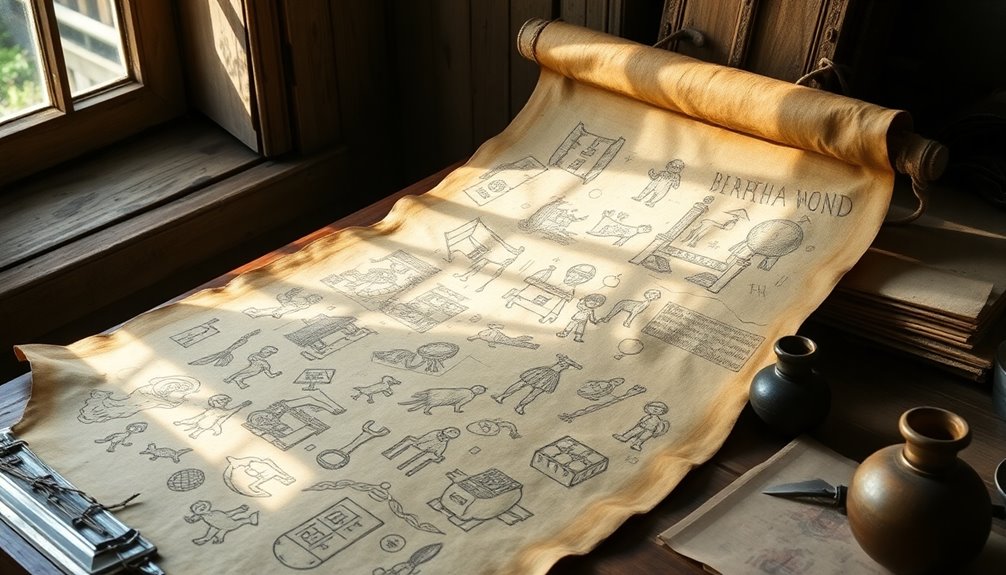
In the 13th century, when Onfim lived in the Novgorod Republic, the region thrived as a cultural and political hub.
You’d find high literacy rates among men and women of various social classes, a rare sight for the time. The birch forests surrounding Novgorod provided a unique resource for writing materials, allowing Onfim and his peers to create birch bark letters that have survived through the ages.
Formal schools taught children like Onfim to engage in spelling and copying texts, including the Book of Psalms.
The archaeological discoveries of over 1,222 birch bark manuscripts reveal not just daily life but also the deep cultural significance of literacy in this vibrant medieval society. The emphasis on high literacy rates in Novgorod parallels the remarkable achievements documented in other historical contexts, showcasing how education can shape societal progress.
Who Was Onfim? A Brief Biography
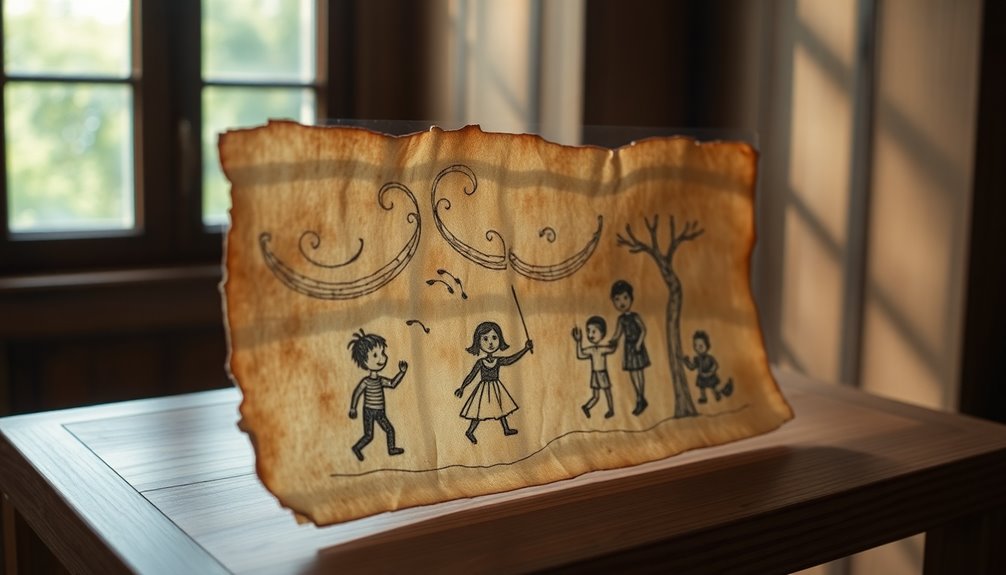
Onfim was a 7-year-old boy from 13th century Veliky Novgorod, and his life was marked by creativity and curiosity.
His unique birch bark drawings and writings reveal not just his artistic talent but also a glimpse into the early learning experiences of children in his time.
Through his illustrations and personal inscriptions, you can see how he expressed both imagination and the everyday themes of his world. His work resonates with the idea of collective action and unity, reflecting how creativity can serve as a powerful tool for expression and resilience in the face of adversity.
Early Life Context
Living in the vibrant city of Veliky Novgorod during the 13th century, a 7-year-old boy named Onfim made a remarkable mark on history through his unique birch bark writings. His contributions reflect the educational environment of the time and the imagination of childhood.
You can appreciate Onfim’s early life context through three key aspects:
- Literacy Rates: Veliky Novgorod boasted high literacy among different social classes, fostering Onfim’s creativity.
- Artistic Talent: Out of seventeen birch bark writings, twelve showcase his drawings, often portraying himself as a knight.
- Religious Connection: His writings, including pleas for divine help, indicate the influence of religious texts on children’s education.
Onfim’s work gives us valuable insights into his world.
Artistic Expression Overview
A young boy from 13th-century Veliky Novgorod, Onfim captured the essence of childhood through his remarkable birch bark drawings and writings.
At just seven years old, he created about seventeen birch bark items, twelve featuring vivid illustrations that showcased his creativity. His drawings depict himself as a warrior, mythical creatures, and interactions with friends, revealing a rich imagination and the adventures of his youthful life.
Onfim’s writings, including phrases like “Lord, help your servant Onfim,” reflect his engagement with literacy and religious texts, highlighting the educational practices of his time.
His unique blend of artistic expression provides invaluable insights into the cultural life of children in medieval Novgorod, marking him as one of the earliest known young artists.
The Significance of Birch Bark in Writing
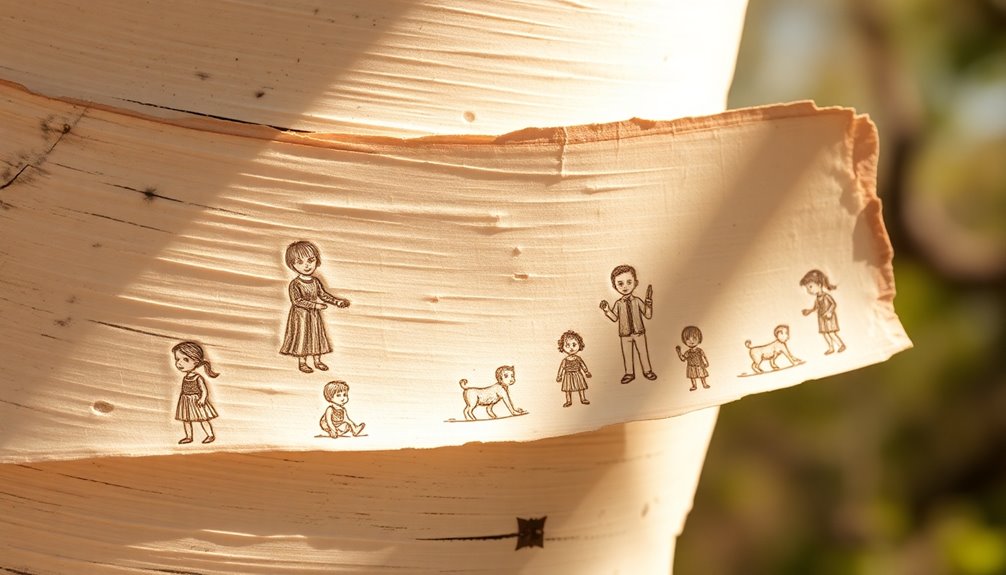
Birch bark has played an essential role in the history of writing, particularly in medieval Novgorod. This unique medium offered several advantages that revolutionized documentation and literacy:
- Accessibility: Birch bark was readily available, allowing for immediate use in writing without needing a manufacturing process.
- Practicality: Its softness and ease of scratching made birch bark an ideal surface for inscribing words, facilitating education and record-keeping.
- Preservation: The material’s ability to survive in oxygen-deficient environments means many manuscripts remain intact, providing valuable insights into medieval life. Additionally, the resilience of birch bark parallels the themes of immigrant resilience found in literature, as it served as a crucial tool for communication in challenging times.
Exploring Onfim’s Artistic Style and Techniques
While exploring Onfim’s artistic style, you’ll notice a distinct simplicity that captures the essence of childhood creativity. His drawings feature stereotyped human figures, marked by two dots for eyes and a capital “I” for eyebrows, paired with long noses and pitchfork-like hands.
Onfim’s work often illustrates themes like knights, horses, and mythical creatures, blending imagination with the rudimentary forms typical of a child’s perspective. The six surviving birch bark gramoty reveal a mix of imaginative scenes, including epic battles and friendly greetings, showcasing his engagement with learning and social interactions.
His use of Cyrillic letters, omitting yers and substituting them with O and E, reflects his developing literacy and playful experimentation with language. This artistic expression can be likened to the intricate plot of mystery novels that captivate readers with their imaginative storytelling.
Key Themes in Onfim’s Drawings
In Onfim’s drawings, you can see the vibrant pulse of childhood imagination and expression, where knights and mythical beasts come to life.
His fascination with conflict and valor shines through as he portrays himself as a warrior.
You’ll also notice the social connections he fosters, with captions that reveal his interactions and friendships, highlighting the importance of communication in his young world. The themes of generational poverty and resilience found in literature like A Tree Grows in Brooklyn resonate with the challenges and aspirations depicted in Onfim’s art.
Childhood Imagination and Expression
There’s something enchanting about the way Onfim’s drawings capture the essence of childhood imagination. His simplistic yet imaginative depictions invite you into a world where battles, mythical creatures, and playful scenes come alive. You can almost feel the joy and creativity radiating from each piece.
Key themes in Onfim’s drawings showcase:
- Simplicity in Art: The exaggerated features of figures reflect a child’s early artistic exploration.
- Social Connection: Captions reveal Onfim’s longing for interaction with friends, emphasizing peer relationships.
- Reality Meets Fantasy: The blend of real and imagined elements illustrates the imaginative freedom characteristic of childhood.
Through these aspects, Onfim’s drawings provide a window into the vibrant world of a 13th-century child’s mind, showcasing the beauty of childhood expression.
Themes of Conflict and Valor
Onfim’s drawings not only celebrate childhood imagination but also reveal an enthralling focus on themes of conflict and valor.
You’ll notice that many of his illustrations depict knights, battles, and warriors, showcasing his fascination with heroism and adventure. One striking image features Onfim as a knight on horseback, portraying himself as a brave figure in his imaginative domain.
His artwork often includes scenes of defeating enemies with a spear, demonstrating an early engagement with narratives of conquest. Additionally, you’ll find mythical elements, like a fire-breathing beast, blending with themes of bravery and struggle.
These varied representations of violence and competition reflect the cultural context of the 13th-century Novgorod Republic, where such themes resonated deeply with societal values.
Social Interactions and Connections
While exploring the vibrant world of Onfim’s drawings, you can’t help but notice the strong emphasis on social interactions and connections among children of his time.
He vividly captures the essence of friendship and camaraderie through his art, highlighting:
- Peer Relationships: Onfim often depicted friends and classmates, illustrating the importance of these bonds in his daily life.
- Communication: Addressing a friend named Danilo in his drawings shows that personal connections were valued, fostering a sense of community.
- Collaborative Themes: Many illustrations reflect a social environment where creativity thrived, revealing how children engaged with one another.
Onfim’s playful expressions not only celebrate childhood but also underscore the cultural significance of friendship within medieval Novgorod.
Notable Birch Bark Items Attributed to Onfim
Notable birch bark items attributed to Onfim reveal a fascinating glimpse into the educational and imaginative world of a young boy in 13th-century Novgorod.
One standout piece, Gramota No. 200, showcases his alphabet exercises and signature, highlighting his early attempts at literacy.
Gramota No. 200 illustrates Onfim’s alphabet exercises, revealing his early journey into the world of literacy.
Another important item, Gramota No. 206, features scripture copying and syllabary exercises, illustrating the educational practices of his time.
Additionally, Gramota No. 203 displays a whimsical fantasy scene paired with a prayer for assistance, demonstrating Onfim’s creative storytelling.
His drawings often include simple, stereotyped human figures and mythical beasts, reflecting both his youth and artistic viewpoint.
Together, these works offer a unique look into childhood experiences in medieval Rus, revealing how educational practices shaped the lives of young individuals during this historical period.
Insights Into Onfim’s Educational Environment
In the vibrant educational landscape of 13th-century Novgorod, children like Onfim engaged in writing exercises that reflected the city’s commitment to literacy across social classes. Onfim wrote on birch bark, practicing the letters of the alphabet and copying familiar texts. His work showcases a unique blend of structured learning and creativity, as seen in his doodles and playful illustrations.
Here are three insights into his educational environment:
- Formal schools provided foundational writing skills, emphasizing the Cyrillic alphabet.
- Peer correspondence, like his greetings to Danilo, highlighted social interactions in learning.
- The influence of religious texts, particularly the Book of Psalms, shaped early educational practices.
Additionally, the emphasis on social justice themes in education encouraged empathy and a sense of responsibility among young learners.
These elements reveal the rich tapestry of childhood education in medieval Novgorod.
The Role of Literacy in the Novgorod Republic
In the Novgorod Republic, you’d find a society where literacy thrived among all classes, including women and children. Birch bark became the go-to medium for writing, making it easy for people to document their lives. As you explore this era, you’ll see how a structured educational environment fostered these remarkable literacy rates. This emphasis on literacy among all classes not only empowered individuals but also contributed to the rich cultural dialogues of the time.
High Literacy Rates
The Novgorod Republic boasted one of the highest literacy rates in medieval Europe, with both men and women across various social classes engaging in written communication.
This remarkable literacy culture is highlighted by the discovery of approximately 956 birch bark manuscripts, known as gramoty, dating from 1050 to 1500 AD.
These Birchbark Letters reveal a society that valued practical literacy for various purposes, including:
- Legal documents that structured societal norms.
- Commercial transactions that facilitated trade and economic growth.
- Educational exercises that promoted learning and knowledge dissemination.
The abundance of birch bark made it an ideal medium for writing, allowing people to express themselves and preserve their thoughts in a vibrant cultural and educational environment.
Use of Birch Bark
Birch bark played a pivotal role in fostering literacy within the Novgorod Republic, allowing people to communicate and document their lives effectively.
With a high literacy rate across genders and social classes, birch bark became the preferred writing medium, enabling easy scratching of text and drawings.
Over 1,222 birch bark manuscripts, dating from the 11th to the 15th centuries, showcase a variety of content—from letters to legal documents.
Children, like Onfim, practiced their skills by writing out the alphabet and copying well-known texts, highlighting the community’s commitment to education.
These manuscripts not only reflect daily life but also reveal the cultural and social contexts that made literacy an essential part of Novgorod’s identity.
Educational Environment Insights
Literacy in the Novgorod Republic shaped a vibrant educational environment where both boys and girls actively engaged in learning. This progressive approach to education included various elements that fostered literacy:
- Formal Education: Schools in Novgorod taught children essential writing exercises, focusing on the alphabet and syllable spelling.
- Religious Texts: Onfim’s writings reflect a focus on engaging with religious texts, enhancing both literacy and moral education through the Book of Psalms.
- Social Learning: Informal interactions among peers enriched the educational experience, as children shared playful correspondence and artistic expressions.
The abundance of birch bark manuscripts highlights the accessibility of writing materials, allowing literacy to flourish across different social classes.
Ultimately, this shaped a well-rounded educational environment in Novgorod.
The Discovery of Onfim’s Drawings
Discovered in a muddy ditch in Novgorod, Onfim’s drawings offer a fascinating glimpse into the life of a 7-year-old boy from the 13th century.
During excavations, over 1,222 pieces of birch bark were uncovered, with 1,113 specifically from Novgorod. Among them, Onfim’s unique drawings made stand out, dating back to around 1260. His art includes illustrations of himself as a warrior and scenes of epic battles, showcasing his vibrant imagination and childhood experiences.
Onfim’s 13th-century drawings reveal a young boy’s imaginative world of warriors and battles, unearthed from Novgorod’s birch bark.
The casual nature of their discovery suggests they were likely discarded by a parent tidying up, raising intriguing questions about how childhood artifacts were preserved.
These drawings not only reflect Onfim’s creativity but also provide insights into literacy and education practices of his time.
Community Reactions to Onfim’s Art
When you look at Onfim’s drawings, you’ll notice how people interpret his art in imaginative and playful ways. There’s also a lively debate about the authenticity of these pieces and the language he used, sparking curiosity about literacy in his time. As you explore these reactions, consider how they reflect a deeper understanding of childhood creativity and historical context. Additionally, similar to the intricate plotting found in historical mystery novels, Onfim’s work invites readers to unravel the complexities of his world.
Artistic Interpretations Explored
While delving into Onfim’s drawings, you’ll notice that community reactions often highlight the intriguing blend of childhood creativity and medieval cultural elements.
This fusion sparks numerous artistic interpretations, reflecting the complex world of a 13th-century child. Here are three key areas of interest:
- Psychological Insights: Many view Onfim’s doodles as a glimpse into the emotional and psychological state of children during medieval times.
- Cyrillic Language: The use of Cyrillic letters in his art captivates scholars, emphasizing the linguistic context of his environment.
- Cultural Reflection: Discussions often explore how Onfim’s children’s art mirrors the societal norms and experiences of his time.
Authenticity And Analysis Debated
As discussions about Onfim’s drawings unfold, questions about their authenticity often take center stage, with some critics likening them to mere “refrigerator doodles” created out of boredom rather than artistic intent.
This skepticism fuels community debates, prompting deeper analysis of his unique style and the implications of his literacy. While some see these drawings as trivial, others argue they provide valuable insights into childhood and creativity in 13th-century Russia.
You might find the blending of words and images in Onfim’s gramoty particularly intriguing, as it reflects a child’s perspective shaped by their cultural environment.
The ongoing discussions reveal a rich tapestry of historical context, challenging perceptions of what constitutes art and the significance of these artifacts.
Language Usage Observed
Engaging with Onfim’s birch bark drawings reveals a fascinating interplay of language and childhood creativity that sparks vibrant community reactions.
The unique language usage in his work, particularly with the Cyrillic alphabet, captivates many. Here are three key observations from the community:
- Educational Insights: Discussions highlight how Onfim’s drawings reflect his learning stage, omitting yers and substituting them with O and E.
- Social Context: The inclusion of conventional phrases, like greetings, sheds light on children’s social interactions in 13th-century Novgorod.
- Curiosity About Literacy: Comments show a growing interest in the historical context of language, revealing how Onfim’s art challenges perceptions of children’s creativity beyond mere “infantile” expressions.
How Does Onfim’s Work Reflect Childhood in the 13th Century?
Onfim’s birch bark drawings vividly illustrate the essence of childhood in 13th century Novgorod, showcasing a young boy’s imaginative world. His art reflects the playful nature of a 7-year-old, filled with themes of battle and mythical creatures, revealing how children blended play with early storytelling.
You can see how Onfim’s letters and doodles highlight his social interactions, depicting friendships and family relationships that were crucial in medieval life. Additionally, his schoolwork and alphabet exercises emphasize the educational practices of the time, showing that literacy was an essential part of a child’s development. Furthermore, the resilience shown in Onfim’s creative expressions can be likened to the transformative impact of hope experienced by survivors in their own narratives.
The casual way Onfim discarded his birch bark manuscripts suggests that artistic expression was woven into daily life, enriching our understanding of childhood experiences back then.
Scholarly Perspectives on Onfim’s Contributions
While many scholars have dismissed Onfim’s birch bark drawings as mere childlike scribbles, these works hold significant historical value that deserves deeper exploration.
- Onfim’s name appears on three of his gramoty, highlighting a personal connection that contrasts sharply with the anonymity typical of ancient artworks.
- His creations showcase the creativity of a child in Medieval Novgorod, blending drawings, homework, and written text to reflect a unique perspective.
- The juxtaposition of individualistic expression in Onfim’s signed works against the selfless art of Eastern Orthodox traditions marks a notable cultural distinction.
The Importance of Autographic Expression in Onfim’s Work
The significance of autographic expression in Onfim’s work can’t be overstated, as it marks a pivotal moment in the evolution of individual creativity within art. By signing his drawings, Onfim shifts away from the traditional anonymity prevalent among medieval Eastern Orthodox creators, embracing personal identity in a way that was rare for his time.
His combination of text and imagery reflects a unique blend of childlike imagination and burgeoning individuality. Each piece not only serves as an educational exercise but also as a personal narrative, revealing his experiences and emotions as a child in the 13th century.
This nascent sense of ownership showcases the importance of autographic expression, offering insights into a developing cultural landscape where individual creativity began to emerge.
What Does Onfim’s Art Reveal About Medieval Culture and Society?
Exploring Onfim’s birch bark drawings reveals a rich tapestry of medieval culture and society, highlighting the interplay between childhood creativity and the broader social context of 13th-century Novgorod. His art reflects significant aspects of the time:
- Literacy and Education: Onfim’s work indicates a high literacy rate among children, showcasing the educational practices that encouraged writing and creative expression.
- Cultural Influences: The themes of knights and mythical beasts reveal childhood imagination intertwined with Eastern Orthodox Christianity’s impact on daily life.
- Personal Identity: His signature signifies a shift toward individual identity in art, contrasting traditional anonymous practices.
Through Onfim’s drawings, you gain unique insights into the societal values, creativity, and community dynamics of medieval Novgorod.
Conclusion
In exploring Onfim’s birch bark drawings, you uncover not just a child’s creativity but a window into 13th-century life. His art captures the essence of childhood, revealing how play and imagination flourished even during tough times. By appreciating Onfim’s work, you gain insight into medieval culture, where every stroke tells a story. Ultimately, his sketches remind us that, even in a world of hardship, the innocence of youth shines bright and leaves a lasting mark.