

Last updated: · By Thomas Reed
Cormac McCarthy’s Blood Meridian (1985) is a novel about violence on the American frontier of the mid-nineteenth century. It follows a teenager called the Kid as he joins a gang of scalp hunters led by the enigmatic Judge Holden, and it argues that violence is central to the making of American history and that the universe offers no moral order to check it. The novel’s power comes from its refusal to console the reader. Its recurring images of blood and dirt, its bleak view of human nature, and its treatment of nihilism are the features that most students and readers want to understand.
Key Takeaways
- Cormac McCarthy published Blood Meridian in 1985, and it draws on the historical Glanton gang, which operated in the Southwest in 1849 and 1850.
- Justin Evans, writing in Modern Philology in 2014, reads the novel as a ‘critical epic’ that radicalizes epic conventions to criticize modern society.
- A Cambridge Journal of Postcolonial Literary Inquiry article argues that the novel shows any history of frontier settlement to be inevitably a history of racial violence.
- Critics commonly read blood as the reality of violence and dirt as the earth’s indifference, and together they express the novel’s cycle of creation and destruction.
- Nihilism, the belief that life lacks inherent meaning or value, is the central philosophical problem the novel poses, and critics have debated its nature since at least Vereen Bell’s 1983 essay.
What Is Blood Meridian About?
Blood Meridian is a picaresque war narrative set mostly in Texas and northern Mexico, where a gang is paid by bounty for Native American scalps. The Kid, who is fourteen when the story opens, drifts through a series of brutal encounters before he falls in with Judge Holden. The plot moves episodically, so the novel is better understood through its episodes and its imagery than through a single storyline.
The book’s historical basis is a real gang that operated in the same region. McCarthy fictionalizes that history and fills it with invented characters and a philosophical framework. Readers who want to see how the novel’s ending reframes its violence may find this unpacking of the novel’s epilogue, which focuses on the Judge and the Kid a useful companion to the discussion below.
How Critics Read Blood Meridian
Scholars have offered several frameworks for reading the novel, and each one changes how you interpret its violence. The table below summarizes the readings covered by the sources used in this article. Students who are new to this kind of comparison may find this guide to mastering literary analysis helpful for building their own argument.
| Critical approach | Source | Main claim |
|---|---|---|
| Genre and form | Justin Evans, Modern Philology, 2014 | The novel is a ‘critical epic’ that radicalizes epic conventions to criticize modern society. |
| Race and empire | Cambridge Journal of Postcolonial Literary Inquiry | Frontier settlement in the novel is inevitably a history of racial violence. |
| Land and economy | Elsevier (ScienceDirect), a study of primitive accumulation | The US-Mexico frontier is an encounter zone between capital and nature. |
| Nihilism | Vereen Bell, The Southern Literary Journal, 1983 | McCarthy’s nihilism is ambiguous, a debate that continues in later scholarship. |
Judge Holden and the Nature of Evil
Judge Holden is the novel’s most discussed character because he embodies a form of evil that is articulate, patient, and apparently unbound by ordinary human limits. He speaks at length about war and history, and he treats violence as a form of knowledge and mastery. Many readers find him more unsettling than any other character for this reason.
What Is Judge Holden’s Philosophy of War?
Holden argues that war is the truest expression of human nature and that the strong inevitably dominate the weak. His speeches give the novel much of its intellectual weight, and they make his cruelty seem coherent rather than random. Readers should treat these speeches as characters’ claims within the fiction, not as the author’s direct statements.
The Judge’s presence also shapes the gang’s behavior. Several men follow him with a devotion that the novel presents as disturbing and hard to explain. That dynamic shows how charisma can turn violence into a shared project.
Is Judge Holden a Symbol of Evil or a Character?
He is both, and the distinction matters for analysis. As a character, he has a physical presence, a voice, and a specific role in the gang’s violence. As a symbol, he represents a universe in which violence is not punished and meaning is not guaranteed. Students should support any symbolic reading with specific scenes and dialogue, since that is what separates a persuasive argument from a general impression.
The Kid and the Limits of Redemption
The Kid is the novel’s central consciousness, and his moral development is the closest thing the book offers to a story of change. He is capable of compassion, but he is also capable of killing, and the novel refuses to let either trait define him fully. Redemption is therefore a question the book keeps open and treats skeptically.
For a fuller account of the novel’s final pages and the relationship between the Kid and the Judge, see this ranking of McCarthy’s novels, which places Blood Meridian alongside The Road and explains why its ending is so often debated. The Kid’s journey also makes a useful comparison point for readers who want to see how McCarthy’s other protagonists face similar moral pressures.
What Do Blood and Dirt Symbolize in Blood Meridian?
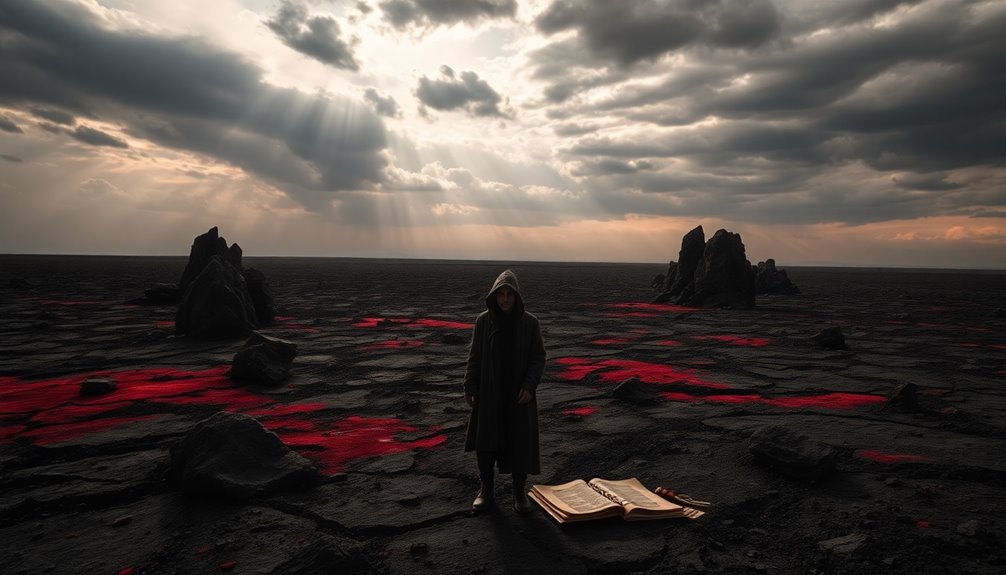
Blood usually symbolizes violence and the shared physical reality of human life, while dirt usually symbolizes the earth’s indifference and the struggle for survival. Together, the two images suggest a cycle in which life and death come from the same ground. The novel uses these images repeatedly, which is why they are among the most useful entry points for close reading.
Blood appears wherever the gang kills, and its presence keeps the violence concrete rather than abstract. Dirt is the setting for nearly every action, and it reminds the reader that the desert does not respond to suffering. Students can use these images as anchors for a thesis about the novel’s larger argument.
The image of a man digging post holes is one of the novel’s most discussed images of ordinary labor. Many readers take it as a figure for the human effort to impose order on an indifferent landscape, though the scene is open to several readings and should be cited carefully in essays.
How Does Blood Work as a Symbol in the Novel?
Blood links the novel’s violence to the body, which keeps the reader from treating killing as an abstraction. In this sense, it carries the novel’s moral weight. When you write about blood, tie each reading to a specific passage and explain what the image reveals about the characters who are bleeding or killing.
How Does Dirt Reflect the Novel’s Worldview?
Dirt represents the ground that outlasts human conflict. It shows a world that continues without regard for who wins or loses. This connects the imagery to the novel’s view that the universe does not reward or punish human action.
Nihilism and the Absence of Divine Purpose
Nihilism is the belief that life has no inherent meaning, value, or moral order, and it is the philosophical problem most often associated with Blood Meridian. The novel presents a world in which religious consolation is largely absent and violence goes unpunished. Readers who want to compare this with another famous treatment of meaninglessness can look at this philosophical analysis of Camus’s The Outsider, which examines the absurd from a different angle.
Critics have long debated whether McCarthy’s nihilism is absolute or ambiguous. Vereen Bell’s 1983 essay ‘The Ambiguous Nihilism of Cormac McCarthy’ in The Southern Literary Journal is an early and frequently cited contribution to that debate. Its title alone signals that many readers see McCarthy’s position as more complicated than simple despair.

Is Blood Meridian Purely Nihilistic?
The answer depends on how you read the novel’s few moments of human connection and its prose style. Some readers find no consolation anywhere in the book, while others argue that the attention McCarthy gives to the natural world and to moments of compassion complicates the nihilism. A strong essay will state a position and then test it against passages that resist it.
The Frontier as a Critique of Modern Society
The novel’s setting is a frontier, and critics read that frontier as a means of examining the origins of modern society. Justin Evans, in his 2014 article in Modern Philology, argues that the novel radicalizes traditional epic conventions in order to criticize modern society. This reading treats the novel as a deliberate reworking of the epic tradition rather than a simple western.
A separate line of scholarship examines land and economy. A study published by Elsevier on ScienceDirect treats the US-Mexico frontier in Blood Meridian as an encounter zone between capital and nature, reading the novel through the lens of primitive accumulation. In this framework, primitive accumulation means the process by which land and resources are seized and turned into capital, often through violence.
The novel also appears in discussions of popular culture and music. A 2021 article in The Journal of Popular Culture by B.S. West compares Blood Meridian with Modest Mouse’s The Moon & Antarctica, drawing on the novel’s bleak landscape and its works-cited list to explore a shared sense of desolation.
How Does Blood Meridian Address Race and Violence?
The novel depicts racial violence as central to frontier history rather than as an incidental feature of it. A Cambridge Journal of Postcolonial Literary Inquiry article argues that the novel shows any history of frontier settlement to be inevitably a history of racial violence. That claim asks readers to consider how the gang’s killings are tied to the wider project of settlement and empire.
Readers should be careful with this reading. The novel’s violence is not a simple argument about one group, and its portrayal of race is complicated by its focus on a single gang and its ambiguous narrator. Students should note the difference between the novel’s depiction of violence and the author’s personal views, which the text does not state.
Gnostic Readings as an Interpretive Option
Some readers compare Judge Holden to a malevolent creator, or relate the novel’s bleak cosmos to Gnostic ideas about a flawed material world. This is an interpretive analogy, not a documented influence, and the sources used for this article do not establish a direct Gnostic connection. If you use this lens, present it as your own reading and support it with specific passages.
The analogy can be useful for explaining the novel’s sense of a world governed by indifference. It becomes weak when it claims that the novel is built on a particular theology. Strong analysis separates what the text shows from what a framework adds to it.
Frequently Asked Questions
What is Blood Meridian about?
Blood Meridian follows the Kid, a teenager who joins a gang of scalp hunters on the American Southwest frontier in the mid-nineteenth century. The gang is led by Judge Holden, a charismatic and violent figure. The novel is known for its graphic violence and its bleak view of human nature.
Is Judge Holden based on a real person?
Judge Holden is a fictional character. The novel draws on a historical gang, the Glanton gang, which operated in the region in 1849 and 1850, but McCarthy invents the Judge and most of the gang members. Readers should treat the Judge as a literary creation rather than a documented historical figure.
What does nihilism mean in Blood Meridian?
Nihilism is the view that life has no inherent meaning, value, or moral order. In the novel, nihilism appears in the absence of divine consolation and in the unpunished violence of the gang. Critics debate whether the novel’s nihilism is total or ambiguous.
What do blood and dirt symbolize in the novel?
Blood generally symbolizes violence and the physical reality of human life. Dirt generally symbolizes the indifference of the earth and the struggle for survival. Together, the images suggest a cycle in which life and death share the same ground.
Why is Blood Meridian considered important?
Blood Meridian is widely studied for its prose, its treatment of violence, and its critique of the myths of the American frontier. Scholars continue to publish new readings of it, including work on genre, race, and economics. Its ambiguity is part of why it remains a common subject in literature courses.
How should students write about Blood Meridian?
Start with a specific claim about a symbol, character, or passage, and support it with quotations from the novel. Engage with at least one published critical reading, and explain how your argument differs from or extends it. Avoid making claims about McCarthy’s personal beliefs unless you can cite a reliable source.
Conclusion
Blood Meridian remains a demanding and unsettling novel because it refuses easy moral comfort. Its blood and dirt imagery, its portrait of Judge Holden, and its treatment of nihilism give students and readers many ways into the text. The best readings of the novel combine close attention to its language with an honest account of the scholarly debates it has generated.