Bret Easton Ellis’s *American Psycho* expertly blends satire with horror, using the grotesque to illuminate the moral void of 1980s consumer culture. You see this through Patrick Bateman, a chilling antihero whose charm masks his savagery. This novel critiques superficiality and violence, revealing the absurdities of wealth. The dark humor draws you in, forcing you to confront your own complicity in consumerism. There’s much more to explore about its cultural commentary and narrative structure.
What Is Satirical Horror and How Does It Apply to American Psycho?
Satirical horror is a unique genre that combines the elements of satire with horror to critique societal issues.
In *American Psycho*, Bret Easton Ellis masterfully employs this blend to expose the moral vacuity of 1980s corporate culture. You see, the protagonist, Patrick Bateman, acts as a satirical lens, using dark humor to reveal the absurdity of wealth and privilege.
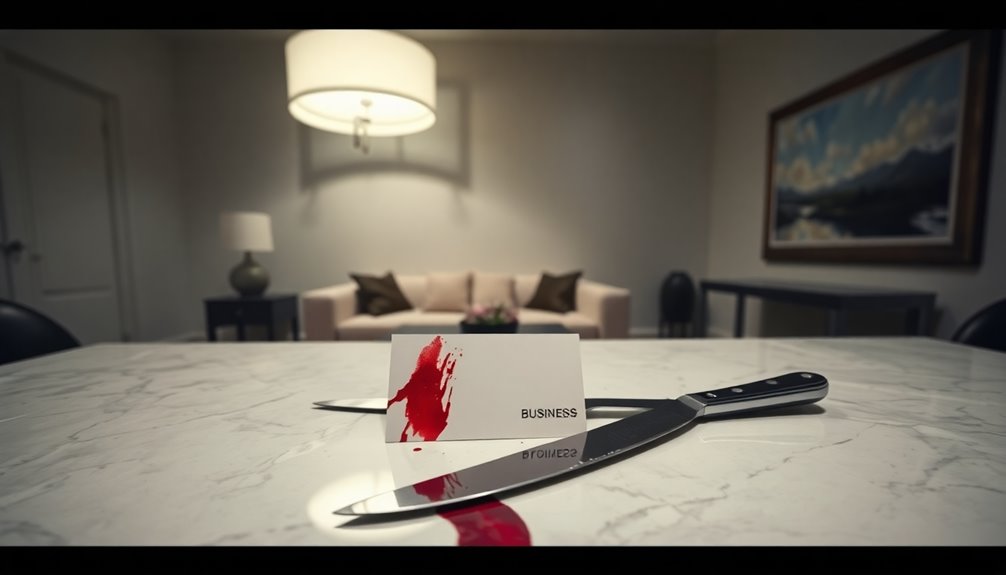
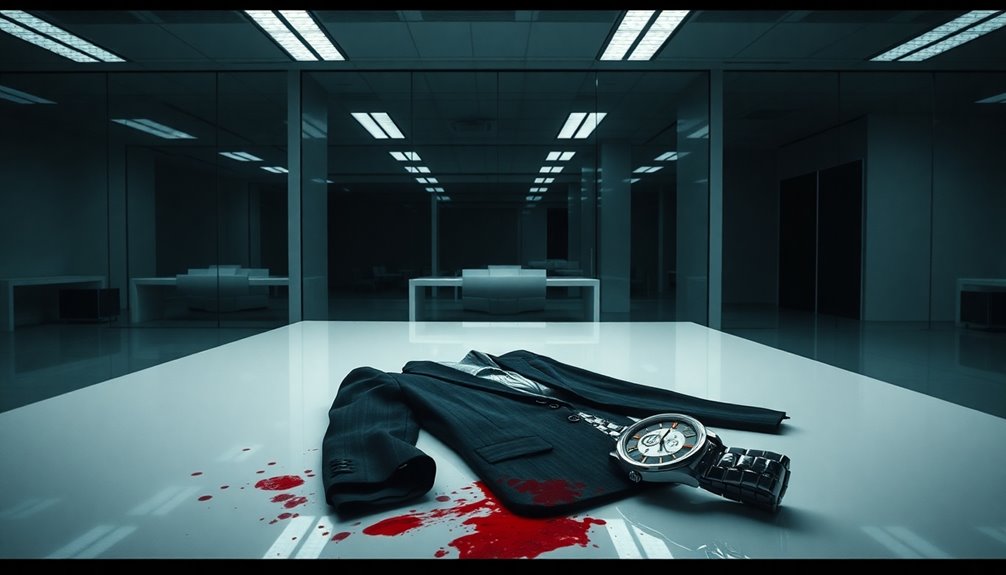
Through exaggerated horror tropes like graphic violence and psychological manipulation, the novel highlights the stark contrast between Bateman’s charming facade and his inner savagery.
This meta-horror approach critiques how media glamorizes violence, urging you to reflect on your own complicity in consumer culture. Moreover, it resonates with the historical injustices portrayed in narratives like *The Help*, demonstrating how fiction can provoke critical conversations about societal norms and moral decay.
In this way, *American Psycho* not only entertains but also provokes thought about societal norms and moral decay.
Unpacking Patrick Bateman: The Iconic Antihero of American Psycho

Patrick Bateman’s charm pulls you in, making him a fascinating yet chilling figure. His character not only critiques the consumer culture of the 1980s but also reveals the psychological complexities lurking beneath his polished surface. As you explore his duality, you’re forced to confront the unsettling balance between charisma and moral depravity. The exploration of individual freedom’s fragility highlights the depths of Bateman’s disconnect from reality and societal norms.
Charismatic Villain Persona
In *American Psycho*, one of the most striking elements is the way Patrick Bateman embodies the charismatic villain persona, enthralling readers with his charm while simultaneously repelling them with his horrific actions.
As a wealthy Wall Street professional, he masks his sociopathic tendencies behind a polished exterior. The narrative pulls you into his internal monologue, exposing an obsession with superficiality and the emptiness of 1980s yuppie culture.
You find yourself captivated and horrified as Bateman’s dual identity as a successful businessman and remorseless killer challenges traditional villain archetypes. His charm and intelligence create a complex mix of fascination and revulsion, making him a paradoxical figure in horror stories that critique the dehumanizing effects of capitalism.
Satirical Consumer Culture Commentary
Bateman’s charm as a charismatic villain not only captivates but also serves as a vehicle for sharp social commentary on the emptiness of consumer culture. His obsession with status and material possessions reveals a chilling truth about the moral vacuity of 1980s capitalism.
Through satirical consumer culture commentary, you see how Bateman prioritizes brand names over genuine connections, exposing the superficiality of affluent circles. The absurdity of his extravagant purchases contrasts starkly with his violent tendencies, highlighting the dark side of a society that equates worth with wealth.
As one of the horror icons of literature, Bateman embodies the disconnection between identity and morality, suggesting that the relentless pursuit of consumer goods can strip away humanity and ethical boundaries.
Psychological Complexity and Duality
Duality lies at the heart of Patrick Bateman’s character, where charm and savagery coexist in a chilling harmony. His psychological complexity makes him a fascinating antihero, reflecting the darkest corners of humanity.
Consider these key aspects:
- Polished Exterior: Bateman’s affluent lifestyle masks his violent tendencies.
- Materialism Obsession: His fixation on status highlights the emptiness of 1980s consumer culture.
- Unreliable Narration: Readers are left questioning his mental stability and the reality of his horror movie-like actions.
- Detachment: His interactions reveal the dehumanizing effects of a capitalistic society, prioritizing image over connection.
Bateman’s descent into madness critiques both masculinity and the moral vacuity of the elite, making him an unsettling yet intriguing figure in contemporary literature.
The Role of Consumerism in American Psycho: A Dark Reflection

While exploring the depths of *American Psycho*, you quickly realize that consumerism serves as a chilling backdrop to Patrick Bateman’s life.
Bret Easton Ellis critiques the rampant materialism of the 1980s, portraying Bateman as a Wall Street professional who equates identity with luxury brands and status symbols. This obsession highlights the emptiness of such pursuits, with detailed descriptions of consumer goods acting as satire against the superficial values of upper-class society.
As Bateman’s violent acts unfold, they starkly contrast with his fixation on high-end products, suggesting a moral decay intertwined with consumer culture.
Ellis cleverly uses dark humor to expose the absurdity of this soulless pursuit, leaving you questioning the true cost of wealth and status in a distorted reality. The themes of systemic racism and social critique in literature, as seen in works like Coates’ *Between the World and Me*, also resonate with the exploration of identity and values in *American Psycho*.
How Do Violence and Humor Intertwine in Bret Easton Ellis’s Narrative?
As you explore *American Psycho*, you can’t help but notice how Bret Easton Ellis masterfully intertwines violence and humor to create a uniquely unsettling narrative. This complex interplay serves several purposes:
- Detached Narration: Patrick Bateman’s chilling voice contrasts brutal violence with mundane observations, making you question reality.
- Dark Humor: Ellis uses absurdity to critique Bateman’s privileged lifestyle, exposing the moral vacuity of 1980s excess.
- Hyperbolic Violence: The exaggerated brutality underscores Bateman’s emotional detachment, creating a surreal atmosphere that shocks and amuses.
- Confronting Absurdity: This mix forces you to reckon with the banalities of Bateman’s world, oscillating between charm and brutality.
Through this blend of humor and violence, Ellis critiques societal values, revealing the darkness beneath a glamorous facade. Additionally, the novel’s intricate plot and iconic twist ending mirror the shocking revelations found in classic mystery literature, enhancing its narrative complexity.
The Satirical Commentary on 1980s Wall Street Culture
In *American Psycho*, Bret Easton Ellis lays bare the absurdities of 1980s Wall Street culture by showcasing a world obsessed with wealth and status. Through Patrick Bateman, you see a satirical critique of materialism and superficiality, where connections are mere transactions. Bateman’s fixation on brand names and luxury goods illustrates the emptiness of consumer culture that dominated the decade. The graphic violence juxtaposed with his mundane rituals mocks the moral vacuity of Wall Street executives, revealing their sociopathic tendencies. Ellis uses dark humor and irony to emphasize how these characters prioritize image over ethics, ultimately questioning the real value of a lifestyle steeped in excess. You can’t help but feel the disconnection that defines this hollow existence. Additionally, the novel reflects the transformative power of empathy and personal responsibility, as it critiques the lack of human connection in pursuit of success.
Analyzing the Unreliable Narrator: What Is Real in American Psycho?
Patrick Bateman’s role as an unreliable narrator forces you to navigate a labyrinth of confusion, where the boundaries between reality and delusion blur disturbingly. You’re left questioning what’s real amidst his chilling tales of violence and excess.
Here are four aspects that highlight Bateman’s mental instability:
- Contrasting Descriptions: His vivid recounting of daily life versus brutal acts creates unsettling duality.
- Narrative Shifts: The constant switching between his thoughts and events complicates your grasp of reality.
- Detached Tone: Bateman’s clinical recounting of violence suggests a disconnection from his own actions.
- Cynical Critique: His unreliable narration critiques consumerism, forcing you to confront the darkness behind his psychopathy.
Ellis masterfully blurs the line between authenticity and fabrication, leaving you in a state of disquiet. Additionally, the themes of systemic racism explored in Richard Wright’s *Native Son* resonate with Bateman’s own social detachment, illustrating how societal neglect breeds moral ambiguity.
The Influence of Horror Tropes in American Psycho’s Structure
Though *American Psycho* is often labeled a satirical critique of consumerism, it also deftly weaves classic horror tropes into its structure, creating a chilling narrative that keeps you on edge.
You’ll find Patrick Bateman, the charismatic yet psychopathic protagonist, reflects the archetype of the charming killer common in slasher films. The graphic depictions of violence shock and provoke, embodying the horror genre’s penchant for visceral scares.
The fragmented narrative mirrors Bateman’s unstable mental state, blurring reality and delusion.
Ellis cleverly utilizes horror clichés, like the isolated urban setting and juxtaposition of mundane life with horrific acts, to critique the emptiness of 1980s yuppie culture, transforming familiar horror motifs into powerful social commentary. Furthermore, like Bigger Thomas’s journey in *Native Son*, Bateman’s character illustrates the systemic racism and dehumanization prevalent in society, albeit in a different context.
Comparing American Psycho to Other Notable Horror Satires
When you compare *American Psycho* to other horror satires, you see how dark humor plays an essential role in critiquing society.
Like *Get Out* and *Shaun of the Dead*, it highlights the absurdities of modern life, yet it does so with a chilling edge that sets it apart.
This blend of social commentary and satire invites you to reflect on the disturbing realities wrapped in entertainment. Moreover, much like the exploration of love and loss in *Birdsong*, *American Psycho* delves into the psychological complexities of its characters, revealing deeper societal critiques beneath the surface.
Dark Humor Explored
- *Shaun of the Dead* blends humor with zombie horror, parodying the genre.
- *Tucker and Dale vs. Evil* twists hillbilly stereotypes through irony.
- *Get Out* uses horror to tackle societal issues, contrasting capitalism with racism.
- *What We Do in the Shadows* showcases absurdity, mocking traditional horror conventions.
Together, these works highlight how dark humor can effectively critique cultural and societal norms, making horror both entertaining and thought-provoking.
Social Commentary Comparison
Social commentary thrives in horror satire, and *American Psycho* stands out as a prime example of this phenomenon. Much like *Get Out*, which tackles racial issues, Ellis critiques 1980s consumer culture through Patrick Bateman’s chilling duality.
Similarly, *What We Do in the Shadows* employs dark humor to reveal the absurdities of vampire life, paralleling Bateman’s materialistic emptiness.
*Shaun of the Dead* also critiques the monotony of daily life amid a zombie apocalypse, reminiscent of Bateman’s banality of evil.
Meanwhile, *Tucker and Dale vs. Evil* flips horror tropes by making hillbillies sympathetic, contrasting Bateman’s charm and monstrosity.
Through these horror comedies, you see how societal fears and stereotypes are dissected in a uniquely engaging way.
The Impact of American Psycho on Contemporary Literature and Film
- Graphic Violence and Dark Humor: It challenged societal norms, inspiring authors to explore horror films and dark satire.
- Character Archetype: Patrick Bateman’s chilling charisma set a precedent for antiheroes in modern narratives.
- Cultural References: The novel and film have been referenced widely, enriching discussions on masculinity and capitalism.
- Legacy in Horror: Its blend of dark comedy and social critique continues to shape the landscape of the Best Horror genre today, much like *Native Son*’s exploration of systemic racism that critiques societal violence.
This blend of commentary and entertainment guarantees *American Psycho* remains a touchstone for creatives.
Why Does American Psycho Remain Relevant: Themes of Alienation and Identity?
How does *American Psycho* continue to resonate in today’s society? The novel’s exploration of alienation hits home as you witness Patrick Bateman’s detachment from reality.
His obsession with status and materialism mirrors the superficiality we often encounter in our own consumer-driven culture. This critique of identity formation reveals how societal pressures can distort your sense of self, blurring the lines between who you’re and who you’re expected to be.
The pursuit of status and materialism reflects our own struggles with identity in a consumer-driven society.
Bret Easton Ellis uses dark humor to highlight the moral emptiness of corporate America, making you confront the fragmented identities people develop in their quest for wealth. As discussions on mental health and societal values grow, *American Psycho* remains a chilling reflection of our ongoing struggles with alienation and identity, paralleling the themes of systemic oppression found in Richard Wright’s *Native Son*.
Conclusion
In the end, “American Psycho” stands as a twisted mirror reflecting the absurdity of consumer culture and the horrors lurking beneath its glossy surface. You see, Bret Easton Ellis masterfully blends satire and terror, crafting a narrative that challenges you to confront uncomfortable truths about identity and alienation. Just like Bateman’s chilling smile, the book lingers in your mind, reminding you that the line between humor and horror is often razor-thin, inviting you to question your own reality.