
*The Thorn Birds* remains a best-selling family saga because it beautifully intertwines love, sacrifice, and resilience against the backdrop of Australian culture. You’ll connect with the Cleary family’s complex dynamics and feel the emotional weight of forbidden love, especially between Meggie and Father Ralph. Its rich narrative spans generations and incorporates significant historical events, engaging you deeply. The themes resonate today, and there’s much more to explore about its lasting impact and relevance.
The Enduring Appeal of The Thorn Birds

The enduring appeal of *The Thorn Birds* lies in its ability to resonate with readers from various backgrounds through its powerful storytelling.
Spanning three generations of the Cleary family, the novel captures the essence of forbidden love set against the rugged Australian Outback. You can’t help but feel the weight of the characters’ struggles, as they navigate the complexities of love and sacrifice.
The themes of generational conflict further enhance your emotional connection, illustrating how familial ties can both bind and divide.
Generational conflict deepens the emotional landscape, showcasing how family bonds can simultaneously unite and fracture.
With over 33 million copies sold worldwide, it’s clear that this tale continues to engage and spark discussions about its relevance today. The rich narrative keeps readers returning for more, ensuring its status as a classic. Additionally, the symbolism of the thorn bird reflects the characters’ pursuits of unattainable love and the sacrifices they make along the way.
A Deep Dive Into the Cleary Family Saga
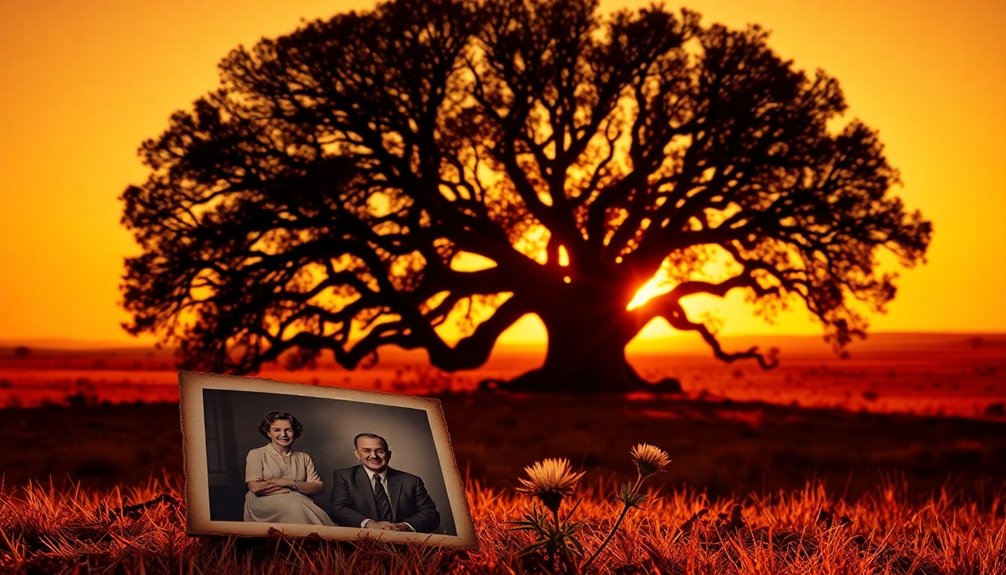
As you explore the Cleary family saga, you’ll uncover the intricate family dynamics that shape their lives on Drogheda. The tension between Meggie and Father Ralph highlights the pain of forbidden love, while generational struggles reveal how deeply rooted issues affect each family member. Together, these elements paint a vivid picture of resilience and conflict against the backdrop of the Australian Outback. The story’s profound exploration of forbidden love dynamics challenges societal norms and encourages readers to reflect on their own relationships.
Complex Family Dynamics
Family dynamics in the Cleary saga reveal a tapestry of love, conflict, and sacrifice as they navigate the harsh realities of life in the Australian Outback.
You’ll see how complex relationships shape their lives through:
- Maternal neglect, as Meggie faces emotional distance from her mother, Fiona.
- Generational conflict that highlights differing values between parents and children.
- The struggle for family loyalty amidst personal ambitions and desires.
- Emotional struggles that arise from choices made in the wake of family tragedies.
- The impact of betrayal on individual identities, particularly through Meggie’s marriages.
These elements intertwine, creating a rich narrative that illustrates how family ties influence personal destinies, making the Cleary saga unforgettable.
Forbidden Love Explored
Steering through the intricate web of family dynamics lays the groundwork for exploring the theme of forbidden love in *The Thorn Birds*.
Meggie Cleary’s tumultuous relationship with Father Ralph de Bricassart embodies the conflict between personal desire and religious duty. Her emotional struggles, rooted in maternal neglect, deepen her intense connection with Ralph, complicating their love amid societal expectations.
As the saga unfolds over three generations, the repercussions of Meggie’s choices—her marriage to Luke O’Neill and the subsequent affair with Ralph—resonate through her children, shaping their lives and relationships.
The Australian Outback serves as a stunning backdrop, contrasting the beauty of nature with Meggie’s passionate, often tragic love story, highlighting the enduring impact of forbidden love.
Generational Struggles Illustrated
While maneuvering through the complexities of the Cleary family’s saga, you can’t help but notice how generational struggles shape their identities and relationships.
The Cleary family’s journey from 1915 to 1969 is rich with emotional conflicts, particularly surrounding Meggie Cleary’s turbulent bond with Father Ralph de Bricassart.
These struggles reveal:
- Maternal neglect from Fiona “Fee” Cleary, impacting Meggie’s self-worth.
- Paddy Cleary’s traditional views that enforce patriarchal influences, causing tension.
- The clash between personal ambitions and societal expectations.
- Sacrifices made for love and belonging.
- The cyclical nature of family dynamics across generations.
Through these intricacies, the Cleary family’s narrative highlights the profound effects of generational struggles within the Australian cultural landscape.
Themes of Love and Sacrifice Explored in the Novel

In *The Thorn Birds*, you’ll encounter the intense dynamics of forbidden love, particularly between Meggie and Father Ralph.
This relationship is deeply intertwined with themes of maternal sacrifice and emotional neglect, revealing how love can both nurture and constrain.
As you explore these themes, you’ll see the profound consequences of the characters’ choices and the sacrifices they make in their pursuit of happiness. Additionally, the novel reflects on the complexities of relationships in a racially divided society, similar to the dynamics seen in *The Help*.
Forbidden Love Dynamics
As you explore the intricate world of *The Thorn Birds*, you’ll discover how forbidden love shapes the lives of its characters, particularly Meggie Cleary and Father Ralph de Bricassart. Their relationship is a poignant mix of passion and sacrifice, constrained by societal expectations and Ralph’s commitment to the priesthood.
Key elements include:
- Meggie’s emotional neglect from her mother, Fee, intensifying her yearning for Ralph.
- The sacrifices both characters make for their desires and duties.
- The thornbird myth, symbolizing the cost of true love.
- Ralph’s ambition clashing with his feelings for Meggie.
- The generational impact of unfulfilled desires explored throughout the saga.
This dynamic captures the essence of love’s complexity, reminding us of its heavy cost.
Maternal Sacrifice and Neglect
The complexities of love in *The Thorn Birds* extend beyond forbidden romance, revealing the profound impact of maternal sacrifice and neglect on the characters’ lives.
Fiona “Fee” Cleary’s emotional neglect of Meggie shapes their tumultuous relationship, highlighting the struggles of maternal sacrifice within the Cleary family. Fee’s aristocratic roots clash with the harsh realities of life on Drogheda, where her sacrifices often go unrecognized.
This theme resonates through Meggie’s journey, as she yearns for love but finds herself mirroring her mother’s pain, trapped in a patriarchal society. As Meggie navigates motherhood and her own sacrifices, the cycle of neglect continues, echoing through generations and emphasizing the cost of love in a world that often undervalues women’s emotional labor.
Consequences of Emotional Choices
While traversing the emotional landscape of *The Thorn Birds*, you’ll find that the characters’ choices often lead to profound consequences, especially regarding love and sacrifice.
Their journeys reveal how emotional neglect and forbidden love shape their lives, prompting tough decisions that echo through generations.
Consider these key themes:
- The toll of emotional neglect on relationships, especially Meggie and her mother.
- Meggie’s sacrifices for forbidden love, illustrating the high personal costs.
- The conflict between family loyalty and personal fulfillment.
- The thornbird metaphor, symbolizing the lengths one goes for love.
- The generational impact of choices based on ambition and desire.
These elements intertwine, showcasing the intricate dance between love, sacrifice, and the quest for happiness.
The Impact of Australian Culture on the Narrative
Rooted deeply in Australian culture, *The Thorn Birds* captures the essence of the Cleary family’s life on Drogheda, a sheep station that embodies the pastoral lifestyle of rural Australia.
Spanning from 1915 to 1969, the narrative intertwines significant historical events, revealing how World Wars shaped the landscape and the people. You see the Cleary family’s ambition and sacrifice, highlighting generational conflicts that resonate with the pioneering spirit of Australia.
Meggie Cleary’s journey reflects the complexities of personal relationships against the backdrop of social and religious norms, making her struggles deeply relatable. The harsh yet beautiful Australian Outback serves not just as a setting but as a character itself, influencing their lives and identities profoundly. Additionally, the novel critiques societal norms that shape individual lives, reflecting the challenges faced by characters like Meggie in their pursuit of love and acceptance.
The Thornbird Myth: Symbolism and Significance
Australian culture deeply influences the narrative of *The Thorn Birds*, but it’s the thornbird myth that truly encapsulates the novel’s core themes. This poignant legend mirrors Meggie Cleary’s relentless quest for love, revealing the profound sacrifices one must make.
- The thornbird’s pursuit of the perfect thorn tree symbolizes the price of beauty.
- Meggie’s journey reflects the struggle between passion and societal expectations.
- The myth emphasizes that true love often comes with deep personal costs.
- Symbolism of the thornbird connects Meggie’s emotional struggles to broader themes of longing.
- Ultimately, the thornbird legend serves as a powerful reminder that love’s beauty can be intertwined with sacrifice.
In these layers, the myth deepens the reader’s understanding of Meggie’s plight, illustrating how her choices reflect the greater themes of ambition in the narrative.
Character Development: From Page to Screen
As you explore the mini-series adaptation of *The Thorn Birds*, you’ll notice how character development takes on a new life through visual storytelling.
Richard Chamberlain’s portrayal of Father Ralph de Bricassart adds emotional depth, vividly showcasing his internal conflicts between love and duty. The character dynamics between Meggie and Ralph are enhanced, allowing you to experience their complex relationship in a way that the written narrative can’t fully capture.
Key scenes, like Meggie’s menstruation, convey character emotions visually, providing a powerful impact. This accessible adaptation condenses the lengthy plot while preserving the essence of their relationships.
Critiques of Meggie’s choices, particularly her pregnancy, resonate with modern audiences, sparking discussions about character motivations and growth throughout the series. The adaptation also reflects broader themes of societal expectations, similar to those found in Baldwin’s *Giovanni’s Room*, enhancing its relevance in contemporary discussions.
Comparing the Book and Mini-Series Adaptation
When you compare the book and mini-series adaptation of *The Thorn Birds*, you’ll notice significant differences in narrative flow and character portrayal.
The mini-series streamlines key moments, making the story more accessible and engaging, while Richard Chamberlain’s performance adds layers to Father Ralph that some readers might miss in the book. This shift in storytelling has led many to prefer the visual experience over the written word, particularly as it echoes themes of familial loyalty explored in other modern narratives.
Adaptation’s Narrative Streamlining
- Key scenes, like the menstruation scene, were altered for better narrative flow.
- Richard Chamberlain’s portrayal of Father Ralph added depth, making him more compelling.
- The visual medium effectively conveyed character emotions, connecting audiences without heavy text reliance.
- Viewer reactions often favored the mini-series, leading some to donate their books.
- Emotional delivery in the mini-series resonated, making it memorable for many.
Ultimately, the mini-series stands out for its engaging storytelling and character portrayal.
Character Portrayal Differences
While the mini-series adaptation of *The Thorn Birds* captures the essence of its characters, it presents them in ways that differ markedly from Colleen McCullough’s original novel.
Richard Chamberlain’s portrayal of Father Ralph de Bricassart adds emotional depth, but it simplifies the complex character development found in the book. The mini-series condenses plot points, offering a streamlined exploration of character dynamics, while the novel explores into the internal struggles of Meggie and Ralph.
Meggie’s character appears more sympathetic on screen, showcasing her emotional turmoil visually, but loses some complexity from the broader narrative. Alterations like the menstruation scene enhance emotions yet lack the nuanced context present in the book, leading some viewers to prefer the adaptation despite its literary depth.
Reader Reactions: Emotions and Transformations
As you explore *The Thorn Birds*, you’re likely to find yourself swept up in a whirlwind of emotions that reflect the novel’s rich tapestry of love, sacrifice, and family dynamics.
Readers often undergo profound transformations, as they confront complex themes and relationships. Your reactions might include:
- Discomfort with certain content, leading to unexpected personal growth.
- A shift in perspective about the book’s significance beyond romance.
- Mixed feelings about the scandalous romantic elements.
- A deeper appreciation for family dynamics and societal expectations.
- Meaningful discussions that challenge your ideas about personal identity.
Additionally, the emotional depth of The Thorn Birds resonates, evoking strong responses and encouraging reflection on the complexities of love and sacrifice within families, much like the acts of resistance that inspire courage in the face of adversity.
Ultimately, the emotional depth of The Thorn Birds resonates, evoking strong responses and encouraging reflection on the complexities of love and sacrifice within families.
The Legacy of The Thorn Birds in Popular Culture
The emotional journey readers experience with *The Thorn Birds* extends far beyond the pages of the novel, leaving a significant mark on popular culture.
Colleen McCullough’s best-selling book has sold over 33 million copies, making it the best-selling Australian novel of all time. Its 1983 miniseries adaptation became a cultural phenomenon, ranking as the second-highest-rated in U.S. history.
Though often perceived primarily as a romance, the story’s themes resonate deeply as a historical family saga. References to *The Thorn Birds* pop up humorously in shows like *Late Night with Seth Meyers*, showing its continued relevance.
In 2022, its inclusion in the Big Jubilee Read list further underscores its enduring cultural significance and legacy. The novel’s exploration of human relationships highlights how love and sacrifice shape individual destinies amidst societal challenges.
Why Should New Generations Read The Thorn Birds?
Why should new generations immerse themselves in *The Thorn Birds*? This sweeping family saga offers a rich exploration of themes that remain relevant today. Here are a few reasons to engage:
Immerse yourself in *The Thorn Birds* for a timeless exploration of love, family, and societal norms.
- Forbidden love: The passionate relationships challenge societal norms, sparking your curiosity.
- Generational conflicts: You’ll see how choices affect family dynamics across generations, prompting reflection on your own life.
- Australian culture: Discover the unique landscape and history that shape the characters’ lives.
- Cultural artifact: With over 33 million copies sold, it’s a significant piece of literature worth experiencing.
- Engaging adaptation: The acclaimed miniseries makes the story accessible and adds another layer to your understanding.
Additionally, the novel emphasizes resilience in adversity, highlighting the human spirit’s ability to triumph despite challenges.
Reading *The Thorn Birds* is more than just enjoyment; it’s an exploration of love and family.
Conclusion
In summary, “The Thorn Birds” continues to captivate readers, with over 30 million copies sold worldwide since its release. Its rich themes of love and sacrifice resonate across generations, making it a timeless family saga. As you explore the Cleary family’s journey, you’ll discover the profound impact of Australian culture and the myth of the thornbird itself. Don’t miss out—embrace this classic and see why it remains a beloved treasure in literature today.