

In *The Dinner*, you witness the unraveling of family dynamics amid a lavish meal, revealing uncomfortable truths about privilege and moral responsibility. Characters struggle with societal perceptions and personal loyalties, often blurring the lines of right and wrong. As you explore the relationships among the Lohman family, you might find reflections of real-life complexities that challenge stereotypes of normalcy. There’s so much more to uncover about how these themes resonate with actual family interactions.
The Setting: A Gourmet Dinner or a Trap?
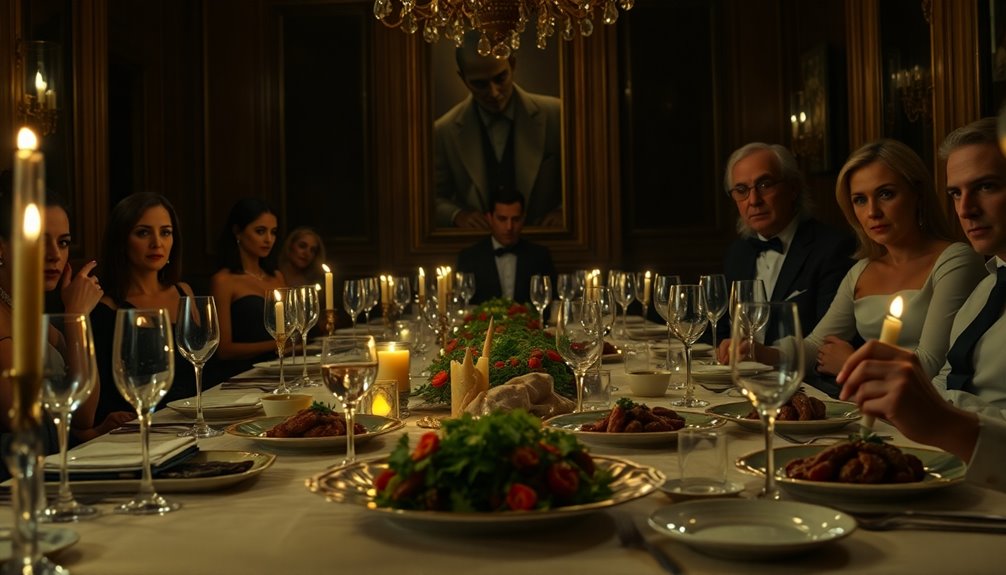
As you step into the high-end restaurant in Amsterdam, it might feel like a luxurious escape, but the setting quickly reveals itself as a trap.
The elegant dinner table, adorned with fine china and flickering candles, contrasts sharply with the tension simmering among the couples. What starts as a seemingly innocent gathering spirals into a confrontation, laying bare the unhappy family dynamics lurking beneath the surface.
The elegant dinner table masks simmering tensions, transforming a celebratory gathering into a revealing confrontation of family dynamics.
The lavish dishes and sophisticated ambiance mask the grim reality of their sons’ involvement in a serious crime. Each course serves not just to delight the palate but to intensify the moral dilemmas faced by the characters.
As the evening progresses, the atmosphere shifts from celebratory to charged, trapping them in their own truths. The systemic issues of their actions echo the broader societal prejudices, reinforcing the weight of their decisions throughout the night.
Key Characters: Who Are the Real Villains?

The tension at the dinner table isn’t just about the crime their sons committed; it’s also about the characters themselves and the darkness they harbor. Each individual plays a role in this tangled web, revealing that the real villains may not be as obvious as you think.
- Paul Lohman’s misanthropy and moral failings
- Serge Lohman’s charismatic facade hiding dark secrets
- Claire Lohman’s emotional manipulation and complicity
- Michel’s sociopathic tendencies linked to parental influence
- The couples’ loyalty blurring lines between victim and villain
As you explore these characters, you see how their flaws and actions contribute to the moral dilemmas, challenging your perception of who the true villains really are. The complexity of storytelling as empowerment serves as a reminder that even the most seemingly benign characters can harbor deep-seated issues.
The Central Crime: What Happened and Why Does It Matter?

In “The Dinner,” the central crime involves two teens violently attacking a homeless man, igniting a night of moral debate among the families.
This incident not only exposes the flaws in their parenting but also strains their relationships, forcing them to confront uncomfortable truths about privilege and responsibility. As you explore the aftermath of this crime, consider how it reshapes their family dynamics and challenges their values, highlighting the importance of systemic racism in understanding social injustices.
The Nature Of The Crime
While exploring the central crime in “The Dinner,” you encounter a shocking incident that sets off a chain reaction of moral dilemmas. The violent assault of a homeless man by the teenage sons of two couples raises profound questions about parental responsibility and societal values.
This crime isn’t just about the act itself; it reflects deeper issues that impact everyone involved.
- It exposes the dehumanization of the less fortunate.
- Parents grapple with the lengths they’ll go to protect their children.
- Characters justify their sons’ actions, revealing moral failings.
- The incident critiques the desire to maintain social image.
- It prompts reflection on the ethical implications of loyalty and accountability.
This layered narrative forces you to confront uncomfortable truths about crime and morality.
Impact On Family Dynamics
As the dinner unfolds, the impact of the crime reverberates through the family dynamics of the two couples. You see how Paul’s disdain for his brother Serge, a politician, complicates their discussions about parental responsibility.
The violent act committed by their sons forces them to confront uncomfortable truths about accountability and privilege. Their differing views expose the inherent darkness lurking within seemingly normal families.
Through tense conversations and flashbacks, you witness how each character’s reaction to the crime reveals their selfishness and moral ambiguities, further straining their relationships.
The dinner becomes a battleground, illustrating how the consequences of one act can unravel years of familial bonds, forcing them to question their roles as parents and their responsibility to protect their children.
Familial Loyalty vs. Moral Responsibility: A Parent’s Dilemma
When faced with a crisis, the instinct to protect your children can clash with the moral obligations you hold as a responsible adult. In “The Dinner,” this struggle is palpable as Paul Lohman grapples with his duty to shield his son, Michel, from the consequences of a serious crime.
The tension between familial loyalty and moral responsibility becomes evident through the characters’ choices:
- Paul’s protective instincts versus his disdain for societal norms
- Serge’s prioritization of public image over accountability
- The impact of parental decisions on ethical dilemmas
- The potential for complicity in wrongdoing
- The complexities of balancing family loyalty with moral integrity
Ultimately, the narrative prompts you to reflect on the implications of these conflicting values in your own life. This conflict resonates with the historical context of racial injustice, where individuals often find themselves torn between protecting their loved ones and confronting systemic issues that affect their community.
Exploring Sociopathy: Nature, Nurture, and the Dinner Table
In “The Dinner,” you see how sociopathy raises questions about whether it’s a product of genetics or environment.
As you observe the characters’ interactions, familial patterns reveal how deeply ingrained behaviors can shape moral choices.
This complex interplay challenges you to reflect on the implications of upbringing on both personal responsibility and societal values. Additionally, the novel resonates with themes of systemic oppression that underscore the influence of societal structures on individual behaviors and choices.
Nature Versus Nurture Debate
While exploring the intricate dynamics of family life, “The Dinner” investigates the nature versus nurture debate, particularly regarding sociopathy. The characters’ behaviors and moral choices raise significant questions about their upbringing.
- Are violent tendencies inherited or learned?
- How does parental influence shape a child’s morality?
Paul Lohman grapples with accepting familial traits while confronting parenting responsibilities. The narrative suggests that nurture plays a vital role in sociopathic behavior.
Mental health discussions intertwine with familial relationships, revealing the potential for evil in ordinary settings.
Familial Patterns of Disorder
As you explore “The Dinner,” you’ll notice how familial patterns of disorder play an essential role in shaping characters’ sociopathic traits.
The novel raises compelling questions about how these traits may emerge from a mix of genetic predispositions and environmental influences.
Take Paul’s son, Michel, whose involvement in a crime underscores how antisocial behaviors can be passed down within families.
Claire’s potential sociopathy illustrates that mental health issues can surface in seemingly normal settings, complicating parental responsibility.
This narrative invites you to contemplate how familial dynamics contribute to sociopathy, challenging your understanding of nature versus nurture.
Ultimately, it prompts you to reflect on the darker aspects of family life and the complexities of love intertwined with moral dilemmas.
Moral Implications of Sociopathy
Familial dynamics not only shape sociopathic traits but also complicate the moral landscape surrounding them. In *The Dinner*, you see characters grappling with parental responsibility, often rationalizing their actions to protect their children.
The narrative poses critical ethical questions about the influence of nature versus nurture on violent behavior.
- Sociopathy as a hereditary trait
- Manipulation and lack of empathy in decisions
- Ethical dilemmas surrounding crime and family loyalty
- Superficiality of social interactions
- The dark potential within normality
These factors reveal how loyalty can blur moral lines, prompting you to question how far you’d go to shield your offspring from societal consequences.
Ultimately, the book critiques the complexities of morality in familial settings.
Themes of Class and Privilege: How Do They Shape Moral Choices?
When you explore “The Dinner,” it becomes clear that themes of class and privilege profoundly shape the characters’ moral choices.
The narrative illustrates how socioeconomic status influences their willingness to protect family image over seeking justice. Characters perceive crime differently based on their privilege, revealing a stark disconnect between accountability and affluence.
As the Lohman family discusses their sons’ actions, you see a critique of moral blindness, where reputation takes precedence over the well-being of others. Their interactions expose the facade of civility that often conceals deeper ethical failings, showing how privilege can distort moral compasses.
The contrasting backgrounds of the families highlight societal issues of inequality and responsibility, emphasizing the pervasive impact of class on decision-making. This mirrors the oppressive experiences faced by characters in *The Help*, showcasing how social dynamics affect moral judgments and responsibilities.
Reality Check: Comparing Fictional Families to Real-Life Dynamics
While the intricate dynamics of the families in “The Dinner” may seem fictional, they resonate deeply with the complexities of real-life relationships. Families often face ethical dilemmas that challenge their bonds and reveal hidden flaws.
Just like in the novel, you might encounter situations where:
- Protecting your children conflicts with holding them accountable.
- Parental instincts blur the lines between loyalty and morality.
- Social status influences decision-making and behavior.
- Secrets can strain familial ties and create tension.
- The idea of the ‘perfect’ family masks deeper issues.
These themes highlight that, much like the characters in “The Dinner,” real families grapple with moral ambiguity and the consequences of their choices, reflecting the multifaceted nature of human connections. Additionally, the pressure of systemic injustices can complicate familial relationships, adding layers of strain and conflict.
The Unreliable Narrator: Whose Perspective Should We Trust?
As you explore “The Dinner,” you’ll quickly realize that Paul Lohman, the protagonist, isn’t a straightforward narrator; instead, his skewed perceptions challenge you to discern the truth behind his biases.
Paul serves as an unreliable narrator, revealing more about his misanthropic views than the actual events unfolding. His disdain for societal norms colors his interactions with characters like his brother Serge and his wife, Claire.
Flashbacks complicate the narrative, offering contrasting perspectives that expose hidden complexities and secrets. This nonlinear structure forces you to piece together events, creating ambiguity about motivations and actions.
Through dark humor and moral dilemmas, Paul rationalizes his behavior, prompting you to question not only his reliability but also your own perceptions of right and wrong. Additionally, the exploration of systemic racism in various narratives can often shed light on the underlying societal issues that shape characters’ motivations and actions.
Conclusion
In dissecting the intricate layers of “The Dinner,” you’ve navigated through moral dilemmas and familial ties that mirror real-life complexities. Curiously, studies show that nearly 25% of families face significant conflict over differing values and ethics, highlighting the relevance of the story’s themes. As you reflect on the characters’ choices and the societal pressures they embody, remember that these narratives often reveal more about us than we might like to admit, making them profoundly relatable.