The man who made an offer we couldn’t refuse is Mario Puzo, the author of the iconic novel “The Godfather,” published in 1969. This bestselling book introduced unforgettable characters like Don Vito and Michael Corleone and sold over nine million copies in just two years. Puzo’s collaboration with filmmaker Francis Ford Coppola transformed the novel into a legendary film, influencing American cinema. There’s so much more to discover about Puzo’s career and the impact of his work.
Mario Puzo: The Man Behind the Novel
Mario Puzo is the creative force behind the iconic novel “The Godfather.” Released in 1969, this groundbreaking work quickly became a bestseller, enthralling readers and selling over nine million copies within two years.
Puzo, initially writing under the pseudonym “Mario Cleri,” crafted a tale that introduced unforgettable characters like Don Vito Corleone and Michael Corleone.
The novel’s success caught the attention of Hollywood, leading to an offer from Paramount Pictures. Puzo co-wrote the screenplay with director Francis Ford Coppola, solidifying his place in film history.
He accepted $12,500 for the rights to his novel, plus an additional $80,000 if the film was made, a deal that helped him clear his gambling debts and launched his illustrious career. This narrative echoes the theme of overlooked contributions found in the stories of hidden heroes, reminding us of the impact of individual voices in shaping culture.
The Creation of an Iconic Line
One of the most memorable lines in cinematic history, “I’ll make him an offer he can’t refuse,” captures the essence of power and persuasion in “The Godfather.” This iconic phrase, crafted by Puzo and Coppola, not only defines Don Vito Corleone’s character but also illustrates the intricate dynamics of the mafia’s influence. Set against the backdrop of New York City, this line showcases the blend of coercion and persuasion that permeates the family business. Here are three reasons this line stands out:
- It encapsulates the mafia’s negotiation tactics.
- It’s become a cultural catchphrase, referenced in countless media.
- Its delivery heightens the tension and stakes within the storyline. Additionally, the line reflects a historical backdrop of oppression and power dynamics, similar to themes explored in literature like “The Book Thief.”
The Collaboration With Francis Ford Coppola
The partnership between Mario Puzo and Francis Ford Coppola transformed *The Godfather* from a novel into a cinematic masterpiece.
After Paramount Pictures acquired the film rights, Puzo co-wrote the screenplay with Coppola, adapting his own 1969 novel. Despite initial creative tensions—Coppola found the novel’s content sleazy—they both aimed to depict the complexities of Italian-American identity.
Their collaboration paid off, resulting in a film that earned ten Academy Award nominations, winning three, including Best Adapted Screenplay. This synergy between Puzo’s storytelling and Coppola’s vision proved pivotal in elevating the narrative. The adaptation process allowed them to weave together themes of resilience and personal growth, enriching the film’s emotional depth.
With contributions from Robert Towne, the screenplay became a rich tapestry of dialogue and character, setting a new standard for film adaptations and leaving an enduring legacy in cinema.
Cultural Impact and Legacy of The Godfather
While many films have attempted to capture the essence of organized crime, few have done so as effectively as *The Godfather*, which has left an indelible mark on American cinema.
Its cultural impact and legacy are undeniable, as Mario Puzo and Francis Ford Coppola created a narrative that resonates deeply.
Here are three key aspects:
- The phrase “an offer he can’t refuse” has entered everyday language, illustrating its far-reaching influence.
- The film garnered three Academy Awards and was preserved in the U.S. National Film Registry in 1990, highlighting its significance.
- Its themes of power, loyalty, and moral ambiguity continue to inspire countless adaptations and references, solidifying its status in popular culture. Additionally, the film’s portrayal of moral ambiguity has sparked discussions about ethics in storytelling, much like the nuanced themes found in *Gone With the Wind*.
The Evolution of Puzo’s Career After The Godfather
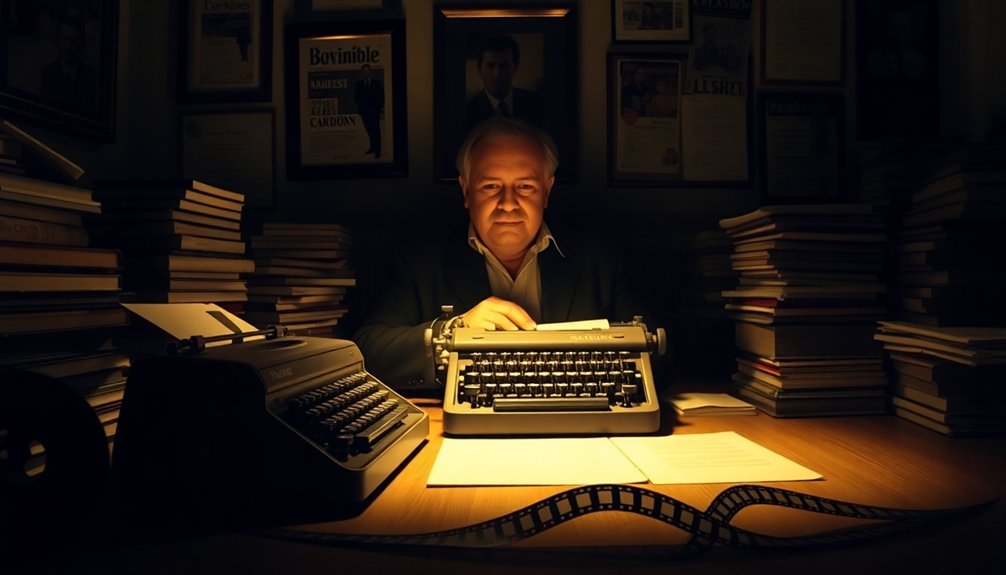
After achieving monumental success with *The Godfather*, Mario Puzo quickly shifted into a prolific phase of his career, capitalizing on his newfound fame.
He moved to Bay Shore, Long Island, where he wrote scripts and screenplays, solidifying his presence in Hollywood. Puzo authored sequels, including *The Sicilian* in 1984, which explored deeper into organized crime themes.
His collaboration with filmmakers like Francis Ford Coppola allowed him to influence various projects, extending his reach in the industry. This success not only helped him pay off gambling debts but also led to financial stability.
As Puzo’s novel continued to resonate with audiences, it dominated the box office, securing his legacy until his passing in 1999. His works also echoed the themes of human resilience, much like the stories of survival found in historical narratives such as *Unbroken*.
Conclusion
To sum up, Mario Puzo’s “The Godfather” not only transformed the landscape of crime fiction but also became a cultural phenomenon, selling over 30 million copies worldwide. This statistic highlights the novel’s enduring impact and the power of Puzo’s storytelling. By collaborating with Francis Ford Coppola, they crafted a cinematic masterpiece that continues to resonate with audiences today. Puzo’s legacy reminds us of the profound influence a single story can have on society and popular culture.