

“The Grapes of Wrath” offers a striking portrayal of the Great Depression. It follows the Joad family’s harrowing journey from Dust Bowl-ravaged Oklahoma to California in search of a better life. As they face exploitation and despair, you witness their struggle and resilience amidst social injustice. The story highlights the power of community and solidarity, showing how hope persists even in the direst circumstances. Discover the significant themes and characters that shape this powerful narrative.
Overview of The Grapes of Wrath
“The Grapes of Wrath” is a powerful novel by John Steinbeck that captures the harrowing journey of the Joad family as they flee the Dust Bowl in search of a better life in California.
At the heart of the story is Tom Joad, who represents the struggles faced by countless migrant workers during the Great Depression.
John Steinbeck highlights the displacement and exploitation these families endure while traveling along Route 66.
Through vivid character development and poignant interchapters, Steinbeck offers a social commentary on resilience, community, and social injustice.
The title itself evokes the anger and suffering of the oppressed, connecting biblical themes to the migrants’ plight.
This novel remains a significant exploration of economic hardship and the fight for dignity. Furthermore, it emphasizes the struggles of marginalized communities and the ongoing quest for social justice in the face of adversity.
Plot Summary and Setting
Set against the backdrop of the 1930s Dust Bowl, “The Grapes of Wrath” follows the Joad family’s desperate migration from Oklahoma to California in search of work and a better life.
You meet Tom Joad, who returns home after prison, only to find his family displaced by large landowners. As the Joad family travels along Route 66, they face numerous hardships, including exploitation and the harsh realities of living in makeshift camps known as Hoovervilles.
The story climaxes when Tom retaliates against a policeman, forcing him to leave for his family’s safety.
This journey starkly contrasts the squalor of migrant camps with the more organized conditions in Weedpatch, highlighting the varied experiences of migrant workers during this tumultuous era. The Joad family’s struggle serves as a powerful illustration of social injustice and the resilience of the human spirit in the face of adversity.
Main Characters
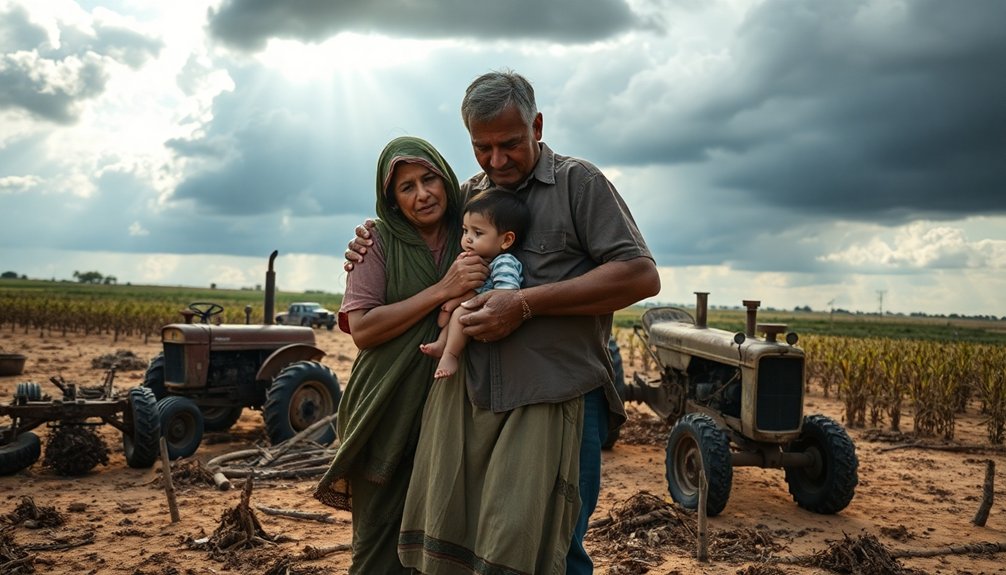
As the Joad family faces the harsh realities of their journey, the characters come to life, each representing different facets of struggle and resilience.
Tom Joad, the protagonist, evolves from focusing solely on personal survival to embracing the importance of collective struggle after his release from prison.
Tom Joad transforms from a solitary survivor to a champion of collective struggle, embodying the spirit of unity in adversity.
Ma Joad stands as the family’s unwavering matriarch, embodying strength and resilience while guiding her loved ones through adversity.
Jim Casy, a former preacher, inspires Tom with his ideals about community and social justice, ultimately becoming a leader for tenant farmers before his tragic death.
The family’s dynamics are further complicated by Pa Joad’s diminishing role and Rose of Sharon’s personal growth, culminating in her selfless act of breastfeeding a starving man. This journey reflects the triumph of the human spirit, as seen in other narratives of resilience, such as Louis Zamperini’s story in Unbroken.
Major Themes and Motifs
In “The Grapes of Wrath,” you’ll see how community and solidarity play vital roles in the Joad family’s journey. Their struggle and resilience highlight the strength found in unity during tough times. As they face numerous challenges, their bond becomes a powerful theme that resonates throughout the narrative. This theme of generational poverty mirrors the experiences of characters like Francie Nolan, who also strive for a better life amidst adversity.
Community and Solidarity
Solidarity emerges as a powerful force in *The Grapes of Wrath*, showcasing how community becomes crucial for survival amid the struggles of the Great Depression.
The Joad family exemplifies this reliance on connections, as they navigate the harsh realities faced by tenant farmers. Their experiences at Weedpatch camp highlight how communal morality fosters a shared identity among migrants, where mutual support thrives.
Tom Joad’s journey illustrates his shift from individualism to understanding that his survival is linked to the well-being of others. Acts of kindness, like the Joads aiding fellow migrants, reinforce the strength found in solidarity.
Jim Casy’s advocacy for collective action inspires many, emphasizing that unity is essential in the fight for social justice and workers’ rights.
Struggle and Resilience
- The relentless fight for survival amid poverty and exploitation.
- The land turtle symbolizing perseverance and determination.
- The shift from individualism to collective struggle within the Joad family and fellow migrants.
- The harsh portrayal of social injustice faced by migrant workers.
- Moments of kindness and human connection that foster hope.
Amid despair, Steinbeck illustrates that resilience thrives through shared experiences, reinforcing the notion that together, communities can withstand even the most challenging circumstances.
Historical Context
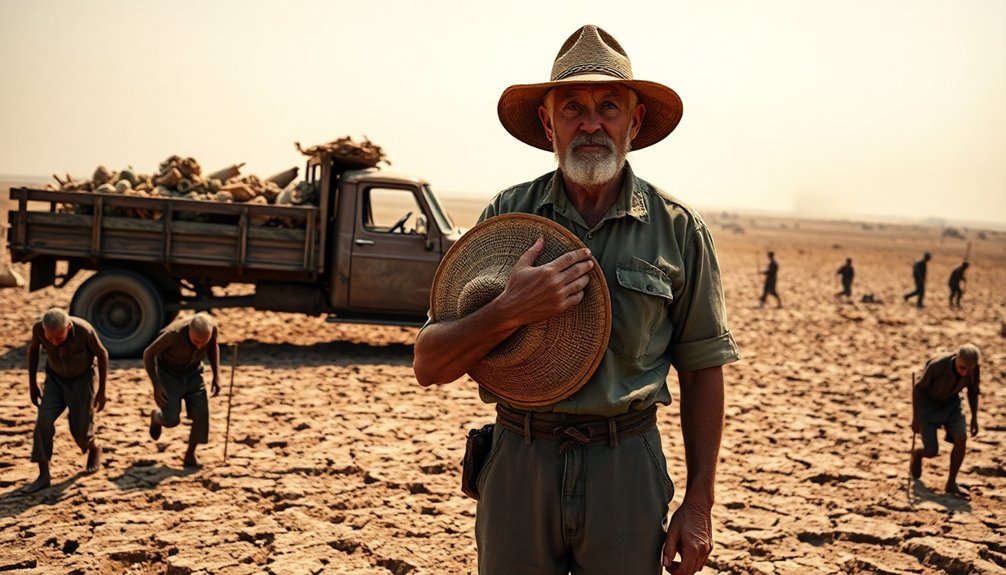
To understand “The Grapes of Wrath,” you need to contemplate the harsh realities of the Dust Bowl Era and the Great Depression. Families faced economic hardships that forced them to migrate to California, searching for a better life. Steinbeck captures their struggles, highlighting the exploitation and social injustice that defined this tumultuous time. The collective action of displaced families mirrors the resilience seen in historical resistance movements, showcasing the strength found in unity against adversity.
Dust Bowl Era
The Dust Bowl era, a catastrophic chapter in American history during the 1930s, saw approximately 2.5 million people uprooted from their homes in the Great Plains, particularly Oklahoma.
This environmental disaster drastically worsened living conditions amid the Great Depression. You’d witness:
- Massive soil erosion and dust storms devastating agriculture.
- “Okies” migrating to California and beyond in search of a better life.
- Severe drought conditions combined with poor farming practices.
- The U.S. government launching relief programs and soil conservation initiatives.
- Lasting impacts on American literature, as authors like Steinbeck highlighted the struggle for survival.
The Dust Bowl not only reshaped the landscape but also the very fabric of American society, revealing resilience amidst adversity.
Economic Hardships Impact
As families struggled to make ends meet during the Great Depression, economic hardships became a harsh reality for millions of Americans. Unemployment soared, peaking at 25% by 1933, while the Dust Bowl devastated agriculture, displacing thousands of families.
Many of these displaced individuals, often labeled “Okies,” sought better opportunities in California, only to face systemic exploitation and discrimination. Living conditions deteriorated, with families often crammed into makeshift camps known as Hoovervilles, where overcrowding and unsanitary environments prevailed.
Steinbeck’s portrayal of these migrant workers in “The Grapes of Wrath” emphasizes the social injustices and economic inequalities that defined this era. The struggle for survival amidst such adversity highlighted the resilience of the human spirit against overwhelming odds.
Migration to California
While searching for a way out of their desperate circumstances, countless families from the Midwest migrated to California during the Great Depression. This migration represented hope and survival, but it also came with harsh realities.
The Joad family, including Uncle John, faced numerous challenges as they traveled along Route 66.
- The Dust Bowl forced many, known as “Okies,” to leave their homes.
- Over 400,000 people left Oklahoma by 1940 for agricultural work.
- Jobs were scarce, and wages were often exploitative.
- Many lived in dire conditions upon arrival.
- Route 66 symbolized the journey toward a better life despite obstacles.
This historical context illustrates the resilience and struggle of those seeking a new beginning.
Analysis and Reception
Upon its release in 1939, “The Grapes of Wrath” stirred a whirlwind of reactions, reflecting the deep societal divides of its time. Critics often labeled it as “communist propaganda,” while working-class readers found solace in its raw depiction of social injustice.
Steinbeck’s powerful storytelling earned him accolades, cementing his place as a significant literary figure and leading to his eventual Nobel Prize. The novel ignited debates on the responsibilities of authors to address economic inequality, prompting discussions about literature’s role in advocating for social change. Additionally, much like Ta-Nehisi Coates’ exploration of systemic racism in “Between the World and Me,” Steinbeck’s work highlights the struggles of marginalized communities.
However, its themes also led to extensive censorship, revealing tensions between artistic freedom and political ideology. Even today, it continues to inspire conversations about community solidarity and the moral challenges during crises.
Key Figures Involved
The impact of “The Grapes of Wrath” extends beyond its pages, shaped considerably by key figures in Steinbeck’s life and work. Their contributions helped mold the narrative, enhancing its emotional and social depth.
- John Steinbeck: The author, whose poignant storytelling earned him the Pulitzer Prize.
- Carol Henning Steinbeck: His wife, typist, and editor, who influenced the novel’s themes.
- Tom Collins: A U.S. government camp worker, representing support for migrants.
- Pascal Covici: Steinbeck’s editor and confidant, essential for maneuvering publication challenges.
- Edward F. Ricketts: Inspired Steinbeck’s interest in ecology, adding depth to Uncle John’s struggles.
These individuals played significant roles in crafting a narrative that resonates with readers and reflects the era’s hardships. Furthermore, Steinbeck’s focus on social injustice parallels Dickens’ exploration of similar themes in “David Copperfield.”
Cultural Impact and Legacy
As “The Grapes of Wrath” hit the shelves in 1939, it ignited essential cultural conversations about social justice and the role of artists in confronting societal issues.
The novel’s stark portrayal of migrant workers’ struggles sparked public inquiries into farm working conditions, earning praise from influential figures like Eleanor Roosevelt.
However, its critical reception also included accusations of communism and literary censorship, with many attempting to ban it due to its candid depictions of poverty and sexuality.
This tension between artistic expression and political ideology remains relevant today.
Steinbeck’s work influenced future generations of writers and activists, showcasing how literature can inspire social change and raise awareness about the working class’s plight, ensuring its legacy endures in ongoing cultural discussions. The themes of resilience amidst adversity reflect the enduring human spirit in the face of hardship.
Conclusion
In conclusion, “The Grapes of Wrath” vividly captures the struggles of families during the Great Depression, showcasing their resilience amidst hardship. Did you know that during the 1930s, around 2.5 million people migrated from the Dust Bowl states to California in search of better opportunities? This staggering number highlights the desperation and hope that drove countless individuals to seek a new life, making Steinbeck’s work not just a story, but a poignant reflection of a defining era in American history.