
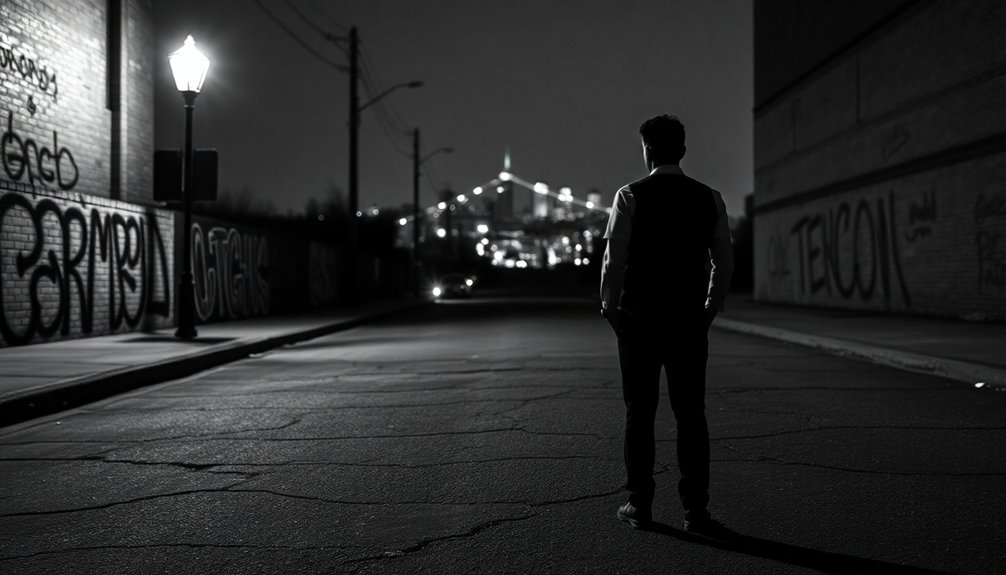
Richard Wright’s *Native Son* thrusts you into the life of Bigger Thomas, a Black man maneuvering through a racially oppressive Chicago in the 1930s. After he accidentally kills Mary Dalton, Bigger’s world spirals into chaos, revealing deep societal injustices. This gripping narrative tackles themes of identity, fear, and the brutality of systemic racism. You’ll uncover how Bigger’s actions are shaped by desperation and despair, and there’s much more to unravel about this powerful work’s impact on society.
Plot Summary
In *Native Son*, as you follow Bigger Thomas, a poor Black man in 1930s Chicago, his life takes a dark turn after he accidentally kills Mary Dalton, a wealthy white woman.
This act of murder spirals into a web of violence and desperation. Bigger, feeling the weight of systemic oppression, attempts to cover his tracks by burning Mary’s body and creating a ransom scheme.
The murder ignites a desperate struggle as Bigger grapples with systemic oppression, resorting to violence to conceal his crime.
As the narrative unfolds through three parts—”Fear,” “Flight,” and “Fate”—you witness the racial prejudice that fuels his trial, turning it into a public spectacle.
Bigger is portrayed as a monstrous figure, highlighting societal repercussions and demands for justice.
Ultimately, he faces a death sentence, illustrating the destructive nature of racism and its impact on individual lives. This tragedy reflects the complexities of power dynamics and systemic injustice that marginalized individuals face.
Character Analysis
Bigger Thomas stands as a powerful symbol of the struggles faced by African Americans in a racially oppressive society. His anger and violence reflect the impact of systemic racism and the unbearable social conditions he endures. Mary Dalton represents the complexities of race and privilege; her attempts to treat Bigger as an equal culminate in tragic consequences. Meanwhile, Bessie Mears becomes a victim of Bigger’s manipulation, highlighting how systemic issues infiltrate personal relationships. Jan Erlone, as Mary’s boyfriend, embodies the naivete of those seeking social justice without grasping the intricacies of racial tensions. Finally, Boris Max, Bigger’s Jewish lawyer, offers a critical perspective during the trial, acknowledging the environment’s influence on behavior amid the pervasive racial prejudices of the legal system. Wright’s exploration of social issues in “Native Son” serves as a compelling critique of the societal forces shaping individual destinies.
Racial Tension and Social Injustice

In *Native Son*, you see how systemic oppression shapes Bigger Thomas’s life, forcing him into a corner where every choice is influenced by racial prejudice.
His experiences reveal the dire consequences of societal bias, particularly in the way the justice system fails him.
As you explore these themes, you’ll confront the harsh realities of injustice that still resonate today. Coates’ exploration of systemic racism highlights how deeply entrenched societal structures continue to affect marginalized communities.
Systemic Oppression Unveiled
Systemic oppression permeates *Native Son*, illustrating the harsh realities faced by individuals like Bigger Thomas in 1930s Chicago. His violent actions emerge from the racial prejudice and economic barriers that confine him, revealing the depths of social injustice.
The character of Mary Dalton embodies racial blindness, as her well-meaning intentions inadvertently sustain oppressive systems. Bigger’s interactions with Mary and Jan Erlone highlight the complexities of race and privilege, showcasing how even the most benevolent actions can contribute to systemic oppression.
The trial scene starkly exposes this reality, casting Bigger as a monster instead of a product of his environment. Through this lens, Richard Wright critiques the American Dream, underscoring the profound racial tensions and injustices embedded in society.
Consequences of Racial Prejudice
While racial prejudice shapes the world of *Native Son*, it’s the consequences of this discrimination that drive the narrative forward. Bigger Thomas’s life tragically illustrates the impact of systemic oppression and societal expectations.
The novel reveals:
- The psychological toll of racism, as Bigger oscillates between fear and anger.
- The legal system’s biases, showcasing how racial tensions skew justice against him.
- The societal blindness of well-meaning characters like the Daltons, whose misguided attitudes exacerbate racial dynamics.
Bigger’s accidental murder of Mary Dalton and subsequent actions highlight the urgent need for social change.
Richard Wright exposes how deeply entrenched racial prejudice manifests in everyday life, leading to devastating consequences for individuals and society alike.
Justice System Failures
Racial tension permeates the trial of Bigger Thomas, revealing how the justice system often prioritizes public perception over true justice.
Prosecutor Buckley paints Bigger as a monster, fueling societal expectations for retribution rather than understanding. Despite Boris Max’s efforts to highlight the environmental factors and systemic racial prejudices that shaped Bigger’s actions, the prevailing biases drown out this critical context.
The trial serves as a stark critique of a justice system that overlooks the complexities of race relations, reducing Bigger’s victimization by poverty and racism to mere sensationalism.
Ultimately, the focus on racial tensions leads to a death sentence, illustrating how the justice system fails to address the underlying issues, leaving Bigger trapped in a cycle of oppression.
Psychological, Emotional, & Relational Analysis

In “Native Son,” you see how Bigger Thomas grapples with intense internal conflict, shaped by the oppressive racial dynamics around him.
His relationships, particularly with Bessie and Mary, highlight the emotional isolation and despair he faces, complicating his quest for identity and connection.
This psychological turmoil drives his actions, ultimately revealing the tragic consequences of a society steeped in prejudice. Additionally, his experience resonates with the themes of resilience amid adversity found in other narratives that explore the impact of oppressive regimes on individual lives.
Bigger’s Internal Conflict
Bigger Thomas’s internal conflict reveals the deep psychological scars inflicted by systemic racism and societal oppression.
You witness his emotional turmoil as he grapples with:
- Fear and anger, stemming from a world that devalues him.
- Identity struggle, as he oscillates between desire for recognition and resentment towards those who embody privilege.
- Violent outcomes, resulting from the psychological burden of his environment.
This conflict drives Bigger to commit murder, seeking power in a society that continually marginalizes him.
His inability to articulate feelings amplifies his social alienation, trapping him in a tragic cycle of manipulation and violence.
Through Bigger’s internal strife, Richard Wright poignantly illustrates the profound impact of racial injustice on individual psychology.
Racial Dynamics and Relationships
While traversing the oppressive landscape of 1930s Chicago, the relationships shaped by systemic racism reveal the complexities of identity and connection for Bigger Thomas.
His interactions with Mrs. Dalton illustrate racial dynamics, as her well-meaning but oblivious attitude masks the societal prejudice that marginalizes him.
Bigger’s tumultuous relationship with Bessie Mears highlights how poverty and societal expectations complicate love, often leading to manipulation and tragedy.
Meanwhile, Jan Erlone’s idealism reflects the naivete of white allies who underestimate the emotional burden and psychological trauma Bigger endures.
Ultimately, these relationships expose the harsh realities of systemic racism, forcing Bigger to navigate a world that devalues his existence and shapes his identity through a lens of oppression.
Emotional Isolation and Despair
Emotional isolation pervades the life of Bigger Thomas, deeply rooted in the systemic racism and poverty that define his existence. This isolation manifests in several ways:
- Strained family ties fueled by economic hardship, leaving him without genuine support.
- The accidental murder of Mary Dalton, which spirals him into a mix of fleeting empowerment and crippling fear of societal repercussions.
- Complex interactions with Bessie Mears, where love becomes manipulation, deepening his sense of alienation.
These dynamics culminate in despair, as Bigger grapples with the racial injustices surrounding him. His trial turns into a spectacle, overshadowing his humanity and reinforcing the hopelessness he feels about his fate, tethering him to the relentless cycle of emotional isolation.
Interpretation & Debate
*Native Son* ignited fierce debates upon its 1940 release, largely due to its stark depiction of systemic racism and violence in America. Critics argue that Bigger Thomas’s actions stem from an oppressive environment, highlighting the broader societal failures to address racial injustice.
The novel’s trial scenes serve as a scathing critique of the American justice system, revealing how racial biases shape public perception and legal outcomes. Richard Wright’s ties to the Communist Party inform the novel’s themes of social protest, emphasizing the urgent need for change against racial oppression.
Its candid exploration of fear, identity, and violence continues to resonate in contemporary discussions about race relations, reinforcing its relevance in today’s society. The themes of collective action in resistance movements provide a historical context that parallels the fight against racial injustice depicted in Wright’s work.
Review Summary
Key aspects that resonate with readers include:
- A raw depiction of racial tensions and social injustices.
- The exploration of graphic violence and its impact on society.
- Ongoing debates around censorship and its role in education.
Despite criticism for its bleakness, *Native Son* remains essential for understanding today’s race relations. Additionally, the novel’s themes echo the historical injustices in medical research highlighted in *The Immortal Life of Henrietta Lacks*, showcasing the ongoing struggle for human rights in various contexts. This ensures Wright’s work continues to provoke thought and discussion.
Conclusion
In summary, “Native Son” isn’t just a story about one man’s struggle; it’s a haunting reflection of society’s failures. You might think it’s too bleak, but consider the chilling cold of the Chicago streets and the weight of despair on Bigger Thomas’s shoulders. This novel forces you to confront uncomfortable truths, igniting a fire within you to challenge systemic injustices. Richard Wright’s work remains essential, urging us to empathize and act in the face of inequality.